Food delivery apps are becoming tremendously popular because of the convenience, flexibility, and affordability offered to restaurants and food enthusiasts, along with seamlessly connecting them on the aggregator app or website. The industry is rapidly evolving with numerous new players looking to build an app like Uber Eats and entering the market, along with the existing players expanding their offerings.
Uber Eats is a popular name in the food delivery industry and is a leading platform that works to effortlessly connect restaurants and customers. Since its launch in 2014, Uber Eats has grown tremendously, expanding into the industry and increasing its global reach. With over 95 million users and more than one million registered restaurants in 11,500 cities on the platform, Uber Eats has become a major player in the online food ordering and delivery industry.
Considering the growth numbers mentioned above, we can anticipate that the online food delivery industry is offering lucrative opportunities for budding food entrepreneurs to make an app like Uber Eats and leverage this proliferating industry. Hence, this blog simplifies the procedure and assists business owners in building a food delivery app like Uber Eats.
Uber Eats is a triple-sided marketplace employing three stakeholders: Restaurants, Customers, and Delivery Agents on the website. To streamline the platform experience, the Uber Eats app offers diverse options, attractive deals and discounts, and convenient home delivery services.
1. Restaurants: Restaurants manage food orders and update menus on the app by marking food items available/unavailable. They can change the restaurant name, contact information, and opening & closing hours as per their availability. They can also decide the price of each item displayed on the menu.
2. Customers: Uber Eats provides the following ordering options to its customers:
Real-Time Ordering: The customers choose the food items from the list of restaurants available in the app, preferably from a nearby location. It is a very useful feature for those who wish to receive their food immediately after placing an order.
Custom Ordering: The customers schedule their orders in advance as per their convenience. They can customize their orders with respect to the delivery date, destination address, and time.
3. Delivery Agents: Uber Eats delivery partners are independent individuals who pick up food from the restaurants and deliver it to the customers’ addresses. They can accept/reject the order request and fulfill multiple deliveries at a time. They get the delivery requests on the basis of their location and proximity to the customer as well as the restaurant.
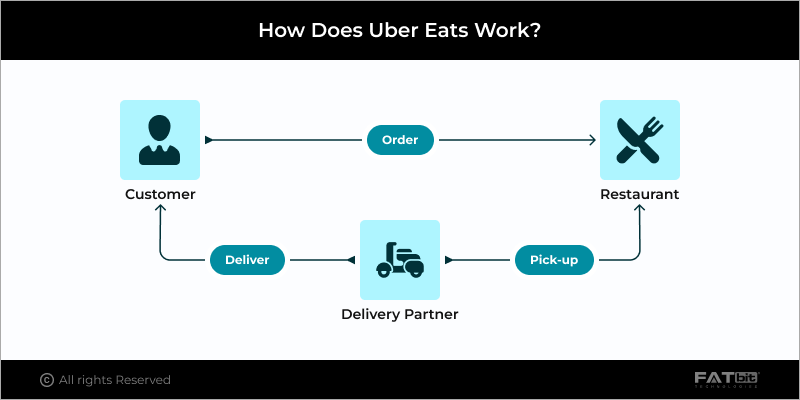
How Does Uber Eats Work?
Uber Eats is a three-way marketplace that connects restaurants, customers, and delivery agents. Multiple restaurants list their brand and menu on the app. The customers search for the restaurants located in their area, browse their menus, and place orders. The delivery boy picks up the order from the restaurant and delivers it to the customer’s doorstep.
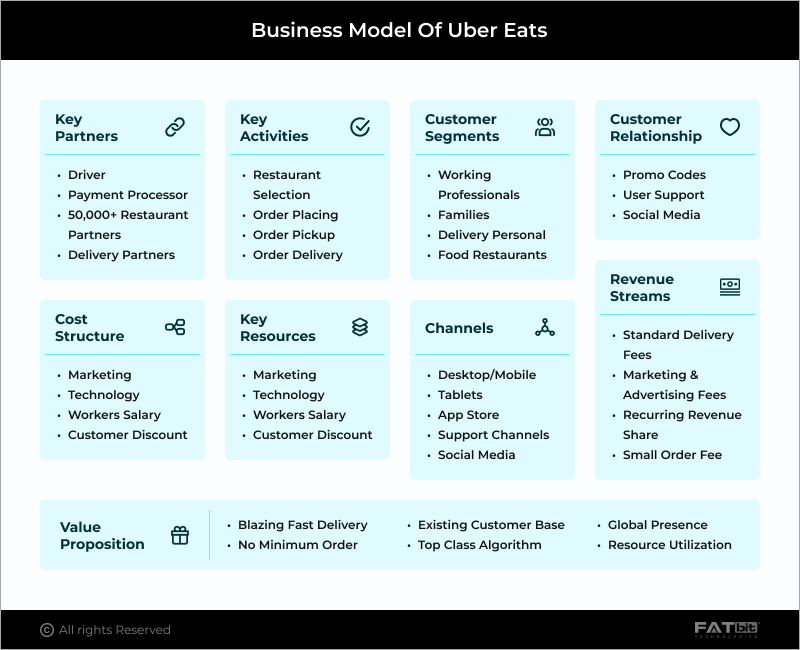
Business Model of Uber Eats
Since its establishment, the technology-driven business model of Uber Eats has inspired budding entrepreneurs to start their online food delivery businesses. The Uber Eats app plays dual roles: it works as a restaurant aggregator as well as a delivery agent.
Uber Eats uses an aggregator model that lists the partner restaurants in the app. This traditional food delivery model enables customers to place a food delivery request to be viewed by the restaurants. The order fulfillment is done by the restaurant itself.
The company supports partnering restaurants with complete logistics support. The food ordering giant uses its logistics network to deliver orders from restaurants that don’t have the resources or bandwidth to provide food delivery to their customers.
Revenue Model of Uber Eats
Uber Eats operates on a diversified revenue model that goes beyond basic commission. The platform combines multiple revenue channels, such as delivery fee, subscription fee, and advertisement fee. This helps the giant generate consistent and long-term profitability.
Let’s explore these revenue streams in detail:
1. Delivery Fees from Customers
The delivery charges are divided into three categories:
Delivery Fee: The customers pay a small amount of delivery fee that depends on location and the availability of delivery partners. The total charge may vary depending on the market in which the company is operating.
Service Fee: Uber Eats charges a service fee of 15% of the order’s subtotal.
Order Fee: A small order fee of $2 or more is charged if the order amount is less than $10, and it also varies depending on the demographics.
2. Optional Subscription Fees from Customers
Uber Eats has a subscription model to earn additional income. Customers can pay a monthly subscription fee of $9.99 to avail the “Eats Pass”. It allows subscribers to get 5% off on orders over $15, with no delivery fee.
3. Commission Fees from Restaurants
Uber Eats cuts 15 to 30% of the total value on each order fulfilled from the restaurant partners. The cutoff percentage is decided based on the maturity and hold of the restaurant in the market.
4. Advertising Fees from Restaurants
The restaurant pays an advertisement fee to the company to come up at the top searches on the app and to get more traction & sales.
Now that you’ve got a deep understanding of Uber Eats’ statistics, business model, and how the food delivery company generates revenue, let’s gain insights about the features that your Uber Eats-like app must have.
Develop a User-Centric Food Ordering & Delivery app like Uber Eats
Building an app like Uber Eats requires more than basic ordering and delivery functionality. To compete in the fast-paced food delivery market, your app must deliver a seamless experience for customers, restaurants, delivery partners, and administrators alike. The right feature set ensures operational efficiency, real-time coordination, secure transactions, and consistent user engagement, all of which are essential for scaling a reliable and high-performing food delivery app in 2026. Further, the table below has the essential features required to build an app like Uber Eats:
Admin Panel
Restaurant App
Customer App
Delivery Partner App
Admin Dashboard
Restaurant Profile Management
User Registration
Secure Login
User Management (Moderate Complexity)
Menu Management
Secure Login
Order Acceptance/Rejection
Restaurant Management
Menu Item Customization (Add-ons)
Restaurant Listing
Real-Time Order Notifications
Order Management
Availability & Timings Control
Advanced Search
Live Order Tracking
Delivery Management
Order Acceptance/Rejection
Restaurant Discovery
Route Optimization
Commission & Tax Management
Order Preparation Time Management
Order Placement
Multiple Deliveries Management
Tracking Payments
Takeaway Options
Scheduled Orders
Earnings Dashboard
Multiple Payment Options
Discounts & Offers
Real-Time Order Tracking
Shift Availability
Refund & Cancellation Management
Promo Code Management
Multiple Payment Options
Navigation Assistance
Key USPs That Differentiate Your Uber Eats-Like App
Here are some unique features that make your Uber Eats-like app an interesting variant of online food delivery businesses:
Shorter Delivery Time: Speed is a critical component when it comes to food delivery. To provide real-time information and keeping user engaged on the platform, your app should track and update customers about restaurant preparation time, rider availability, and traffic conditions. This helps provide a faster delivery service and a predictable customer experience.
Location Agnostics: A general concern that many customers face while placing an order is location eligibility. Inspired by Uber Eats, your app should support deliveries to flexible locations such as offices, hospitals, parks, campuses, and event venues. This capability expands the addressable market and removes friction during checkout.
Customized Pick-Ups: Other than home delivery, offer self-pickups. It provides flexibility and saves cost. An in-built pickup option allows users to place orders in advance and collect delivery from the restaurant, reducing the delivery fee.
Scheduled Orders: Scheduled ordering enables users to place orders ahead of time and receive them at a preferred location and time. This feature is especially valuable for office lunches, events, and peak-hour planning.
Personalized Discovery and Recommendations: Use customer behavior, order history, and preferences to deliver personalized restaurant discovery. AI-driven recommendations for cuisines, dishes, and deals improve engagement, increase average order value, and drive repeat usage.
Dynamic Pricing and Smart Promotions: Offer time-based discounts, surge-aware delivery pricing, and targeted promotions to balance demand, boost off-peak orders, and maximize platform revenue.
End-to-End Transparency and Real-Time Tracking: Provide live order tracking, accurate ETA updates, instant notifications, and clear pricing breakdowns to build trust and reduce order-related queries.
The procedure to build an app like Uber Eats in this competitive landscape can be a challenging task that involves putting together a lot of components. Therefore, having a clear roadmap is necessary to make a mark in the online food industry. Taking Uber Eats as an example, we have explained some vital steps that restaurateurs must follow to start similar online ventures. Let’s begin:
Step 1: Conduct Market Research
The first step to make an app like Uber Eats is to research deeply about your competitors, target audience, and the latest food industry trends. To get a solid grasp of the current market situation, you must find answers to the following questions:
Who are your competitors and what kind of services are they offering to their customers?
Who are your target customers?
Which features must you include in your food delivery app to steal the spotlight?
What are the hot trends in the online food industry?
Step 2: Select Business Model
After conducting thorough market research, the next step is to choose a food delivery model that can meet your business goals as well as your customers’ demands. The business model you select defines how orders are processed, who manages logistics, and how revenue flows through the platform.
Below are the most common business models used by food delivery platforms:
Order Only Marketplace: In this model, the restaurant is responsible for food preparation and delivery logistics. This structure emphasizes discovery and ordering convenience without the complexity of managing delivery operations on the platform side.
Order and Delivery Marketplace: Platforms operating on this model manage delivery management along with orders. Restaurants prepare the food, while your platform either assigns delivery partners or integrates with third-party couriers.
Scheduled Delivery and BOPIS (Buy Online Pickup In Store): Some platforms allow users to schedule orders ahead of time or select pickup from partner outlets (BOPIS). This variation improves flexibility for customers and can reduce delivery load during peak hours.
Cloud Kitchen and Virtual Restaurant Model: Cloud kitchens and virtual restaurants operate without a typical dine-in space. These kitchens serve multiple brands or menus exclusively through delivery platforms, reducing overhead and enabling fast scaling of delivery-centric operations.
Fully Integrated Model: Under the fully integrated model, the platform oversees everything, including order management, food preparation, delivery logistics, and kitchen operations.
Selecting the business model lays the foundation for platform architecture, feature planning, and cost estimation.
Step 3: Choose Prominent Features of an Uber Eats-like App Service
After finalizing the business model, the next crucial step is to decide the must-have features your food delivery app must have to get an edge over your competitors. These features include:
Customer mobile app (iOS and Android)
Restaurant onboarding and management panel
Delivery partner mobile app
Real-time order tracking and live ETAs
Multiple payment gateway integrations
Advanced search and filter functionality
AI-powered recommendations and personalization
Scheduled orders and self-pickup options
Ratings, reviews, and feedback system
Admin dashboard with analytics and reporting
Step 4: Leverage the Power of the Right Technology Stack
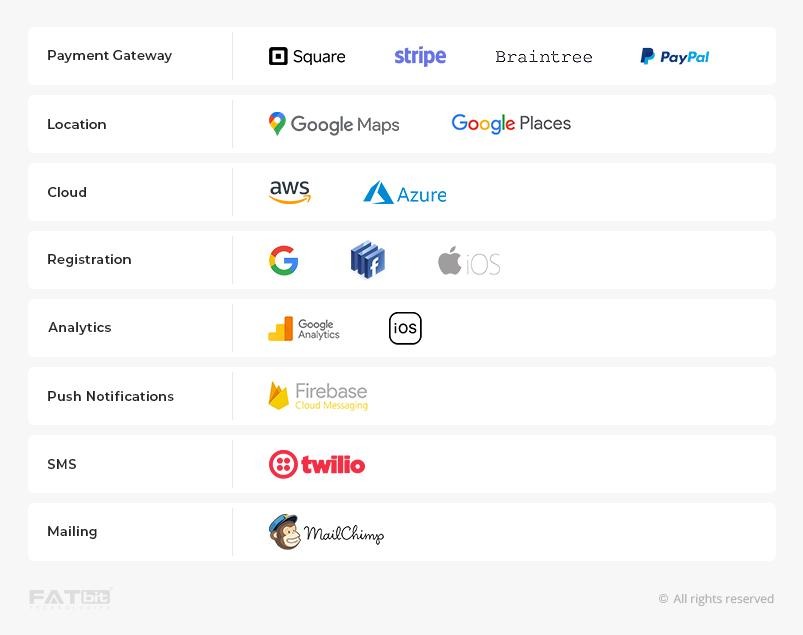
When it comes to building an app like Uber Eats, selecting the right technology stack is very crucial as it forms the foundation for providing a seamless user experience. You might need different technologies depending on the business model of your food ordering & delivery app. Below are some essential technologies to build a food delivery app similar to Uber Eats:
Web App Development AngularJS or React
Mobile App Development| Kotlin (Android) and Swift (iOS)
Back-End Development PHP
Databases MySQL
Third-Party Services
Step 5: Pick a Feasible App Development Option
Once you decide on the features and powerful technology stack, you must finalize the viable options to make an app like Uber Eats as per your requirements. Primarily, there are two options:
1. Hire an App Development Team
If you want to build your app like Uber Eats from scratch and with full customization, you will need to hire an app development team. This approach requires a dedicated team of developers, designers, project managers, analysts, and testers, who will develop the app or website in months. Therefore, it requires a high financial and time commitment.
2. Use a Ready-Made Solution
If you want to build your food delivery app in a short time, then picking a ready-made solution can turn out to be the best option to get your food delivery business started.
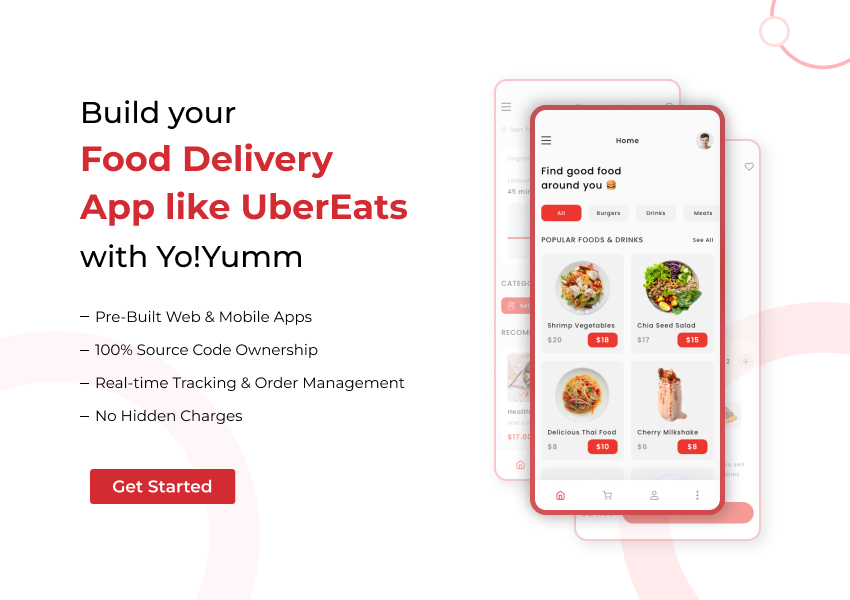
One such readymade white label food delivery solution is Yo!Yumm, which can cater to the requirements of a well-operational food delivery platform. The solution is fully customizable and scalable, feature-rich with pre-built industry-specific functionalities. Therefore, a business owner can modify it according to their requirements and grow without limits.
Schedule a Personalized Demo and Explore the Cutting-Edge Capabilities of Yo!Yumm
The final step after deciding on the development option is to deploy the app. However, before deployment, onboard restaurants and delivery partners with launch incentives to ensure supply readiness. Promote the app through app local SEO, paid campaigns, and referral programs. Use introductory offers and free delivery promotions to drive early adoption, monitor user feedback, and optimize performance for scalable growth.
How Much Does it Cost to Build an App like Uber Eats?
The final cost of developing a food delivery app like Uber Eats may vary depending on the following factors:
1. App Size
It is one of the major factors that play a crucial role in determining the cost of your Uber Eats-like app. The size of an app depends on app complexity and the number of features you want to incorporate into your app. The more features you include, the higher the price will be.
2. App Design
Another factor that influences the development cost is app design. Your food delivery app, like Uber Eats, will not garner enough eyeballs without an attractive user interface. Therefore, the cost will highly depend on the app theme and eye-catching graphics.
3. App Platforms
The choice of platform for building a food delivery app also decides the development time and cost. Android and iOS are two major platforms available in the app development market. The price could vary based on the platform you select to create your app.
4. App Development Team
Select a mobile app development agency or an in-house development team to develop your Uber Eats-like app that aligns with your business requirements and is a cost-efficient option. Therefore, the cost to build an app like Uber Eats is highly influenced by the choice of developmental methods and the team selected for the project.
5. Estimated Cost Breakdown
The cost of building an app like Uber Eats depends on feature complexity and development approach. These two factors outweigh all others in terms of impact on budget, timeline, and resource allocation.
Custom app development from scratch: Typically ranges between USD 80,000 to USD 200,000+, depending on features, platforms, and integrations. Additionally, this approach involves longer development timelines and higher maintenance costs.
Ready-made or white-label solution: Most of the readymade solutions offer packages starting from $2000. Furthermore, they provide faster deployment, lower upfront investment, and the flexibility to customize and scale as the business grows.
Choosing the right development approach depends on your budget, timeline, and long-term scalability goals. For most startups and mid-sized businesses, ready-made solutions offer a cost-efficient and faster path to launching a competitive Uber Eats-like app.
Final Verdict
The increasing inclination of modern users towards the availability of varied options delivered conveniently to their doorstep has added to the rising demand for Uber Eats-like apps. This is an opportune time for restaurateurs seeking to enter the online food industry. Moreover, building a food delivery app considering the business model, revenue model, features, tech stack, and other essential factors in this blog post will definitely give you a perfect start in the online food industry.
Building an Uber Eats-like app from scratch is a long process that requires a lot of investment in terms of money and effort. In contrast, using a readymade solution like Yo!Yumm can cut short the time-to-market and help in launching a feature-rich app like Uber Eats in no time. Being white-label, the solution can also build a customized platform as per the business requirements and stand tall to give fierce competition in the market.
FAQs
Q 1. How long does it take to build an app like Uber Eats?
Ans. The time to build an app like Uber Eats depends highly on the development approach followed by a business owner. Primarily, there are two methods for determining the time taken to develop an app like Uber Eats: a custom developmental approach and a readymade solution.
While the custom development method takes around 8-12 months to launch an Uber Eats-like app, the turnkey solutions, such as Yo!Yumm assists in launching your feature-rich app and website hassle-free within a few weeks, depending on the customization requirements.
Q 2. What’s the easiest way to build an Uber Eats clone without coding?
Ans. Building an Uber Eats-like app can be cumbersome for a business owner with little to no technical or coding experience. The readymade software providers have addressed this pain point by offering a solution built to scale, with pre-built functionalities and all essential features. Hence, by leveraging a readymade solution, business owners can easily and successfully launch and expand their food delivery business with no coding experience.
Q 3. What kind of marketing does Uber Eats do?
Ans. Uber Eats uses effective and fitting market strategies to build a strong customer base for its restaurants.
Pre-made content Uber Eats provides pre-made content for their restaurants to give them an upper hand while enticing their customers.
Uber Eats Badge The unique strategy of providing badges to their restaurants acts as a loyalty mark. It enhances the visibility of the restaurants, attracting more customers.
Assistance in marketing Uber Eats lends its restaurants a helping hand in designing the campaigns for marketing. It provides unique and exclusive ideas to its partner restaurants to build a strong customer base.
Lighthouse customer advocacy Uber does a brilliant job of leveraging early adopter advocacy. Dual marketing attracts customers and restaurants.
Q 4. How affordable is a ready-made solution compared to custom development for building an app like Uber Eats?
Ans. The cost to build an app like Uber Eats is determined by the method of development selected by a business owner.
The custom developmental approach requires a team of dedicated developers who build the app from scratch. Therefore, it increases the timeline and demands a higher financial investment of around $80,000 to $2,00,000+.
On the other hand, readymade solutions are tried and tested software equipped with industry-specific features that allow a business to grow seamlessly with its pre-built functionalities. These white-label solutions support high customization ability, allowing business owners to take control of the platform branding. These solutions are available starting from just $2000, around 10 times less than the custom-made platforms. To know more about the seamless functions, consult the field experts.
Q 5. Is a white label solution best for building an app like Uber Eats?
Ans. Yes, a white label solution is best for building an app like Uber Eats. Yo!Yumm is a market-ready white label online food delivery app solution to launch a food delivery business. It supports multiple business models, adding to the customization offered to a new business owner. Uber Eats app development is now made feasible and hassle-free with Yo!Yumm. Given below is the expanded list for the same.
Order Only
Order and Delivery
Fully Integrated
Reservation Booking
Scheduled Delivery, and more.
Q 6. To start a food delivery business, is it necessary to have all the functionalities like Uber Eats?
Ans. The food delivery industry is an extensive and inviting market for the upcoming industry trends and technological advancements. A business owner can acknowledge the functionality of the food delivery giant to make an app like Uber Eats while also aiming to build a unique app that stands out in the market.
A business owner can invest in building an app according to their market requirements, demographics, vital market strategies, and more, without indulging extensively in creating an app like Uber Eats with all its functionalities to start their food delivery business. Therefore, invest in software with essential features that support high customization abilities for your platform.
Take a look at the advanced feature list supported by Yo!Yumm, and build your unique Uber Eats-like app hassle-free, cost-effectively, and in a profitable time of higher ROI.
Q 7. What are similar Apps Like Uber Eats (Alternatives)?
Ans. A few on-demand food delivery apps similar to Uber Eats are listed below:
All innovation starts with an idea to solve real-world problems. At FATbit Technologies we are passionate about driving digital transformation to prepare businesses for a digital-first tomorrow. Let’s discuss your BIG idea NOW.
Disclaimer: The Blog has been created with consideration and care. We strive to ensure that all information is as complete, correct, comprehensible, accurate and up-to-date as possible. Despite our continuing efforts, we cannot guarantee that the information made available is complete, correct, accurate or up-to-date. We advise - the readers should not take decisions completely based on the information and views shared by FATbit on its blog, readers should do their own research to further assure themselves before taking any commercial decision. The 3rd party trademarks, logos and screenshots of the websites and mobile applications are property of their respective owners, we are not directly associated with most of them.
Abhishek Kataria is a business consultant at FATbit Technologies. He assists entrepreneurs and business owners in developing viable digital touchpoints and marketplaces. Abhishek is curious about exploring and analyzing new business trends and has a keen eye for the latest developments in the eCommerce sector. Apart from consulting, you can find him practicing French and exploring his creativity in Photoshop.











Comments (3)
 veronica gilbert
 FATbit Chef
 Georgedavid
Hey there, very useful article…Thanks for sharing!!
Hello Veronica,
Thank you so much for your appreciation. Stay tuned for more insights.
Best Regards,
Team FATbit
Hi, This is George from SpotnEats.
Thanks for sharing wonderful information.