Web-based dress rental platforms like Rent the Runway allow style-conscious people to rent designer dresses, clothes and accessories for special occasions and have become the topic of discussion in the rapidly evolving fashion industry.
The idea of renting out clothes may seem odd at first, but the success of Rent The Runway-like platforms has proven the potential of this emerging rental business model. Additionally, a report by Grand View Research predicts that the global clothing rental industry is anticipated to grow at a CAGR of 8.5% from 2025-2030. Propelled by the growing need for high-end, premium clothes, the industry presents a perfect opportunity for businesses aiming to build a dress rental marketplace like Rent the Runway.
Hence, this blog aims to elucidate the essentials to build a dress rental platform like Rent the Runway, covering everything from features and functionalities to strategic steps and the best dress rental software.
Rent the Runway is a well-renowned clothing rental platform that was established in 2009, empowering customers to subscribe and rent designer clothes and accessories. Based in New York City, the platform was founded with a belief to simplify access to high-end clothes and accessories at affordable prices for as long as people need, eliminating the hefty costs associated with ownership. What sets Rent the Runway apart from other dress rental platforms is that the marketplace also provides a free backup size, along with every order.
Besides renting high-quality clothes for events, the inventory includes a wide range of products including everyday clothes, home decor items, workwear, children’s clothes and ski apparel. Apart from the 4- to 8-day period rental-based model, Rent the Runway incorporates a specialized monthly subscription-based model as well. In addition to renting, the platform also allows customers to purchase their loved items permanently, offering greater operational flexibility.
Founded In: 2009
Headquarters: New York, United States
Annual Revenue: $306.20 million
Founders: Jennifer Hyman & Jennifer Fleiss
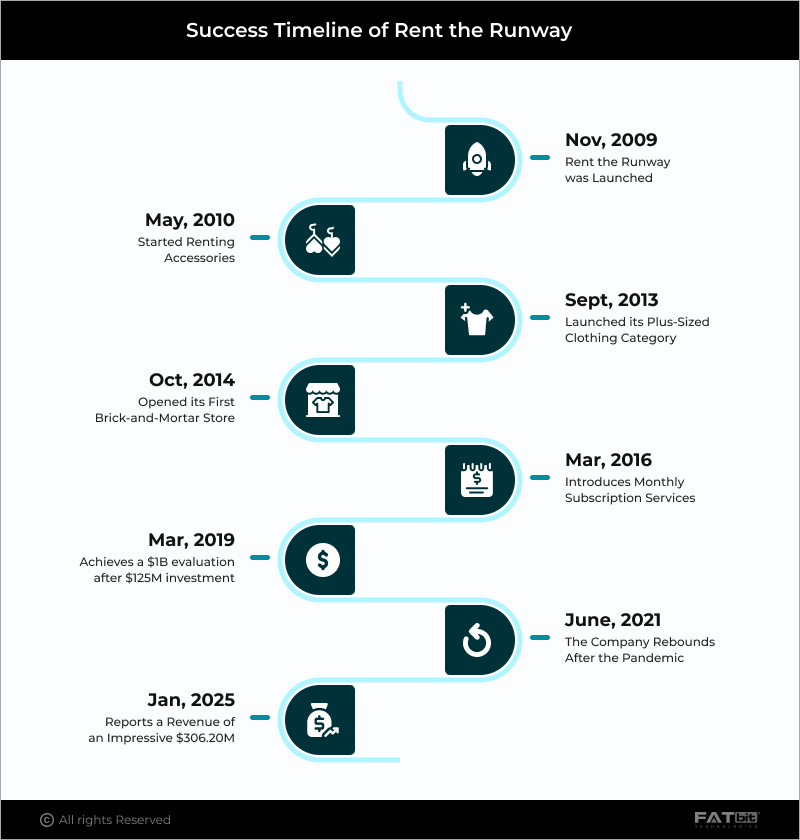
Success Timeline of Rent the Runway: From a Startup to an Industry Leader
November 2009 – Rent the Runway was Launched
May 2010 – Started Renting Accessories
September 2013 – Launched its Plus-Sized Clothing Category
October 2014 – Opened its First Brick-and-Mortar Store
March 2016 – Introduces Monthly Subscription Services
March 2019 – Achieves a $1 billion evaluation after $125 million investment
June 2021 – The Company Rebounds After the Pandemic
January 2025 – Reports a Revenue of an Impressive $306.20 million
Business Model of a Clothing Rental Platform like Rent the Runway
An online dress rental marketplace like Rent the Runway is more than just a fashion company. It is also a technology company that is reinventing the fashion rental industry. The business model is based on strategic partnerships with multiple designers and agencies to give their audience access to their newest outfits and accessories. Here’s how Rent the Runway works:
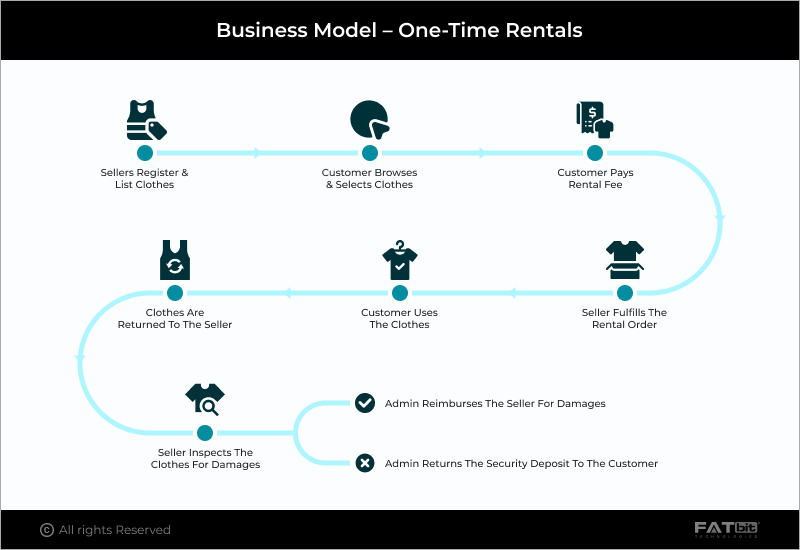
#Business Model 1 – One-Time Rentals
Rent the Runway empowers customers to reserve and rent their preferred clothes for a 4- or 8-day rental period. Here’s how it works:
Designers register on the platform and list their clothes.
Customers browse through those listings and select their preferred clothes.
They then select their preferred rental period, either 4-day rentals or 8-day rentals, along with the free backup size they desire.
The customers pay a rental fee along with a security deposit to place the order.
The order is then prepared for fulfillment and shipped as per the preferred method.
Once the rental period ends, the customer returns the clothes via the included prepaid shipping label.
The clothes owner inspects the clothes for any unexpected wear & tear and reports them to the admin.
The admin then reimburses the owner for any damages and returns the remaining security deposit to the customer.
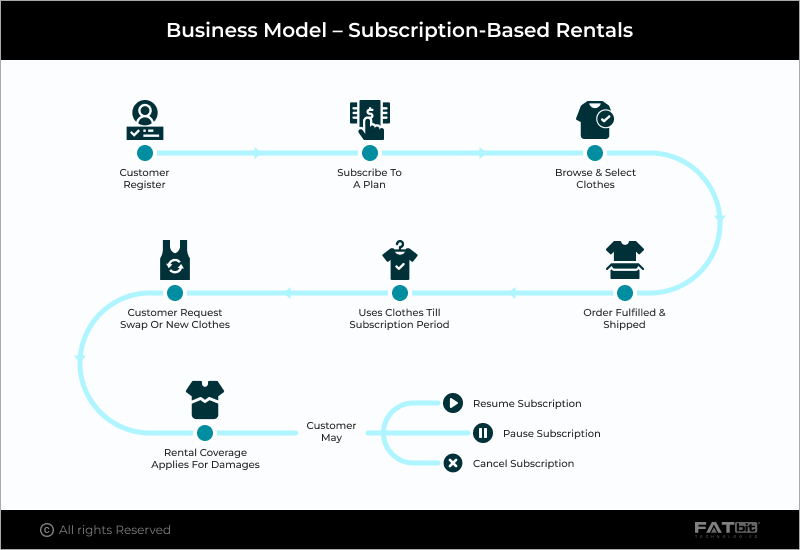
#Business Model 2 – Subscription-Based Rentals
Apart from the one-off rentals, Rent the Runway follows a subscription-based model as well that offers access to perpetually revolving designer products at a one-off monthly subscription price. Here’s how the business model works:
Rent the Runway offers multiple subscription plans for customers, specifying the number of clothes and shipments allowed with each plan.
Customers pick and subscribe to a plan that best aligns with their requirements.
Customers browse and select the products they want.
The order is then fulfilled within 3 business days, while some may receive the orders sooner in selected zip codes.
The customer uses the products for a whole month.
Further, they can instantly choose the next shipment whenever they’re ready to swap.
These rental packages include a rental coverage fee that helps reimburse any unexpected damage that occurs to the products.
Additionally, the customers can buy the products if they like them.
These subscriptions can be modified as per the customer’s requirements, allowing them to pause, cancel or switch the plans.
Revenue Strategies of a Dress Rental Platform like Rent the Runway
Besides making money from renting clothes, your online dress rental platform can generate revenue from the following channels:
Commissions: Get a small commission from every dress rental transaction on your website.
Advertising: Make advertising on website or app a part of your long-term monetization plan
Featured or Sponsored Listing: Allow dress owners to feature their offerings on homepage & other highlighted sections of the website in exchange for a small fee.
Subscriptions: Create varied monthly or annual subscription plans where users purchase a subscription in exchange for perks like relaxation in delivery fees, cashbacks or even a free dress rental on successfully registering themselves.
Rental Add-Ons: Offer optional extras with the main rental products to upsell on the platform, increasing the overall cart value.
In addition, you can also upgrade your online designer dress rental platform by adding a selling feature to it. Allow fashion brands to sell their products on your website, and it will serve as another source of revenue in the form of commissions from those sales.
Launch a Profitable Dress Rental Platform Tailored to Diverse Revenue Channels
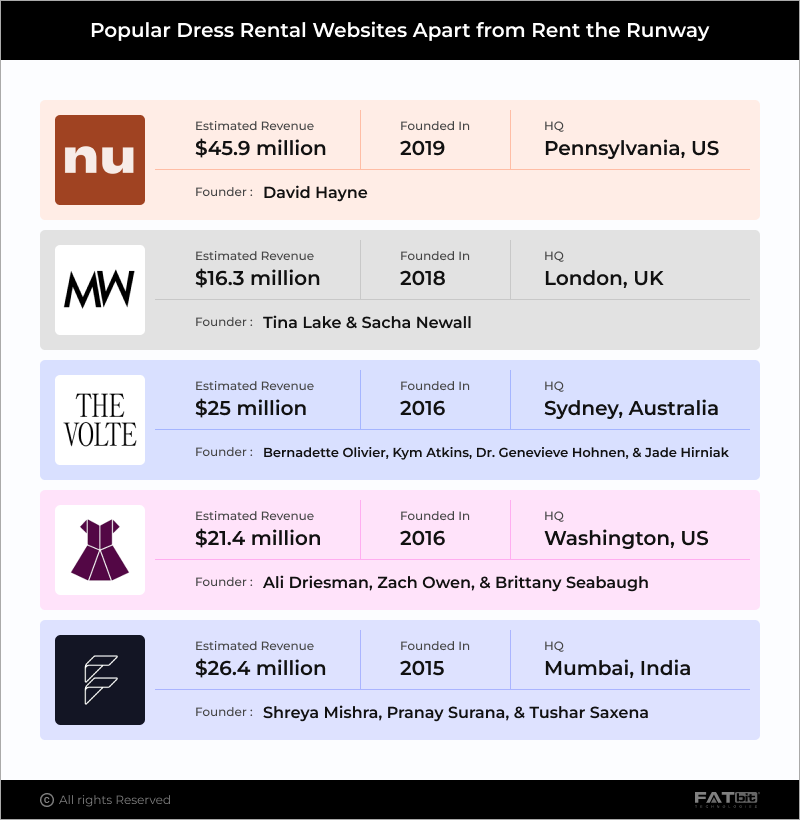
Popular Dress Rental Websites Apart from Rent the Runway
The dress rental industry is intensifying rapidly at a CAGR of 8.5% for the projection period 2025-2030. As customer preferences shift to rentals over ownership, several platforms are leveraging these growth indicators to capitalize on this market trend. Here are a few key players who’ve established a strong brand name in this industry:
Most of these dress rental websites cater to a specific geographical area. So, it would be wrong to consider them as a competitor to your dress rental portal, unless they operate in the same market that you are targeting.
Now that we have understood the business model and have an idea about the top online dress rental marketplaces, let’s find out more about the required marketplace features.
Key Features to Build an Online Dress Rental Marketplace like Rent the Runway
As mentioned earlier in this post, your online clothing rental platform is more of a technology business, thus, the platform should be integrated with advanced, rent-centric features. Below are a few key features mentioned for a successful online dress rental platform development:
Rental Booking Calendar: Integrate an in-app rental booking calendar that displays product availability and takes rental date inputs, allowing customers to seamlessly rent clothes while eliminating the risk of double bookings for businesses.
Rental Security Management: Collect rental security deposits on the platform from customers every time they rent a product in order to reimburse the sellers in case of any unexpected damage.
Rental Agreement Management & eSign: Empower sellers to upload custom rental agreements, implying their varied rental terms & conditions and allowing customers to acknowledge them via eSignatures.
Late Returns/Cancellations Management: Levy diverse late return or cancellation periods along with their respective penalties to overcome any losses.
Rental Buffer Period: Implement a robust rental buffer period to synchronize the under-maintenance inventory with online inventory, allowing sellers to inspect the products thoroughly before renting them to another customer.
Dynamic Pricing: Employ dynamic pricing based on duration (hourly, daily, weekly or monthly), seasonality and demand to cater to varied customer needs.
Product Comparison: Integrate a smart product comparison tool that allows customers to compare multiple products simultaneously on a single page, eliminating the complexities associated with navigating through multiple pages.
Advanced Search Filters: Simplify product searching for customers with an advanced search and filters option, allowing them to find products by type, price, category, size or more.
Rent Plus Sell: Incorporate selling functionality besides renting on the platform, boosting profitability for sellers while offering maximum flexibility to customers to purchase the products they love.
Multi-Cart Checkout: Implement a multi-cart checkout functionality, allowing customers to rent clothes from multiple sellers smoothly without any friction, offering added convenience.
Inventory Management: Utilize an advanced inventory management system to provide sellers with real-time notifications on the inventory status, whether rented, available or under maintenance.
Reports & Analytics: Provide data-backed insights into KPIs, platform performance, customer behaviors and earnings with a robust analytics dashboard, allowing admins to optimize the marketplace and modify marketing strategies accordingly.
Customer Subscriptions: Offer varied subscription plans to customers, providing added benefits while establishing a predictable, steady flow of income.
Launch a Rent the Runway-Like Platform Equipped with Unmatched Features
Key Development Approaches to Build a Clothing Rental Platform like Rent the Runway
There are primarily two key development approaches to build a dress rental platform like Rent the Runway, which are: Custom Development and Readymade Software. Both the approaches offer distinct advantages and considerations, and choosing the right approach largely depends on your business requirements, budget and market entry.
Here’s a clear overview of both:
1. Custom Development:
This bespoke development approach enables businesses to build a dress rental marketplace like Rent the Runway completely from scratch, allowing them to tailor each and every aspect of the marketplace to their unique business requirements. However, while this approach offers extensive flexibility and customizability, it also requires a hefty investment, resources and timeline to launch. Thus, businesses that need a uniquely tailored marketplace with extended development cycles can utilize this approach to build a dress rental platform.
2. Readymade Dress Rental Software:
Readymade clothing rental software offers an optimal approach for businesses aiming to build and launch a dress rental platform like Rent the Runway with accelerated market entry. Such solutions are pre-built frameworks that integrate essential features and business APIs right from the beginning, allowing businesses to launch a fully functional dress rental marketplace quickly and cost-efficiently. Moreover, most modern dress rental software offers enterprise-level customizability and scalability that help businesses tailor the platform to their unique business vision and seamlessly scale globally.
Parameters
Custom Development
Readymade Software
Development Time
Longer development cycles; may take anywhere from 6 months to over a year
Can be launched quickly in a few days or weeks
Cost
Higher, ranging between $20,000 – $500,000
Depends on the chosen software type; spanning from $1000 to $10,000
Flexibility
Yes, but demands a greater investment of both capital & time
Adapts to your unique business requirements easily
Customizability
Allows complete customization capabilities
Versatile enough to support specific needs, from rebranding to workflow customizations
Ownership
Full ownership, with sole responsibilities for all maintenance and upkeep
Varies by software type. Retain complete ownership rights with self-hosted clothing rental software
Scalability
High, but demands continuous maintenance expenses
Moderate to high; contingent upon the chosen software type. Self-hosted solutions offer enterprise-level scalability, while SaaS solutions impose specific caps
Integrates necessary security frameworks from the beginning
Customer Support
Separate investment required for additional customer support
Often provided by the software provider
Risk
Elevated risk of service disruptions and extended development cycles
Lower, as such solutions are already tried and tested to guarantee performance and stability
Efforts
Higher; demands a multidisciplinary team to plan, design, code and test the platform
Minimal overhead, allowing businesses to focus on marketing and platform growth
Subsequent to a thorough comparison between custom development and readymade clothing rental software, it is quite obvious that utilizing a readymade clothing rental software offers an optimal choice to build a clothing rental platform like Rent the Runway.
Best Clothing Rental Software to Build a Dress Rental Marketplace
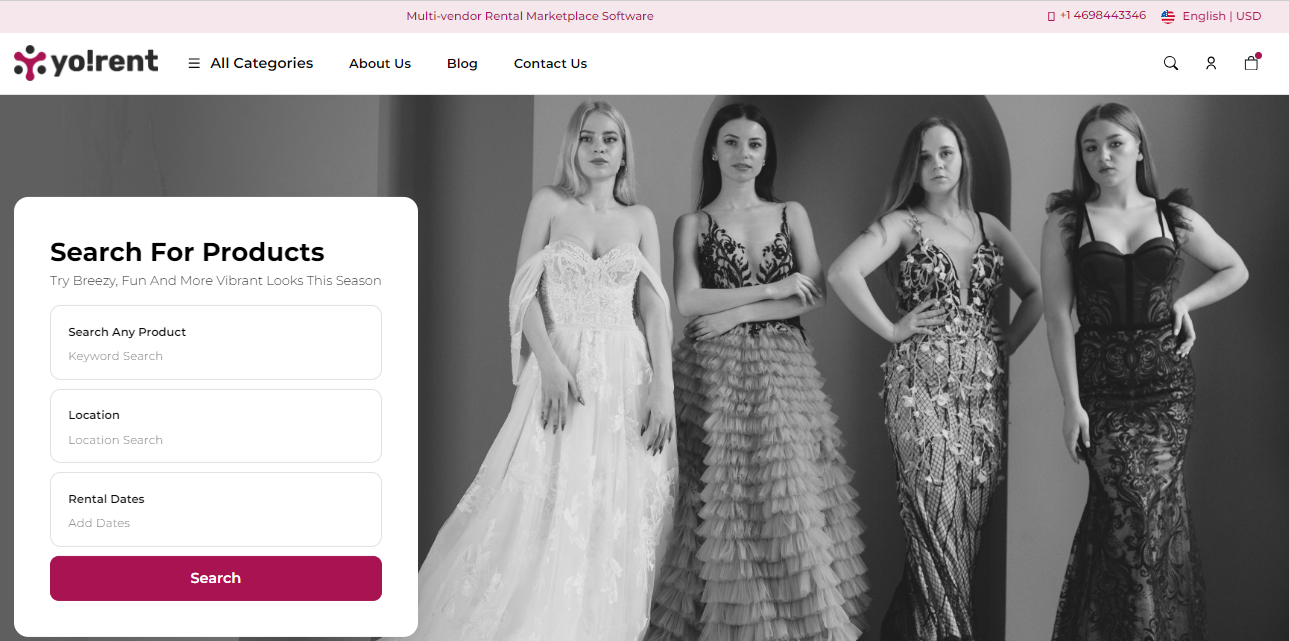
Among the many alternatives, Yo!Rent stands as the best dress rental software to build a dress rental marketplace like Rent the Runway. Yo!Rent is a turnkey, self-hosted solution. Designed exclusively for rental businesses, it integrates advanced rent-centric features and integrations in the first instance, helping businesses build a fully functional dress rental platform without any complexities associated with custom dress rental marketplace development.
Yo!Rent seamlessly automates key rental processes, from rental bookings and inventory management to rental invoicing and insights-driven business analytics. Whether you want to build a P2P dress rental marketplace or a subscription-based platform, Yo!Rent supports diverse business models. In addition, the software offers maximum flexibility and scalability to launch a fully scalable dress rental marketplace akin to Rent the Runway.
Key Benefits of Yo!Rent:
100% white label solutions with complete rebranding flexibility
The growing interest in sustainable fashion is fueling the rental market’s expansion, especially when it comes to greater variety and significant savings. Whether you’re aiming to start a clothing rental business fresh or expand your already existing business, the industry poses significant opportunities for businesses to establish a strong brand name. However, to build a scalable, technologically resilient dress rental platform like Rent the Runway, one must invest in a future-ready technology that can be adapted to distinct business demands.
This is where, utilizing a clothing rental software like Yo!Rent is advisable to build a clothing rental platform like Rent the Runway in order to ensure a perfect balance with operational efficiency, unique branding and ownership.
FAQs
Is it economically worthwhile to start a clothing rental business?
Spurred by the growing demand for sustainable and affordable access over ownership, starting a clothing rental business is a worthwhile investment. With a tremendous growth at a CAGR of 8.5% from 2025 to 2030, the market thus presents significant growth opportunities for businesses aiming to build a clothing rental platform. Additionally, the higher profit margins and enhanced automated operations further enhance the appeal of an online dress rental platform.
Which clothing types are profitable to build a clothing rental platform?
Sustainability and affordability have played significant roles in the growth of the clothing rental market. However, there are diverse clothing types that businesses can cater to establish a strong business presence. Among these, here are the most profitable clothing types to start a clothing rental business:
High-end luxury dresses: For events, galas, and parties, as consumers seek designer dresses for exclusive parties
Formal wear: Such as suits, blazers, or formal dresses for corporate events
Bridal dresses: Bridal gowns or other outfits offer higher profit margins due to their high cost and single-use
Kidswear: As children quickly outgrow their clothes, so launching a kidswear rental platform also offers a substantial opportunity
Themed events & costumes: Costumes for Halloween, Christmas and other events are one-time use only, presenting a massive opportunity for businesses
Maternity clothing: Expectant mothers need a temporary wardrobe for a limited time, making rentals a cost-effective, practical solution
How much money does it take to build a dress rental platform like Rent the Runway?
The cost to build a dress rental platform like Rent the Runway largely depends on the chosen development approach. On one hand, custom development requires building every aspect of the platform from scratch, demanding anywhere from $20,000 to $500,000 or more. On the contrary, readymade clothing rental software significantly eliminates these costs, allowing one to build a dress rental platform cost-effectively, ranging from $1,000 to $10,000, depending on the customizations required.
How to build a subscription-based clothing rental platform?
Building a subscription-based clothing rental platform offers an eminent opportunity to launch a dress rental platform. However, it also demands a sophisticated infrastructure and advanced controls. Thus, employing a dedicated clothing rental software expedites launch, enhances operational efficiency and delivers the scalability required to build a high-value, revenue-driven subscription-based clothing rental platform.
Which is the best clothing rental software to build a dress rental platform like Rent the Runway?
Amid countless alternatives, Yo!Rent serves as the clothing rental software to build a dress rental platform like Rent the Runway, achieving an ideal balance between scalability, customizability and ownership. It is a self-hosted software that offers a lifetime license at a one-time-only purchase. Additionally, built with extreme precision, the software integrates advanced features and functionalities tailored for rental operations, providing enterprise-level scalability to expand the business internationally.
All innovation starts with an idea to solve real-world problems. At FATbit Technologies we are passionate about driving digital transformation to prepare businesses for a digital-first tomorrow. Let’s discuss your BIG idea NOW.
Disclaimer: The Blog has been created with consideration and care. We strive to ensure that all information is as complete, correct, comprehensible, accurate and up-to-date as possible. Despite our continuing efforts, we cannot guarantee that the information made available is complete, correct, accurate or up-to-date. We advise - the readers should not take decisions completely based on the information and views shared by FATbit on its blog, readers should do their own research to further assure themselves before taking any commercial decision. The 3rd party trademarks, logos and screenshots of the websites and mobile applications are property of their respective owners, we are not directly associated with most of them.
FATbit Chef is the official broadcaster of everything that happens inside FATbit. Count on the invisible reporter for detailed analysis based posts, new service additions, and other brand related updates.
Hello Fatbit team, I’m interested in starting a clothing rental website, would like your help. Can you get back to me ?
FATbit Chef Post author
Sure, we will be more than help you 🙂
Our business team will get in touch with you soon.
Meanwhile, if you have any specific requirements related to the clothing rental website, you can share with the team at salesteam@fatbit.com. This will help us serve you better.
Have a nice day.
FATbit Team
Criss Angle
I loved the way you discuss the topic great work thanks for the share.
FATbit Chef Post author
You’re welcome.
Keep visiting us for more such interesting topics.
Cheers!
Team FATbit
Suzzane Joanna
This is great information for students. This article is very helpful i really like this blog thanks.
FATbit Chef Post author
You are Welcome.
Cheers!
Team FATbit.
Janice
Hi FatBit team,
I want to start the rental business. Can you please get back to me asap.
The only thing I’m struggling to find information on, is how to charge customers for damaged or lost items. Once a customer is charged when they place the rental, there is no way to charge them again if the items isn’t returned. If someone could shed some light on this, I’d be grateful.
FATbit Chef Post author
Hello Drew,
Thanks for connecting!
In the scenario you mentioned, you can charge a security amount when the product is being rented out. The security amount can equal to or less than the cost of the product. If the product is returned in the same condition, then the whole amount can be refunded back to the rentee. If the condition is not up to the mark, an amount can be dedicated which is decided mutually by the admin and the renter.
Yo!Rent, a rental ecommerce solution, has an inbuilt security deposit at the admin end. The security is received and kept with the admin and is released once the item is returned. Check the admin demo to know more https://fashion.v3demo.yo-rent.com/admin
Detailed article. Can you people guide me on the integrations and plugins your software supports?
Sarita Sonavane
As per study added by Value Market Research, the online clothing rental refers to services that allow consumers to rent garments for a specific time. The booming online retail industry is one of the main factors driving the market growth worldwide. Additionally, a growing urban population with higher fashion consciousness is also contributing to the increasing service demand.














Comments (32)
 Jessica Rosado
 FATbit Chef Post author
 FATbit Chef Post author
 Sameer Khan
 FATbit Chef Post author
 lena
lena
 FATbit Chef Post author
 Lakshika
 FATbit Chef Post author
 Sneha Sultania
 FATbit Chef Post author
 Shouq
Shouq
 FATbit Chef Post author
 Criss Angle
 FATbit Chef Post author
 Suzzane Joanna
 FATbit Chef Post author
 Janice
 FATbit Chef Post author
 IvaJesus
 Stephanie
 FATbit Chef Post author
 Romina Kirchmaier
 FATbit Chef Post author
 drew
drew
 FATbit Chef Post author
 Pre shipment Inspection
 FATbit Chef Post author
 Lakshmi
 FATbit Chef Post author
 Vishnu Nair
 Sarita Sonavane
Need a dress rental website. Please sen me an estimated
Hello Jessica,
Thanks for reaching us out. One of our representative will get back to you soon.
Cheers
Hey Frank,
One of our expert will get in touch with you soon.
Thanks
Hello, i want to build an ecommerce website with a uniqhue 3 hour delivery service in hyderabad, India. Please get back to us to help us.
Hello Sameer,
We will be more than happy to help you.
Our experts will get back to you soon.
Cheers !
i am interested in creating an online dress rental business. Can you please get back to me asap.
Cheers
Hello Lena,
Our startup expert will contact you soon !
In the mean time, kindly send us your business requirements via https://www.fatbit.com/website-design-company/requestaquote.html , this will help us serve you better 🙂
Regards,
FATbit Team
Hi,
I want to start an online renting business..Please share Estimate cost that I need to put in.
Hi Lakshika,
Thanks for connecting with us.
We would be glad to work on this project.
Our expert will get in touch with you to discuss the same. Meanwhile, you can share your detailed requirements with us via https://www.fatbit.com/website-design-company/requestaquote.html
Regards,
FATbit Team
Hi FatBit team, exploring this business idea – need help with developing the platform. Please connect to discuss. Thanks.
Hi Sneha,
Thanks for showing interest in us.
We would be glad to work on this project.
Our expert will get in touch with you to discuss the same. Meanwhile, you can share your detailed requirements with us via https://www.fatbit.com/website-design-company/requestaquote.html
Regards,
FATbit Team
Hello Fatbit team, I’m interested in starting a clothing rental website, would like your help. Can you get back to me ?
Sure, we will be more than help you 🙂
Our business team will get in touch with you soon.
Meanwhile, if you have any specific requirements related to the clothing rental website, you can share with the team at salesteam@fatbit.com. This will help us serve you better.
Have a nice day.
FATbit Team
I loved the way you discuss the topic great work thanks for the share.
You’re welcome.
Keep visiting us for more such interesting topics.
Cheers!
Team FATbit
This is great information for students. This article is very helpful i really like this blog thanks.
You are Welcome.
Cheers!
Team FATbit.
Hi FatBit team,
I want to start the rental business. Can you please get back to me asap.
Thank you.
Hello Janice,
Thanks for reaching us out. One of our representatives will get in touch with you soon to discuss the details. Meanwhile, please send your more queries if any, through https://www.fatbit.com/website-design-company/requestaquote.html
Cheers!
Team FATbit.
Nice post 🙂 Thanks for sharing this 🙂
Hello I’m interested in starting an online rental company. Could someone reach out to me for consultation?
Hello Stephanie,
One of our experts from the business development team will get in touch with you shortly.
Have a nice day!
– FATbit Team
Hi there – would like to get some figures on building a clothes rental website.
Please advise. Also, do you provide the back-end inventory management?
Thanks!
Hi,
Thanks for connecting with us.
We would be glad to help you.
Our expert will get in touch with you to discuss the same. Meanwhile, you can share your queries with us (if any) via https://www.fatbit.com/website-design-company/enquiry.html
Regards,
FATbit Team.
The only thing I’m struggling to find information on, is how to charge customers for damaged or lost items. Once a customer is charged when they place the rental, there is no way to charge them again if the items isn’t returned. If someone could shed some light on this, I’d be grateful.
Hello Drew,
Thanks for connecting!
In the scenario you mentioned, you can charge a security amount when the product is being rented out. The security amount can equal to or less than the cost of the product. If the product is returned in the same condition, then the whole amount can be refunded back to the rentee. If the condition is not up to the mark, an amount can be dedicated which is decided mutually by the admin and the renter.
Yo!Rent, a rental ecommerce solution, has an inbuilt security deposit at the admin end. The security is received and kept with the admin and is released once the item is returned. Check the admin demo to know more https://fashion.v3demo.yo-rent.com/admin
We hope you have received an answer to your question. If not, please let us know more. https://www.fatbit.com/website-design-company/requestaquote.html
I’m interested in starting a clothing rental website and superb blog.
Hello,
Please send in your details, we’ll be glad to assist.
https://www.fatbit.com/website-design-company/requestaquote.html
Thanks & Regards,
Team FATbit
I heard this online rental business first time, but i am excited to do.
Hello Lakshmi,
That’ll be great. Please feel free to get in touch. We’ll be happy to help.
https://www.fatbit.com/website-design-company/requestaquote.html
Thanks & Regards,
Team FATbit
Detailed article. Can you people guide me on the integrations and plugins your software supports?
As per study added by Value Market Research, the online clothing rental refers to services that allow consumers to rent garments for a specific time. The booming online retail industry is one of the main factors driving the market growth worldwide. Additionally, a growing urban population with higher fashion consciousness is also contributing to the increasing service demand.