The digitalization of the transportation industry, specifically through the advent of ride-hailing apps, represents a significant transition in the urban mobility landscape. Starting a ride-hailing app business represents not merely a speculative venture, but a strategic undertaking that demands rigor, foresight and disciplined execution.
In a market defined by intricate operations, strict regulatory oversight and ever-evolving customer expectations, the margin between success and stagnation is determined by how effectively the early phases are orchestrated. The initial 90-day period transcends a mere setup phase, serving as a critical foundation for businesses that determines long-term scalability, profitability and brand credibility.
This blog presents a pragmatic 90-day roadmap designed for businesses seeking clarity, speed and precision. Rather than just an abstract theory, it outlines a phased, outcome-driven approach on how to start a ride-hailing app business in 90 days.
Phase 1: Business Planning (The Initial 30 Days)
The first 30 days lay the strategic foundation for a successful ride-hailing app venture. The ultimate goal in this phase is not rapid development, but strategic groundwork—determining your competitive arena, your intended audience and the value proposition for your ride-hailing app business. Prudent business planning at this stage thus minimizes execution risks and ensures the commercial viability of all subsequent development and marketing efforts.
The primary objective of this phase is to move from a nascent, broad idea to a clearly articulated business vision with a defensible market position.
Find a Business Niche for the Ride-Hailing App
Identifying the precise ride-hailing app business niche is a determinative decision in launching a ride-hailing app. Rather than simply pursuing a broad, undifferentiated market entry, businesses can garner competitive differentiation by addressing specific, underserved segments or by introducing specialized mobility solutions.
However, the process should begin with a structured assessment of market inefficiencies and unmet demand. Additionally, market research should combine qualitative insights, such as passenger pain points and driver challenges, along with other insights on demand patterns, pricing sensitivities and adoption rates.
The business niches may relate to:
- Geographies – tier 2 or tier 3 cities
- Customer segment – corporate commuters, students, etc.
- Vehicle type – luxury cars, EVs, bikes and so forth
- Purpose – women-friendly, airport transfers, last-mile connectivity
Hence, a well-defined niche allows you to design a focused value proposition and optimize ride-hailing operations from the beginning.
Evaluate the Competitive Landscape
A rigorous evaluation of the competitive landscape forms the strategic backbone of a successful ride-hailing venture.
For this, begin with a structured analysis of major global leaders, successful regional players and merging niche-focused ride-hailing businesses. Examine their service models, pricing structures, geographical boundaries coverage, driver engagement strategies and customer acquisition tactics. Furthermore, evaluate their technological capabilities, including app performance, scalability, user experience consistency, and data security measures.
These insights will thus help you craft a unique value proposition, ensuring the business competes on strategic advantage rather than price point alone. Here are some of the top ride-hailing apps in the industry:
| Ride-Hailing App |
Headquarters |
Founded In |
Special Offerings |
Annual Revenue |
| Uber |
California, US |
2009 |
Global giant that offers diverse ride options |
$49.610 billion |
| Lyft |
California, US |
2012 |
Major competitor of Uber; covers dynamic ride offerings |
$6.274 billion |
| Bolt |
Tallinn, Estonia |
2013 |
Superapp that extends its offerings to diverse industries beyond ride-hailing |
$5.4 billion |
| Waze Carpool |
California, US |
2016 |
Focuses on carpooling and minimizing traffic congestion |
$76.3 million |
| Via |
New York, US |
2012 |
End-to-end mobility solutions for modern communities |
$801.8 million |
| Freenow |
Hamburg, Germany |
2009 |
European multi-mobility app |
$273.8 million |
| Shebah |
Australia |
2017 |
Women-only ride services |
$7.7 million |
| Grab |
Singapore |
2012 |
Singapore-based app that expands its ecosystem to diverse industries |
$3.229 billion5 |
Launch a Fully-Branded Ride-Hailing App Like Uber or Lyft
Determine the Key Features to Start a Ride-Hailing App Business
Determining the key features of your ride-hailing app business requires a disciplined approach that aligns user expectations with business objectives and technical feasibility. Core features of a ride-hailing app includes user-friendly interface, multi-lingual & multi-currency support, push notifications, scalability, customizability, smooth user journey, regulatory compliance and so forth.
Beyond these standard features, here are some of the key features of a ride-hailing app specific to each user type:
Passenger App Features:
1. Seamless Login: Allow passengers to sign up or log in on the ride-hailing app smoothly via email, OTP, phone number or social media accounts, enabling them to create profiles without any friction.
2. Effortless Booking: Provide customers with the flexibility to book rides effortlessly, whether for instant rides or book in advance, allowing seamless management without any stress.
3. Ride-Sharing: Customers can share rides with other passengers heading in the same direction or along the same route, enabling them to cut ride costs and reducing traffic congestion on the roads.
4. Real-time Tracking: Provide passengers with real-time location tracking of drivers with ETA updates to provide expedited route information, offering peace of mind and boosting trust.
5. Upfront Fare Estimate: Integrate an in-app fare estimator that provides an upfront estimate of the fare based on distance and times, allowing passengers to make informed ride decisions before ride booking.
6. Package Delivery: Enable customers to deliver parcels from one point to another safely and securely through the app, while providing real-time location tracking.
7. Ratings & Reviews: Encourage passengers to share genuine ratings for drivers and reviews for the ride experience to improve service quality and enhance long-term trust.
8. SOS Alerts: Equip an SOS feature that allows passengers to share their ride details along with real-time tracking with their pre-designated emergency contacts in case of emergencies.
Driver App Features:
1. Streamlined Registration & Verification: Allow drivers to effortlessly register themselves and create profiles on the app. Additionally, provide clear instructions to upload relevant documents for seamless verification.
2. Ride Management: Enable drivers with complete functionality to accept or reject rides based on their preferences and availability.
3. Availability Toggle: Provide an in-app toggle to drivers, allowing them to manage their operational hours based on their preferences. This helps drivers receive ride requests only when operational.
4. Navigation & Route Optimization: Integrate Google Maps and real-time GPS tracking to provide drivers with accurate, time-efficient routes, allowing them to quickly complete rides while eliminating routes with high traffic.
5. Initiate Payout: Provide drivers with a digital wallet for earnings tracking and allow them to initiate payouts at their convenience, enabling them to manage their earnings efficiently.
6. Subscription Offers: Deliver dynamic subscription packages to drivers that provide exclusive perks like reduced commissions, priority bookings or advanced features access, based on the chosen subscription package.
7. Ride Requests & History: Enable drivers to access detailed ride history, stats, earnings, ratings, and rider information, allowing them to analyze their performance and make informed decisions.
Admin Panel Features:
1. User Management: Admins can oversee and manage user profiles, user behavior, and activities effectively, providing efficient oversight.
2. Geo-Fencing: Utilize geo-fencing to manage operational boundaries, service zones and discarded regions for precise location-based services, enabling complete control over ride operations.
3. Commission Management: Provides admins with complete functionality to define commission settings based on vehicle type, seasonality, demand periods and more, enabling admins to manage earnings effectively while remaining competitive.
4. Multiple Vehicle Categories: Configure multiple vehicle types such as cars, SUVs, sedans, bikes, EVs, vans, shuttles and more, providing passengers with a wide range of vehicle types while catering to diverse customer needs and enhancing business versatility.
5.Subscription Order Management: Enabled admins to create diverse membership plans, pricing, activation, renewals, expirations and payments, while providing real-time updates and notifications to users.
6. Discounts & Promotions Management: Provides robust tools for customer engagement and acquisition, such as managing discount coupons, referral incentives and loyalty bonuses.
7. Reports & Analytics: Integrate an advanced reporting & analytics dashboard that provides greater visibility into KPIs, such as user behaviors, driver conduct, user engagement, app performance and earnings, to make informed business decisions.
Want to Launch a Feature-Packed Ride-Hailing App Business?
Secure Business License & Permits to Build a Ride-Hailing App
Securing the appropriate business licenses and permits is a crucial step that directly impacts your ability to operate legally and scale confidently.
Ride-hailing regulations vary widely across jurisdictions and may involve transportation authority approvals, business registrations, driver background checks, tax obligations, insurance mandates and compliance with data protection laws.
Failure to address these considerations proactively can result in operational delays, financial penalties or reputational risks.
Thus, engaging with legal advisors or regulatory consultants during this stage is strongly recommended, especially when operating across multiple jurisdictions. Proactive compliance mitigates legal & financial risk while enhancing trust among each user type and establishing a stable operational foundation.
Identify the Budget to Start a Ride-Hailing App Business
A clearly articulated budget underpins the successful execution of the entire roadmap. Financial planning should encompass all critical cost components, including:
- Technological development or software licensing
- Cloud infrastructure
- Regulatory compliance
- Marketing initiatives
- Cybersecurity measures
In addition to these, operational expenditures, such as user acquisition costs, driver onboarding incentives, customer support setup and payment processing fees, must also be accurately factored into early financial planning.
Beyond immediate costs, allocate contingency funds to address unforeseen regulatory changes, technical refinements, maintenance & upgrades in the future or shifts in market dynamics. Hence, adopting a phased budgeting model aligned with development, launch and early growth milestones enables greater financial discipline & transparency and supports informed decision-making.
Phase 2: Ride-Hailing App Development (Day 30 – Day 60)
Phase 2 represents the operational core of the 90-day roadmap. This stage is where strategic planning evolves into a fully-functional, enterprise-ready ride-hailing app. The emphasis shifts to selecting the right technological foundation, configuring the app to match business goals, establishing a credible brand presence and ensuring the app is secure and scalable.
Thus, decisions made in this phase will define the time-to-market, operational efficiency and long-term ROI.
Choose a Reliable Ride-Hailing Software to Build a Ride-Hailing App
Building a ride-hailing app from the ground up is capital-intensive, time-consuming and exposes the business to unnecessary technical risks. For this reason, selecting a versatile readymade ride-hailing software is a strategic imperative.
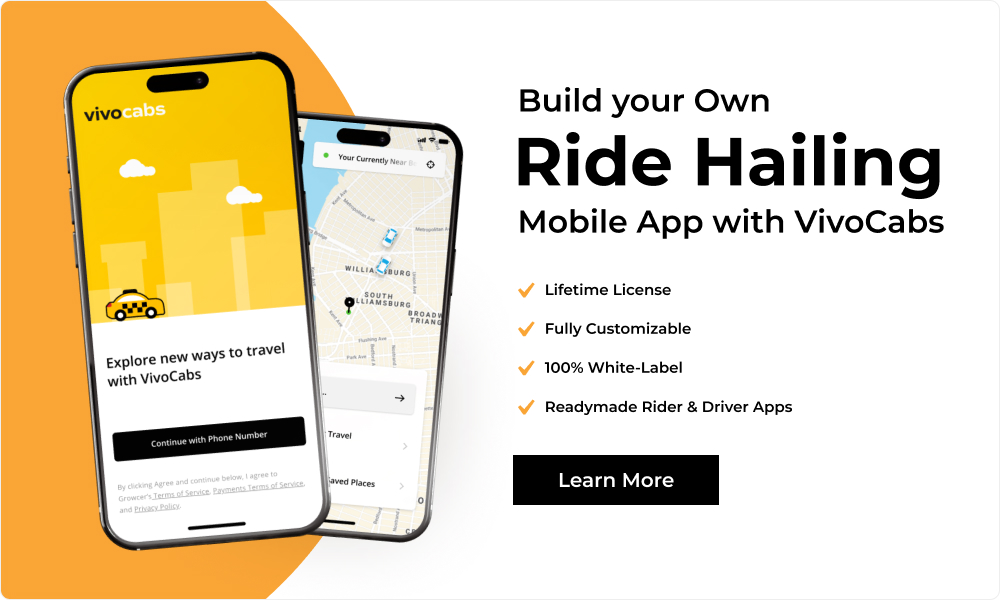
VivoCabs thus stands as a turnkey, enterprise-grade ride-hailing software designed to support both early-stage launches and large-scale operations. It boasts a mature, future-proof technology stack with robust native rider-driver apps, along with a web admin panel—each engineered for performance and security. The software pre-integrates dynamic features such as real-time GPS tracking, ride matching, secure payment workflows, dynamic fare calculation and seamless report & analytics mechanisms. Its modular architecture enables businesses to tailor the UI/UX design, customize workflows, integrate distinct third-party APIs and add new features as market demand evolves.
With VivoCabs, businesses gain access to a stable, field-tested software at an upfront purchase, offering a license for a lifetime at no ongoing monthly, quarterly or annual charges. This helps businesses concentrate on market expansion, partnerships and revenue growth rather than technical complexities.
Here’s why businesses choose VivoCabs:
- Self-hosted infrastructure with complete flexibility to choose the server
- 100% white-label software engineered for brand alignment
- Pre-integrates core features, functionalities and third-party APIs
- Globally scalable and secure software
- Customizable, modular software for unique business needs
- Trusted by a global clientele for deep industry expertise
- Free demo availability, whether instant or scheduled
- Dedicated technical support for 1 year post-purchase
Innovate ride-hailing apps built with VivoCabs:
- RUNR App – US-Based On-Demand Courier Service App
- Idle – Driver-First Ride-Hailing App with No Commission Charges
- TripLi – Transforming On-Demand Mobility in Africa
- ZipCarz – Hong Kong-based Ride-Hailing App Influencing Passenger Safety
- EasyRide – Robust, Convenient Ride-Hailing App Based in Ghana
Schedule a Personalized Free Demo Session for VivoCabs
Configure the Ride-Hailing App
Once the software foundation is in place and the ride-hailing app is built, configuration becomes critical. This step ensures that the ride-hailing app accurately reflects the business’s operational model, unique value proposition, and regulatory environment, aligning technology with business objectives.
Configuring the ride-hailing app typically includes:
- Fare structures, commission models and surge pricing logic
- Driver onboarding workflows and verification requirements
- Service types (standard, bike, premium, EVs, corporate or more)
- Localization settings such as currency, language and tax rules
- CMS (app policies, FAQs & late cancellations/extended wait time penalties)
- Compliance with regional and global security standards
- Discounts and referral policies
- Dispute resolution mechanisms and customer support
A properly configured ride-hailing app thus delivers operational clarity, significantly minimizes manual intervention and enables rapid scaling across multiple jurisdictions.
Create a Distinct Brand Identity
In this highly competitive ride-hailing market, brand trust and recognition are essential for user acquisition and retention. This ride-hailing app must be aligned with a cohesive and professional brand identity that resonates with each user, whether passenger, driver or the admin.
- This process includes finalizing the app name, logo, icon and visual design elements.
- Color schemes, typography and UI components should be consistent across each user interface to reinforce brand recall and professionalism.
- Brand messaging, such as value propositions, onboarding content and in-app communications, must clearly articulate reliability, safety and service quality.
A strong, well-informed brand identity thus elevates market perception, builds confidence among early adopters and positions the ride-hailing app as a credible alternative to existing players.
Implement Rigorous Testing of the App
Before going live, the ride-hailing app must undergo comprehensive and methodical testing. Rigorous quality assurance is critical to ensuring stability, security and performance of the ride-hailing app under real-world conditions. Any compromise at this stage can result in reputational damage and operational disruption post-launch.
Testing should encompass functional testing of all features and workflows, performance testing under peak demand scenarios, security & data protection validation, and cross-device and cross-platform compatibility to ensure consistent performance across different operating systems, screen sizes and network conditions.
By identifying and resolving issues proactively during this stage, businesses significantly reduce post-launch risks and establish a strong foundation for customer satisfaction.
Phase 3: Launch & Market the Ride-hailing App (Day 60 – Day 90)
Phase 3 is an execution-focused stage, where the right-hailing app is stable, compliant and technically ready for market entry. Thus, the focus shifts to orchestrating a controlled launch, establishing brand credibility and generating predictable demand. However, success in this stage depends primarily on strategic discipline, operational alignment and data-backed execution.
Orchestrate a Strategic Launch Plan
A well-defined launch strategy is essential to minimize go-to-market risk and ensure a seamless transition from development to launch. Rather than a full-scale release, you can begin with a phased or soft launch. This will allow you to validate the business idea and demand while maintaining operational control.
Key priorities include:
- Select priority launch regions based on demand density and regulatory clarity. This enables focused resource allocation and quick performance optimization.
- Finalize end-to-end workflows, covering everything from driver onboarding and payments to customer support and issue escalation.
- Lock in pricing models, commission structures, promotions and incentive programs, balancing early user acquisition with long-term profitability.
- Define clear success metrics such as average wait times, completed trips, cost per acquisition and early retention rates to guide decision making during the launch.
- Establish contingency plans for service disruptions, system load and regulatory inquiries to ensure uninterrupted operations during launch.
Market the Ride-Hailing App
Marketing the ride-hailing app should be purposeful, targeted and measurable. The objective is to not only drive app installs but to build trust among users, whether rider or driver, while positioning the ride-hailing app business as a reliable mobility solution. High-impact marketing initiatives typically include:
- Demand-Generation Campaigns: Execute performance-driven marketing across search engines, app stores and social media handles with geo-targeted marketing tailored to local market needs.
- User Acquisition Programs: Promote transparent earnings, sign-up incentives and flexible operational hours for drivers, while offering exclusive discounts and referral incentives to riders to generate early adoption.
- Brand Positioning: Leverage press releases, industry publications and executive thought leadership to establish authority and differentiate the ride-hailing app business in a competitive market.
- Strategic Partnerships: Collaborate with corporate clients, hotels, travel agencies and local businesses to secure recurring ride demand and enhance brand visibility.
- Data-Backed Optimization: Continuously monitor campaign performance, user behavior and conversion metrics to refine marketing strategies and optimize the ride-hailing app based on real-time insights.
By the end of Day 90, the ride-hailing app should be operationally stable and generating validated market traction, creating a strong foundation for scalable growth and long-term profitability.
Leverage a Ride-hailing Software with Dynamic Marketing Tools
Phase 4: Scaling the Ride-Hailing App Business Operations (Post 90 Days)
Once the ride-hailing app has been successfully launched and stabilized in the market, the focus shifts from validation to sustainable scale and supported growth. This stage is about transforming early traction into predictable growth through data-driven decisions, operational refinement and continuous app optimization.
Analyze App Performance
Comprehensive performance analysis serves as the cornerstone of informed decision-making at scale. At this stage, every decision should be guided by measurable insights rather than assumptions. Implement an advanced reports and analytics dashboard to gain real-time insights into essential KPIs. Critical performance indicators to assess include:
- User lifecycle metrics
- Behavioral patterns
- Operational performance
- Revenue metrics
- Customer experience insights
- Technical stability
- User feedback
- Campaign performance
- App profitability
- Regional demand
Regular performance reviews thus enable businesses to identify bottlenecks, uncover growth opportunities and align operational priorities with strategic business goals.
Optimize the App for Sustained Growth
The ride-hailing app’s performance insights must translate into structured optimization initiatives. The goal in this phase is to enhance scalability without compromising service quality. Collect and utilize user feedback to understand evolving user expectations.
Introduce data-backed improvements such as dynamic pricing, loyalty programs or subscription models. Additionally, scale into new geographies based on demand density and regulatory readiness, strengthen the backend system to handle high transaction volumes & peak-demand traffic, and introduce performance-based incentives & programs to ensure a stable, motivated driver ecosystem. Establish strategic alliances with local businesses, corporate businesses, hotel and travel agencies to diversify revenue streams and strengthen market positioning.
Scaling a ride-hailing business demands disciplined execution and continuous iteration. By aligning technology, data intelligence and operational strategy, businesses can thus transition from early growth to a resilient, enterprise-grade ride-hailing app positioned for long-term market leadership.
Conclusion
Starting a ride-hailing app business in 90 days is achievable when execution is anchored in clarity, discipline and the right technology partnerships. This roadmap underscores the importance of a phased execution model, one that begins with rigorous business planning and market validation, progressing through rapid yet reliable ride-hailing app development and culminates in a well-orchestrated market entry. Businesses that adopt a scalable ride-hailing app foundation with informed growth strategies are best positioned to achieve accelerated market penetration, enduring customer trust and measurable business returns.
Thus, by aligning business strategy with a proven ride-hailing software solution like VivoCabs, businesses can avoid common ride-hailing app development bottlenecks, accelerate development and focus on differentiation.
FAQs
Q 1. What is the estimated cost to build a ride-hailing app in 90 days?
Ans. The overall investment required to start a ride-hailing app business is contingent upon the chosen development approach and additional customization requirements. Custom ride-hailing app development typically costs anywhere from $20,000 to over $500,000, but adopting a ready-made self-hosted ride-hailing software offers substantial savings. For instance, a complete turnkey ride-hailing software like VivoCabs begins at just $1499, cutting traditional development costs significantly.
Q 2. Why should businesses choose VivoCabs over custom development to start a ride-hailing app business?
Ans. VivoCabs offers a strategic alternative to custom ride-hailing app development, drastically reducing the time-to-market. This pre-built framework serves as a powerful alternative to bespoke development, offering a complete suite of features and integrations at a fraction of the cost, specifically up to five times less investment. Furthermore, the software has a proven track record, having undergone comprehensive testing to guarantee high performance and reliability, which mitigates the risks of errors or downtimes.
Q 3. Does VivoCabs allow businesses to customize the ride-hailing app to their business needs?
Ans. Absolutely. VivoCabs is a highly modular and customizable software that allows businesses to customize the key components, whether features, design elements, workflows or integrations, to their distinct business needs effortlessly, establishing a competitive brand differentiation.
Q 4. What makes VivoCabs a scalable ride-hailing software for global expansion?
Ans. VivoCabs’s white-label customization, multi-lingual & multi-currency support, integration with secure payment gateways, regulatory readiness and dynamic security standards make it a scalable and highly adaptable ride-hailing software, enabling businesses to scale the ride-hailing app to international markets effortlessly without compromising performance.
Q 5. Is it possible to launch a full-fledged ride-hailing app in just 90 days?
Ans. Yes, building a ride-hailing app in 90 days is achievable if you follow the correct roadmap discussed above carefully. By combining strategic planning with a powerful, ready-to-deploy ride-hailing software like VivoCabs, businesses can enter the market quickly and operate efficiently with minimal overhead.