The ride-hailing industry has undergone a significant transformation over the past decade, reshaping how people commute. What began as a niche service has now evolved into a global, multi-billion-dollar industry that provides reliable and cost-effective alternatives to traditional taxis.
The ride-hailing industry marks a tremendous growth at a CAGR of 16.61% over the projection period 2025-2030, expecting to reach a splendid $342.07 billion by 2030, up from $158.65 billion in 2025.
Inspired by the advent of smartphones, GPS technology, and widespread internet access, the ride-hailing apps like Bolt, Uber, Lyft, and Careem have thus quickly scaled to serve millions of users. Ultimately, disrupting the transportation market while providing on-demand mobility solutions at the tap of a button.
In this blog, we’ll walk you through the step-by-step process to build a ride-hailing app like Bolt that could deliver reliable services and boost profitability. Whether you’re an industry veteran or just starting out, you’ll discover insights that can help you turn your vision into a vibrant reality and equip you with the key aspects for a successful Bolt clone app development.
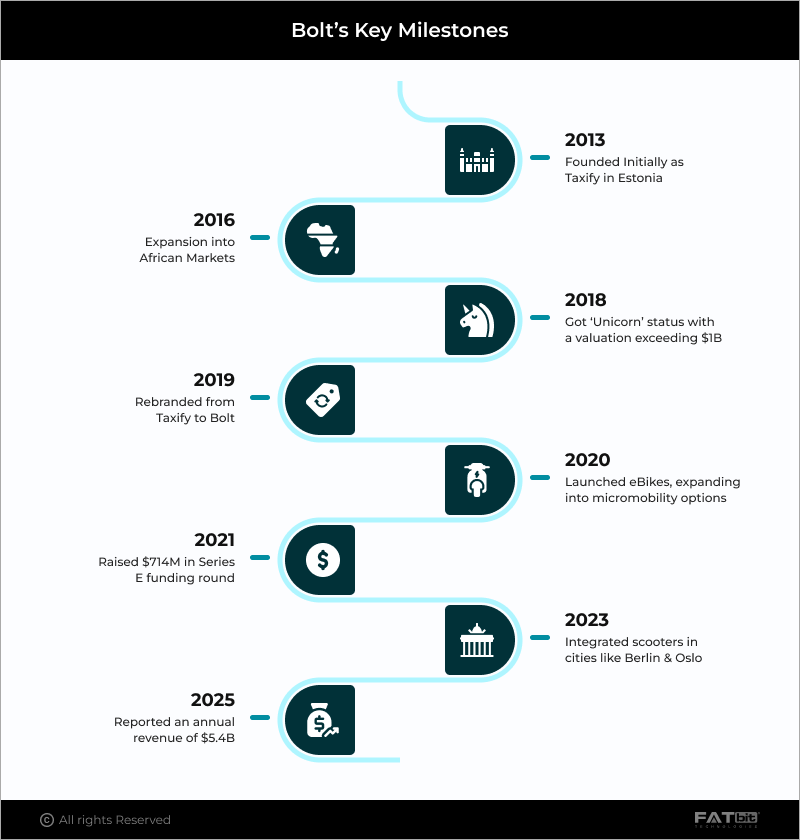
Bolt is one of the fastest-growing ride-hailing apps in the world, offering services that span far beyond just transportation. Founded in 2013 by Markus Villig in Estonia, Bolt (formerly known as Taxify) began as a local solution to meet the transportation needs of smaller European cities. The platform quickly gained popularity due to its affordability and simplicity, rapidly expanding its operations beyond Estonia.
Over the years, Bolt has grown into a global brand, now operating in more than 45 countries and 600 cities worldwide, serving millions of customers daily. The company’s evolution is marked by its strategic adaptability and constant innovation. What started as a standard ride-hailing app has expanded to include additional services like offering e-scooter rentals for eco-friendly options.
In the course of time, the company has raised $1.98B in total of 14 rounds, associating with 7 legal entities. Ultimately, Bolt’s holistic approach to mobility, paired with its competitive pricing model, has positioned it as a key player in transforming urban transportation across the globe.
Bolt’s Primary Services
Ride-hailing: Bolt’s core service connects riders with drivers for convenient, affordable, and quick trips within cities. It offers a wide variety of vehicle types, from budget-friendly rides to premium options, catering to varied user preferences.
E-scooters and E-bikes: In response to the growing demand for sustainable transportation, Bolt has expanded into electric scooters and bike rentals, allowing users to navigate shorter distances in eco-friendly ways.
Corporate Travel: Provides businesses with a centralized corporate account, allowing them to manage transportation for their employees or clients efficiently and cut travel costs significantly.
A well-defined business model is crucial for the success of any ride-hailing app like Bolt. Taxi apps like Bolt connect riders with drivers via a digital platform, offering on-demand transportation services with efficiency and convenience. The core business model revolves around facilitating these connections and generating revenue through commissions, service fees, and additional value-added services. Typically, a Bolt clone app consists of three primary interfaces that work collaboratively to create a seamless experience for all stakeholders:
1. Rider App: Enables users to effortlessly schedule rides by entering their pick-up/drop-off points, selecting their desired vehicle type and preferred payment option.
2. Driver App: Alerts drivers for nearby ride requests and allows them to accept/decline those rides based on their preferences. They can access detailed ride information, navigate to pick-up sites, and effectively monitor their earnings through the app.
3. Admin Panel: The admin panel offers complete visibility into all activities involving riders and drivers, including ride monitoring, transaction oversight, and customer support. This ensures efficient operations and allows for quick resolution of any issues that may occur.
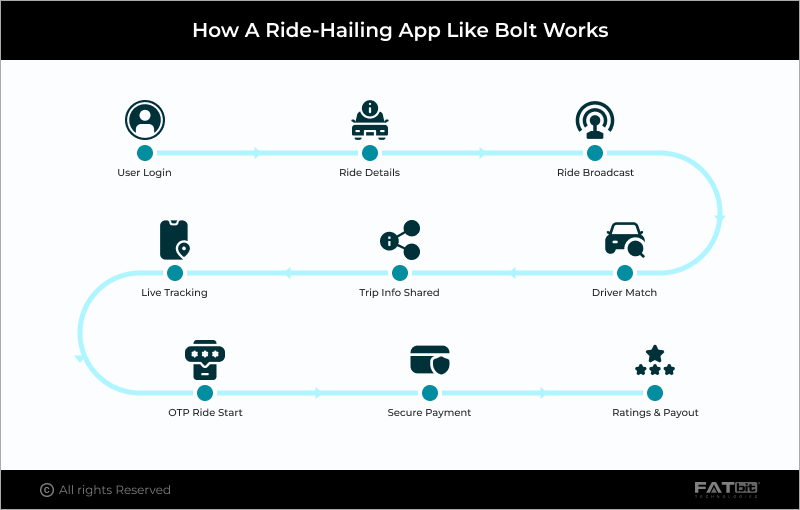
Here’s how a ride-hailing app like Bolt works:
User signs up or logs in on the app and requests a ride by entering the essential details like pick-up/drop-off locations or desired vehicle type.
The system broadcasts the ride request to the nearby available drivers, allowing them to accept/decline based on their operational availability and preferences.
Once a driver accepts the ride request, both stakeholders receive each other’s essential information, including real-time location tracking and ETA updates.
The driver drives to the pick-up location and initiates the ride with a unique OTP shared by the passenger.
Upon ride completion, the passenger makes the payment via the chosen payment method.
This payment is transferred to the driver’s digital wallet after deducting the platform commission.
Both parties are then encouraged to share ratings and honest reviews to enhance the transparency and service quality on the ride-hailing app.
Why Businesses Should Invest in a Bolt Clone App Development
Building a ride-hailing app like Bolt exhibits many advantages, from a lean, scalable business model to maximizing revenue potential, and the list goes on. Here are a few key benefits of building a ride-hailing app like Bolt:
1. Accelerating Market Growth: The ride-hailing industry continues to see a significant market surge, propelled by the increasing smartphone penetration and shifting consumer preferences for convenient, affordable transportation options. This presents an accelerated market opportunity to build an app like Bolt and establish a strong presence in the market.
2. Proven Business Model: A Bolt clone app offers a proven, established and tested pathway to build a ride-hailing app, eliminating the risks associated with making a new beginning. This provides you with insights into strategies to follow or things to neglect for a profitable business venture.
3. Competitive Business Advantage: The lean operating model and minimized overhead pose a significant competitive business advantage for businesses to build a ride-hailing app like Bolt. You can build a widely-recognized, everyday-use brand, boosting business value, customer retention and investor interest.
4. High Revenue Potential: Revenue channels in a ride-hailing app stretch far beyond ride commissions. Bolt-like ride-hailing apps employ multiple revenue channels such as memberships, advertising, partnerships, surge pricing and the possibilities are endless, presenting high revenue potential and maximizing business profitability.
5. Improved User Convenience: Modern ride-hailing apps offer a tailored, personalized user experience to passengers that surpasses traditional transportation options. From instant ride needs and advanced bookings to package deliveries and airport transfers, modern ride-hailing apps offer added user convenience, creating a highly convenient transportation ecosystem.
With the global ride-hailing industry projected to reach a market volume of $212.80 billion by 2029, there are substantial opportunities to enter this market. To succeed in this competitive landscape, a ride-hailing app like Bolt must offer a robust set of features that cater to both riders and drivers while ensuring effective management through the admin panel. Below is a detailed breakdown of essential features required for successful Bolt clone app development:
Rider App Features:
Ride Sharing:
Allow passengers heading in the same direction to share rides and split travel costs between them, providing affordable ride options for passengers while empowering a more sustainable ecosystem.
Quick and Easy Login
Implement seamless login options, such as OTP verification, phone number logins, or integration with social media accounts. This simplifies the onboarding process and enhances user retention by allowing quick access to ride booking.
Ride Scheduling
Facilitate easy ride bookings by guiding users through a straightforward process that includes essential information like pick-up and drop-off locations, preferred vehicle types, and payment methods.
Ride Bidding
Enable riders to propose fare offers directly to drivers, allowing for price negotiations. This feature empowers riders to select rides that align with their budget preferences, resulting in significant cost savings and heightened user satisfaction.
Real-time Tracking
Offering precise GPS tracking ensures that riders can easily monitor their driver’s real-time location, the chosen route, and the Estimated Time of Arrival (ETA), providing a sense of security and convenience.
Fare Estimation
Incorporate an intuitive in-app fare estimator that helps riders gauge the cost of their trip before booking. This promotes transparency and allows riders to make informed decisions.
Easy Payment
Simplify the payment process by integrating multiple options, such as credit/debit cards, digital wallets, and cash. This ensures a quick, convenient, and hassle-free transaction experience for all riders.
SOS
Enhance rider safety with a dedicated in-app SOS feature that allows them to send immediate alerts to their emergency contacts. The alerts include vital ride details with real-time location tracking, providing an added layer of security and peace of mind during their journeys.
Driver App Features:
Easy Registration & Verification
The onboarding process should be straightforward and seamless. The registration process must include minimal steps with clear guidelines for providing necessary documents. Also, verification of documents must be streamlined for both speed and accuracy to prevent delays in onboarding.
Availability Sign In/Out
Implement a sign-in/out toggle that allows drivers to manage their work hours effortlessly. This provides them more flexibility in work hours, making it easier to manage schedules. Ultimately, enhancing driver retention by promoting a more flexible and driver-friendly work environment.
Ride Requests and Management
Enable drivers to view and manage ride requests in real time. Drivers can accept or decline ride requests based on their availability, location, and preferences, improving efficiency and user experience.
Advanced Navigation and Route Optimization
Integrate advanced navigation tools to help drivers efficiently navigate to pick-up and drop-off locations. Optimized routes can help drivers choose the quickest and most efficient path, reducing travel time and increasing customer satisfaction.
Initiate Payout
Allow drivers to request payouts anytime, giving them more control over their earnings. This increases driver satisfaction, especially for those who rely on daily cash flow, making your app more attractive to potential drivers.
Ratings & Reviews
Enable drivers to provide feedback for every ride by rating the rider and overall ride experience. This feature will help maintain quality service by promoting positive behavior and maintaining a high standard of service across the app.
Subscription Plans
Offer optional subscription packages to drivers at an additional cost that provide benefits such as reduced commission rates or exclusive services. These plans incentivize drivers to stay with the platform by offering cost savings through tiered membership options.
Admin Panel Features:
User Management
The admin panel should include a centralized dashboard for managing both driver and rider accounts. This includes approving new driver applications, verifying uploaded documents, and handling any necessary account maintenance.
Vehicle Listings and Management
Allow the admin to configure various vehicle types. Enable them to set different pricing structures, commission rates, peak-time surcharges, and cancellation fees for each vehicle category to better serve diverse rider needs.
Geo-Fencing
Implement geo-fencing capabilities to define operational areas for your service. This enables the admin to restrict or allow ride requests within certain geographical areas, improving service efficiency and coverage.
Manual Ride Booking
Empower the admin team to book rides manually, catering to customers who might be facing internet connectivity issues or may not have access to smartphones. This feature ensures inclusivity and accessibility to all user demographics.
Commissions Management
The admin should be able to track and manage commissions earned from each completed ride. This feature helps streamline revenue generation and allows the admin to adjust commission structures as needed for various vehicle categories.
Subscription Order Management
Allow the admin to manage driver subscription plans, including details such as pricing, renewals, expirations, and payments. This tool ensures smooth subscription management and can automatically notify drivers for upcoming plan renewals.
Reports & Analytics
Provide detailed reports and analytics based on user data and operational insights. The admin can thus use this data to identify top-performing areas of the business and make data-driven decisions to improve service, efficiency, and profitability.
Strategic Steps on How to Build a Ride-Hailing App Like Bolt
Developing a profitable & scalable ride-hailing app like Bolt demands strategic planning, operational resilience and future-ready technology. Here’s a detailed step-by-step process for anyone who is aiming to build a Bolt clone app:
1. Conduct Thorough Market Research
Begin with thorough market research to identify customer pain points and industry trends. Analyze existing ride-hailing solutions to understand user preferences and challenges.
Gather insights on competitors, focusing on their strengths and weaknesses. Review their pricing models, service quality, and technological innovations. Understanding these insights will help you strategically position your Bolt-like app, define your unique selling proposition (USP), and develop features that set your app apart.
2. Define Your Unique Selling Proposition
Differentiating your Bolt clone app is essential to stand out in the ride-hailing industry. To attract both drivers and riders, your ride-hailing app must offer something unique that sets it apart from the competition. Consider offering:
Lower commission rates for drivers, which could increase your supply of vehicles.
Advanced safety features such as SOS buttons or background-verified drivers.
Specialized ride options that address niche markets or specific demographics. Some potential niches may include luxury ride-hailing, ride-sharing, airport transfers, corporate transportation or eco-friendly options such as on-demand electric taxis or eBikes.
3. Select Your Niche
Choosing a distinct niche serves as a foundation for a successful Bolt clone app development, as it defines the market segment you intend to serve and differentiates your service from competitors. Here are the crucial elements to consider when selecting your niche:
Conduct thorough market research to understand current trends, user needs, and existing competitors in the ride-hailing space.
Define your target audience based on demographic factors such as age, income level, and lifestyle.
Think creatively about how to enhance the user experience. This could involve developing unique features that set your app apart or personalized ride options based on user preferences.
Finally, decide on the types of services you will offer. Beyond standard rides, you could include options like taxi booking, bike booking, shuttle service, corporate rides, and more.
4. Define Monetization Strategy
A well-thought-out monetization strategy is crucial for the sustainability of a ride-hailing app like Bolt. Determine how the app will generate revenue. Consider the following revenue models to generate revenue:
Commission-Based Model: Earn a percentage from each ride booked through your ride-hailing app.
Subscription Services: Offer users premium services or drivers discounted commissions for a monthly or yearly fee.
In-App Advertising and Partnerships: Generate revenue through targeted ads and partnerships with local businesses.
Surge Pricing: Implement dynamic pricing during peak demand times to maximize revenue.
Loyalty Programs: Encourage repeat usage by offering rewards and incentives for frequent riders.
Carefully understanding these revenue models is thus crucial for enhancing the profitability of the Bolt clone app.
Launch a Fully-Equipped Bolt Clone App with Vast Revenue Potential
The development phase is critical in determining the future scalability and performance of your ride-hailing app like Bolt. There are two key approaches when it comes to building a ride-hailing app, Custom Development and Readymade Software, each having its own advantages and considerations.
Custom Development
Custom Development involves building a Bolt clone app from scratch, tailored to your unique requirements. Custom development ensures maximum control over every aspect of the app, including its design, functionality, and user experience. However, it also comes with higher costs and longer development timelines.
Readymade Software
Alternatively, opting for readymade software enables you to build a ride-hailing app like Bolt more swiftly and cost-effectively. These solutions come pre-built with core features and functionalities required for a successful Bolt clone app development. With pre-integrated features, readymade software allows for a faster launch with reduced investment.
Parameters
Custom Development
Readymade Software
Development Cost
Requires a significantly higher investment
Eliminates the custom development costs by up to 5 times
Efforts
Necessitates a skilled development team
No coding knowledge required, eliminating any technical complexities
Timeline
Longer, several months to a year or more, due to planning, designing, coding and testing
Faster, can be launched in a few days or weeks, as they’re pre-built and ready to use
Control
Complete control with additional obligations to update the software with the evolving needs
Varies on the chosen software type. While self-hosted software offers full control over data & operations, SaaS solutions may imply certain restrictions
Ownership
The business reserves full ownership
Self-hosted software provides lifetime ownership, whereas access is tied to an ongoing subscription in SaaS solutions
User Experience
Built to your unique requirements from scratch, requiring a significant investment and time
Can be rebranded to your business vision and requirements in substantially less cost and time
Scalability
Built-in scalability, but comes at an additional cost of updates and maintenance
Depends on the service provider. Self-hosted ride-hailing software like VivoCabs offers enterprise-level scalability, allowing effortless global expansion
Risks
High risk of inaccurate estimates, scope creep, project delays, bugs, operational downtime and budget outruns
Lower due to a tried-and-tested, proven solution, rigorously tested for performance.
Given the complexity and cost associated with developing a ride-hailing app like Bolt from scratch, leveraging readymade software solutions has thus become a practical and popular choice now. Such software solutions offer a variety of features that can expedite the Bolt clone app development process and eliminate hefty costs associated with custom app development.
6. Configure the Bolt Clone App
Once the ride-hailing app like Bolt is developed, it is essential to configure the app to your unique branding, policies and market differentiation. In order to create maximum value, it’s crucial to set up the ride-hailing app, including:
Configuring the policies of usage
Adding vehicle categories
Setting geographical boundaries
Adding discounts & referral policies
Implementing commissions
Establishing varied subscription packages
This helps you define a unique value proposition on the market and establish distinct rules that define your Bolt clone app, providing maximum value.
7. Launch and Market the Ride-Hailing App
Upon configuring the taxi app like Bolt, the next step is to launch and market. This involves deploying the app to app stores (like Google App Store or Apple App Store) and ensuring it is ready for public use. However, it’s advisable to test the app for any bugs or errors before launching in order to ensure the app remains reliable and technologically resilient. Furthermore, it’s essential to launch the app with a well-planned marketing strategy, optimizing the app for SEO, targeted marketing campaigns and content strategies. Offer reduced commissions to drivers and incentivize customers for early adopters.
In addition to this, utilize robust analytics and reports to leverage robust information-driven insights for app performance, user behaviours and earnings. Lastly, keep engaging with users and gathering relevant reviews for continuous improvement.
How to Select the Right Ride-Hailing Software for Your Bolt Clone App?
Amidst a sea of competitors, it is essential to conduct thorough research to identify and find the right software that best aligns with your specific business requirements. Thus, after identifying potential software solutions, conduct a detailed evaluation based on the following factors:
Credibility:
Evaluate the credibility of the shortlisted software solutions, consider the company’s reputation and history, client testimonials, and case studies. Check for industry certifications and compliance with standards. Positive client feedback and a solid track record enhance the software’s trustworthiness and reliability.
Pricing:
Analyze the pricing structure of each solution. Consider not just the upfront costs, but also ongoing expenses such as maintenance, upgrades, and transaction fees. Determine which options fit within your budget while still meeting your operational needs.
Cost-Benefit Ratio:
Assess the value provided by the software in relation to its cost. This includes considering features, support, and scalability. A solution that appears expensive may offer greater long-term value through enhanced capabilities and reliability.
Scalability:
Ensure the software can scale alongside your business. As your user base grows, your Bolt clone app will need to accommodate increased demand without compromising performance. Verify that the solution can support additional features and users seamlessly.
Customization:
Every business has unique needs, and your ride-hailing app like Bolt also requires specific features to meet those demands. Evaluate how customizable each software solution is. The ability to tailor features, branding, and workflows to suit your business will be crucial in maintaining a competitive edge.
Free Demos and Trials:
Many software providers offer free demos and trials, allowing you to test their software before committing. Utilize these opportunities to gain hands-on experience with the software and evaluate the software’s functionality, user interface, and overall performance.
Customer Support:
Reliable customer support is essential for addressing any issues that may arise during implementation and beyond. Evaluate the level of support provided by each vendor, including response times, availability, and the quality of technical assistance.
Best Ride-Hailing Software to Build a Bolt Clone App
Although there are several ride-hailing solutions available in the market, VivoCabs emerges as an ideal software solution for a successful Bolt clone app development. More than just a Bolt clone app script, VivoCabs is a complete ride-hailing software that integrates all the essential and advanced features to launch a ride-hailing app like Bolt. Designed with precision, it caters to the unique requirements of all stakeholders and is available for both Android and iOS platforms.
By utilizing VivoCabs, businesses can serve diverse segments—be it taxi booking, car rentals, shuttle service, or eco-friendly options like on-demand electric taxis—through a single software. Thus, increasing their customer base while offering a convenient and all-inclusive service. Moreover, the software provides an efficient and ready-to-deploy approach to build a ride-hailing app like Bolt that is fully flexible and reflects your unique value proposition.
Following are some of the various benefits that VivoCabs offers to business owners:
White Label Solution
Source Code Ownership
Extensive Customization and Scalability
No Recurring Charges
Lifetime License at a One-Time Upfront Cost
1 Year of FREE Technical Support Post-Sale
Request a Free Demo Session to Explore VivoCabs Firsthand
Building a ride-hailing app like Bolt necessitates a strategic approach that encompasses thorough market research to identify opportunities for market differentiation. Defining your unique value proposition is essential for standing out in this competitive landscape, followed by choosing between the right development approach, whether custom development or readymade software, as it will significantly impact your budget and timeline. Thus, it is essential to evaluate available solutions carefully to ensure they align with your business goals. By leveraging proven software solutions like VivoCabs, you can enhance user experience and streamline operations, ultimately setting the ride-hailing app on the path to success.
FAQs
Q 1. Which is the right approach to Bolt clone app development: Custom Development or Readymade Software?
Ans. Utilizing a readymade ride-hailing software to build an app like Bolt serves as the best foundation, as it eliminates the lengthy development cycles and costs associated with building an app from scratch. Additionally, they are proven, tried-and-tested software that eliminates any risks and allows businesses to launch a fully functional taxi app like Bolt, with enterprise-level scalability and customizability.
Q 2. How much does it cost to build a ride-hailing app like Bolt?
Ans. The estimated cost for Bolt clone app development largely depends on the development approach that you choose and any specific business requirements. While custom development may incur anywhere around $20,000 to $500,000, readymade software solutions range from $1,500 – $15,000 only. This allows businesses to eliminate the hefty costs associated with custom development and launch a ride-hailing app like Bolt cost-effectively while remaining relevant and reflecting a unique value proposition.
Q 3. How long does it take for Bolt clone app development?
Ans. Where launching a ride-hailing app like Bolt with custom development takes anywhere from 6 months to 1 year+, readymade software eliminates these lengthy development cycles and thus allows businesses to accelerate their market entry and start capitalizing on the market trend quickly.
Q 4. Which is the best software to build a ride-hailing app like Bolt?
Ans. Despite the many alternatives in the industry, VivoCabs stands as the best ride-hailing software to build a ride-hailing app like Bolt. VivoCabs is more than just a Bolt clone app script, it’s a complete ride-hailing solution that allows businesses to tailor the app to their unique business demands. It is a self-hosted software that offers a lifetime license at a one-off purchase, providing complete control and ownership over your Bolt-like app.
All innovation starts with an idea to solve real-world problems. At FATbit Technologies we are passionate about driving digital transformation to prepare businesses for a digital-first tomorrow. Let’s discuss your BIG idea NOW.
Disclaimer: The Blog has been created with consideration and care. We strive to ensure that all information is as complete, correct, comprehensible, accurate and up-to-date as possible. Despite our continuing efforts, we cannot guarantee that the information made available is complete, correct, accurate or up-to-date. We advise - the readers should not take decisions completely based on the information and views shared by FATbit on its blog, readers should do their own research to further assure themselves before taking any commercial decision. The 3rd party trademarks, logos and screenshots of the websites and mobile applications are property of their respective owners, we are not directly associated with most of them.
Tanya is a seasoned business consultant at FATbit Technologies. Keen to explore emerging e-commerce trends and insights, Tanya spurs entrepreneurs and business owners with creative ideas to build strategic marketplaces. Her writings provide practical perspectives on e-commerce industry development, aimed at professionals seeking to navigate the digital landscape. Beyond writing, she loves to travel and refine her skills in content strategy.