The food delivery landscape is rapidly changing, with consumers preferring to order online and get their food delivered to their doorstep without the hassle of visiting the restaurant. This change has also led to an increase in the usage of mobile apps for enhanced customer convenience in ordering food on the go.
According to Statista, the online food delivery market is expected to reach US$1.39 trillion in 2025 with an annual growth rate of 7.64% from 2025-2030. The market volume is projected to be around US$2.02 trillion by the end of 2030.
These numbers create a sense of urgency for restaurants and aspiring entrepreneurs to seek food delivery app development software that aligns with their food delivery business goals, enabling them to create an online food ordering and delivery app with minimal upfront costs. However, understanding the nuances related to food delivery software and knowing which is best for building a restaurant delivery app is important.
This blog provides facts and insights about building a food delivery app with the help of readymade restaurant delivery software, empowering entrepreneurs to enter the market in no time. The blog will further delve into the best delivery apps used by the majority of users, the essential features of an app, and how readymade software is ideal build a restaurant app.
Types of Restaurant Delivery Apps
Food delivery apps are generally categorized according to business models, each designed to cater to specific user requirements and restaurant business needs. Majorly, three types of apps having huge demands are stated by the industry experts as discussed below.
1. Aggregator Apps
These apps connect multiple restaurants with customers, allowing buyers to explore various options for food delivery and for merchants to handle the food packaging and delivery services. They usually follow an order-with-delivery business model.
Examples of Food Delivery Apps: Uber Eats, Grubhub
2. Full Stack Restaurant Apps
Often known as single-vendor food delivery apps for restaurants, it allows the business owners and entrepreneurs complete control over everything from food preparation to its delivery to the customer. Additionally, the owners can customize their UI/UX and branding as per the industry’s needs. The app works on a full-stack business model.
Examples of Food Delivery Apps: McDonald’s, Dominos
3. Logistics Support Apps
These apps support restaurants by handling the crucial delivery process and managing the logistics process through their delivery network or hiring third-party delivery services. Additionally, these apps enable real-time tracking and communication between restaurants and buyers. It follows an order-only business model.
Examples of Food Delivery Apps: Postmates, DoorDash
Want To Start Your Food Ordering And Delivery App
Top Restaurant Food Delivery Apps
Demand for food delivery apps for restaurants is on the rise, and before stepping into the market, it is important to know about the competitors. The list below presents the top players dominating the food delivery app market.
1. UberEats
It is an online food ordering and delivery app connecting customers with a wide range of local restaurants registered on the platform. It allows users to browse through the list, place orders, and track food deliveries in real-time. The restaurant food delivery app utilizes Uber’s existing infrastructure and delivery network to facilitate food deliveries to customers’ doorsteps.
Key Information:
- Founded In 2014
- Founder: Garret Camp, Trans Kalanick
- HQ: US
- App Downloads: 100,000,000+ downloads
2. Doordash
It is the top restaurant food delivery app in the world, bridging the gap between customers and restaurants, allowing users to order food and get it delivered to their doorstep without any hassle. The app offers built-in features and functionalities, offering a seamless workflow for each user. Additionally, Doordash benefits food delivery app owners by helping them expand their market reach by using certain marketing tools.
Key Information:
- Revenue: US$10.72 billion
- Founded In: 2013
- Founder: Tony Xu, Andy Fang, Stanley Tang
- HQ: US
- App Downloads: 50,000,000+ downloads
3. Grubhub
It is one of the leading players in the food industry, offering industry-leading restaurant food delivery services to its users. Grubhub prioritizes exceptional customer service by providing an easy-to-use restaurant delivery app with intuitive navigation and personalized recommendations to its customers, creating a better meal delivery experience for the users.
Key Information:
- Revenue: US$2.1 billion
- Founded In 2004
- Founder: Matt Maloney, Mike Evans
- HQ: US
- App Release: 2021
- App Downloads: 10,000,000+ downloads
4. Deliveroo
It is a leading player in the online food delivery market in the UK. Deliveroo empowers restaurant owners to set up their very own online delivery-only kitchens, specifically targeting newer areas to expand their customer base. The app provides timely reports to restaurants highlighting the current food and recipe trends to bring people the food they love to their doorsteps.
Key Information:
- Revenue: US$2.5 billion
- Founded In: 2013
- Founder: Will Shu, Greg Orlowski
- HQ: UK
- App Downloads: 10,000,000+ downloads
Want To Build A Restaurant Food Delivery App Like Doordash
How Food Delivery Apps for Restaurants Generate Revenue
Restaurant food delivery apps use various monetization strategies to earn revenue, contributing to their businesses’ overall financial growth. Some of the streams are discussed below.
- Commission from Restaurants: The admin charges a specific percentage of fees on every order placed on the food delivery app.
- Sponsored Listing and Promotion: Admins can deduct a certain amount from the merchants who wish to promote their products via banners, offers, and discounts on the platform.
- Delivery Fees: Admins can charge both vendors and customers a certain amount for their orders. Vendors pay if they opt for their delivery partners, and customers pay based on their order quantity, order time, and radius of delivery.
- Subscriptions: Restaurant delivery app owners can enable subscription packages for vendors who want to sell their products on the platform. Admins can also offer subscription packages to customers who want to avail of special offers, discounts, and premium features of the mobile app.
- Surge Pricing: Some mobile app owners tend to increase the prices of food and recipes and limit the choice of restaurants at particular hours for customers. It helps the owners earn extra money and regulates a surge in demand.
- Third-Party Advertising and Cross-Sell: Third parties pay a certain price to run their advertisements and promotional offers on the app, benefiting the users, while the restaurant delivery app owners earn passive income.
Must-have Features for Building a Profitable Restaurant App
Understanding users’ point of view and their needs is necessary to build an impressive and efficient restaurant app. Even though the implementation of certain features depends on the entrepreneur’s business requirements, the features provided below are crucial to ensure a smooth workflow. Below is the list of features for each user.
For Customers:
Entrepreneurs can build restaurant app for customers, keeping in mind the user-centric features that allow buyers to easily browse, select, order, and make payments without any hassle.
- User-Friendly Interface: Offers customers a clean and intuitive app design that is easy to navigate and interact with.
- Restaurant Search and Filtering: Enable customers to seamlessly find restaurants and cuisines with smart search filters using specific keywords.
- Multiple Payment Options: Allow customers to use secure payment gateways and multiple payment options, ensuring a smooth checkout process.
- Real-Time Order Tracking: Updates customers about their delivery partners, the current location of their order, and the estimated time of delivery.
- Ratings and Reviews: Customers can provide feedback and ratings for food and restaurants. Merchants can implement the same to improve their services.
For Merchants:
To successfully build a restaurant app for merchants and restaurants, it is crucial to include features that complement its business model as well as cater to challenges faced by vendors. The following features are proven to streamline the work process and restaurant management, enhancing the user experience.
- Easy Registration: Allows merchants and restaurants to easily register and sign up themselves as partners on the app using a one-click method to avail of the services.
- Order and Menu Management: Restaurants can manage their order as well as add, edit, and update menu items, prices, and availability.
- Delivery Tracking: With real-time tracking, merchants can track order status and delivery staff while maintaining a smooth workflow.
- Loyalty Program: Restaurants can offer loyalty rewards, offers, and deals to customers to increase loyalty and user engagement.
- Review Management: Merchants can check and respond to user reviews and suggestions as well as implement the same for the future.
For Delivery Staff:
Create a restaurant food delivery app for delivery personnel while focusing on efficiency, ease of use, driver safety, and route optimization for timely order delivery. Some of the essential features to include are as follows.
- Login and Registration: Enables delivery staff to register and login to the app, allowing them to customize and manage their profile.
- Order Assignment: Delivery staff can check the orders assigned and can accept or reject them as per their availability.
- GPS Tracking & Route Optimization: In-built GPS technology allows delivery partners to complete order deliveries in less time with proper route optimization.
- Real-Time Payment Tracking: Allows the delivery personnel to monitor earnings, transactions, payment withdrawals, and ensure effective wallet management.
- Order Status Update: Delivery staff can use this feature to provide updates in real time about the order, whether it is picked up, on the way to delivery, delayed, or delivered.
For Admins:
A well-built and designed restaurant food delivery app provides crucial features for the admins to oversee app operations, monitor and manage resources, and effectively enhance the user experience.
- Admin Dashboard: Essential for admins to handle their restaurant business logistics and operations effectively.
- User Management: Admins can manage customer, merchant, and delivery driver accounts.
- Restaurant Management: The owners can add or remove restaurant partners, approve listings, and manage their commissions.
- Define Radius: Allows the admin to define the area they want to serve as per the demographics report.
- Offers/ Deals Management: Admins can manage and notify repeat customers about deals, offers, loyalty rewards, discounts, and more.
Explore More Exemplary Features Of A Restaurant App
The above-mentioned features are the key aspects for making your restaurant food delivery app exceptional and powerful to attract potential customers. After the selection of features, it is time to decide on the development approaches an entrepreneur can leverage to build their food delivery app. The next section will outline the two major development approaches, with factors determining the ideal approach.
Different Development Approaches: How Readymade Software is an Ideal Option
The two major options that are widely opted for are either building an app from scratch using custom development or going for readymade software to quickly enter the market. The following context describes the two approaches.
1. Custom development: Opting for custom app development requires hiring a team of expert developers and designers from third-party organizations by the entrepreneurs. Due to the deployment of outside resources, the cost of development varies and is usually expensive. Additionally, the time to build and launch the restaurant app in the market can range from 6 to 12 months or even a year. Though entrepreneurs have flexibility and customization control, it is usually not a suitable choice for those lacking the necessary resources.
2. Readymade restaurant delivery software: A readymade restaurant delivery software is pre-built with industry-specific features and functionalities, allowing entrepreneurs to launch their restaurant food delivery app easily. Compared to custom food delivery app development, a readymade software is proven to be a cost-effective option with a deployment time of a few weeks. A readymade software is a customizable and scalable solution, with pre-integrated capabilities and a proven industry success record, suitable for entrepreneurs with no technical expertise.
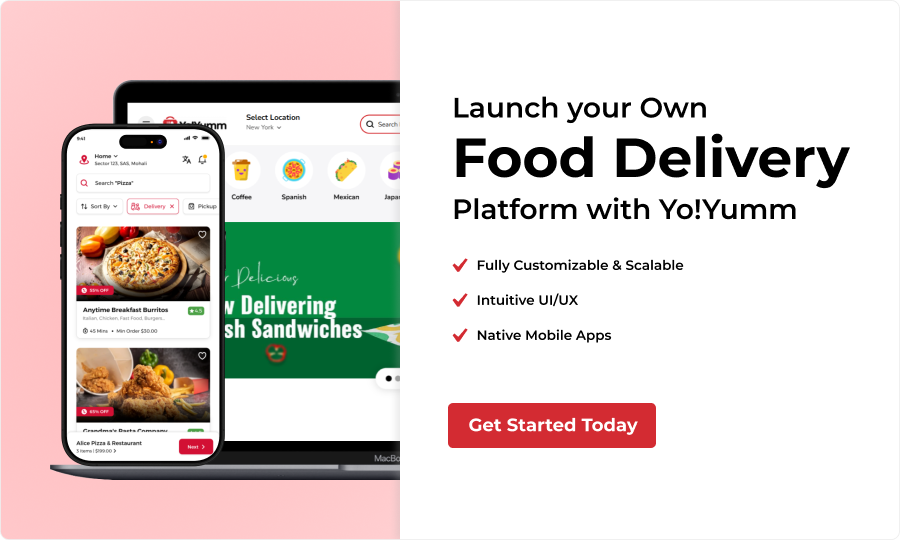
The food delivery industry also has plenty of options, out of which Yo!Yumm, a restaurant food ordering and delivery software by FATbit Technologies, is one such turnkey solution that enables restaurant owners to create their restaurant delivery app without any hassle.
Why a Readymade Restaurant Delivery Software is Ideal for Restaurant App Development
After a clear understanding of the given approaches, it is evident that a readymade software is a better option than custom development to easily build a restaurant app hassle-free and in no time. If there are still nuances that are not clear, the table below highlights some more factors differentiating between the two approaches.
| Factors |
Custom Development |
Readymade Software |
| Cost-Effectiveness |
Expensive |
Low Upfront Costs |
| Time-To-Market |
6–12 months or 1 year |
Few Weeks |
| Proven Reliability & Stability |
Not Tested |
Industry Tested |
| Resources Required |
Extensive Resources |
Minimum or No Resources |
| Integrations |
Need to Integrate |
Pre-Integrated |
| Comprehensive Features |
To Be Added |
Built-In |
| Dedicated Support |
Not Provided |
Provided |
| Operational Risks |
Occurs Frequently |
Reduced or No Risks |
Create Your Restaurant Food Delivery App With Readymade Software
Build a Restaurant App with a Readymade Solution
As is clear from the above section, opting for a readymade software is much better and a safer option than expensive custom development. However, readymade software further includes various types, out of which the two commonly used software are SaaS and Self-Hosted. To decide which one is the best out of the two, understanding both individually is necessary. This section delves into the details of the two software with pros and cons to ultimately help entrepreneurs decide.
1. SaaS Software:
It refers to a software, hosted on the cloud or software provider’s server, and opting for this software requires an entrepreneur to pay monthly or annual subscription fees to avail of the services provided. It may provide ease of use and automatic updates, but it limits the customization, control, speed, security, and more. Thus, SaaS software is usually recommended for small businesses or solo entrepreneurs.
Pros
- Cloud Hosted: Eliminates the need for entrepreneurs to manage their own server infrastructure.
- Easy Deployment: Quick implementation allowing entrepreneurs faster time-to-market.
- Tried and Tested: Undergone rigorous testing offering reliability, reduced risks and seamless user experience.
- Easily Accessible: It is accessible from anywhere with an internet connection, and offers easy to use and navigate app interface to the users.
Cons
- No Data & Source Code Ownership: Entrepreneurs do not have complete control over data and source code, limiting customizations and scalability.
- Annual or Monthly Payments: Required to pay recurring charges to continue using software perks which can increase overtime.
- Limited Customizations: Comes with fewer customization options, restricting the ability to modify the app as per entrepreneur’s unique needs.
- Less Flexible & Scalable: With the increase in the number of users and workload, the cost to incorporate it all increases for entrepreneurs.
- Less Secure: The app relies on software provider for security measures which can expose the app to data breaches, unauthorized access, and potential theft.
- Expensive: The cost increases with the implementation of industry specific features and functionalities.
2. Self-Hosted Software:
On the other hand, self-hosted software does not require recurring subscription fees and can be purchased by paying a one-time cost. It offers the freedom of selecting a hosting server as per the entrepreneur’s restaurant business requirements. As compared to SaaS solutions, self-hosted software offers full control, scalability, customization, complete data, and source code ownership with a lifetime license.
Pros
- No Recurring Charges: Entrepreneurs need to make one time payment to acquire and use the software to build a restaurant food delivery app.
- Customizable: Allows entrepreneurs to customize and adapt the app as per their needs without any limitations.
- Highly Secure: The software comes with pre-integrated advanced security features providing greater control over sensitive data and enhanced privacy.
- Reliable: Offers high-quality performance without any technical issues, offering minimal downtime.
- Flexible & Scalable: Ability to handle increased workload and onboard new users without affecting the app performance.
- Industry Tested: Proven efficiency and credibility of the software in real-world applications.
- Lifetime License: One time payment allows entrepreneurs to gain complete access or lifetime license of the software.
- Source Code Ownership: Complete control over the source code allows entrepreneurs to customize the aspects of their restaurant app.
- Cost-Effective: No recurring charges or monthly subscription fees needs to be paid to use the software services.
Cons
- Hosting Server Required: Entrepreneurs need to manage their own server infrastructure to run the software.
- Technical Expertise Required: Running self-hosted software requires a certain level of technical expertise to manage the server, security, and troubleshooting.
Yo!Yumm: A Readymade Software Solution to Build a Resaturant App
The search for the best restaurant food delivery app development solution ends here. Developed by experts at FATbit Technologies, Yo!Yumm is a versatile, 100% white label food delivery software designed to help restaurant owners and aspiring entrepreneurs launch their multi-restaurant food delivery app. It is a self-hosted software with in-built industry-specific features and functionalities that provide end-to-end management tools for its users, ensuring seamless operations and workflow.
It supports multiple business models and caters to 10+ niches, including fully functional mobile applications for merchants, buyers, and delivery staff. Additionally, the software offers customization options to admins to improve and scale the app according to their requirements.
Key Benefits of Yo!Yumm
- Self-hosted software
- 100% white label
- Flexible and scalable
- Customizable
- Complete source code ownership
- One-time payment, Lifetime license
- Free Personalized demo
- Integrated API’s
- 1 Year of free technical support
- GDPR Compliant
Case Study
Yo! Yumm Helped A UK-Based Client To Launch A Restaurant Food Delivery App
FreshEats: Powered by Yo!Yumm, it is an online food ordering and delivery app connecting local restaurants with customers in the UK. It aims to offer a seamless food delivery experience by allowing customers to choose from their favourite restaurants and get it delivered to their doorsteps while creating opportunities for their partners to earn money. The app also includes features such as order tracking, subscription offers and discounts, order scheduling, and multiple payment methods to make the user journey hassle-free.
Read more about FreshEats.
By choosing Yo!Yumm, entrepreneurs gain powerful, flexible, and cost-effective restaurant delivery software to build and scale their restaurant app, to compete effectively in the dynamic online food delivery market.
Build A Feature-Rich Restaurant Food Delivery App With Yo!Yumm
Conclusion
The online food delivery market is growing day by day, presenting a significant opportunity for restaurant owners and entrepreneurs to meet the industry’s demands. Building a restaurant app no longer requires huge investments, extensive resources, or technical expertise. With readymade restaurant delivery software like Yo!Yumm, entrepreneurs can launch a feature-rich, scalable, and fully functional restaurant app in just a few weeks with low upfront costs. By leveraging the power of a readymade app, entrepreneurs can expand their reach, enhance customer experience, and stand out from their competition.
FAQ’s
Q 1. How much does it cost to build a restaurant app?
Ans. The cost of building a food delivery app depends on certain factors such as the budget, development approach selected, number of features and functionalities to include, resources hired, and more. However, a restaurant app development software such as Yo!Yumm offers a cost-effective and affordable way to create a restaurant food delivery app.
Q 2. How long does it take for a food ordering and delivery app to be released in the market?
Ans. Entrepreneurs opting for custom development to build an app have to wait for 6 to 12 months or even a year to see their food delivery app up and working. On the other hand, building an app with a readymade food delivery app solution will take only a few weeks to be visible in the market.
Q 3. Is it possible to integrate additional features and functionalities in an app built with Yo!Yumm?
Ans. Yes, apart from the pre-included features and functionalities, entrepreneurs can choose to include integration specific to their region, business, and consumer needs. Yo!Yumm offers this customization and scalability option to improve user experience and streamline app operations.
Q 4. Who can manage the food order deliveries in an app powered by Yo!Yumm?
Ans. Food delivery apps built with Yo!Yumm enables both admins and merchants to handle food order deliveries. However, it is to be noted that for each delivery order received, the deliveries can be handled by only one user for a particular restaurant.
Q 5. As a restaurant delivery software, is Yo!Yumm scalable?
Ans. Yes, Yo!Yumm is a scalable software designed to accommodate and onboard additional merchants/restaurants, customers, and other users without affecting the performance of the food delivery apps.