How to Build a Food Delivery App Without Code: Step-by-Step Guide
Views - 1193
Planning to build a food delivery app? It’s the right time to tap into the industry. The global online food delivery market is experiencing unprecedented growth. The numbers highlight the industry’s potential.
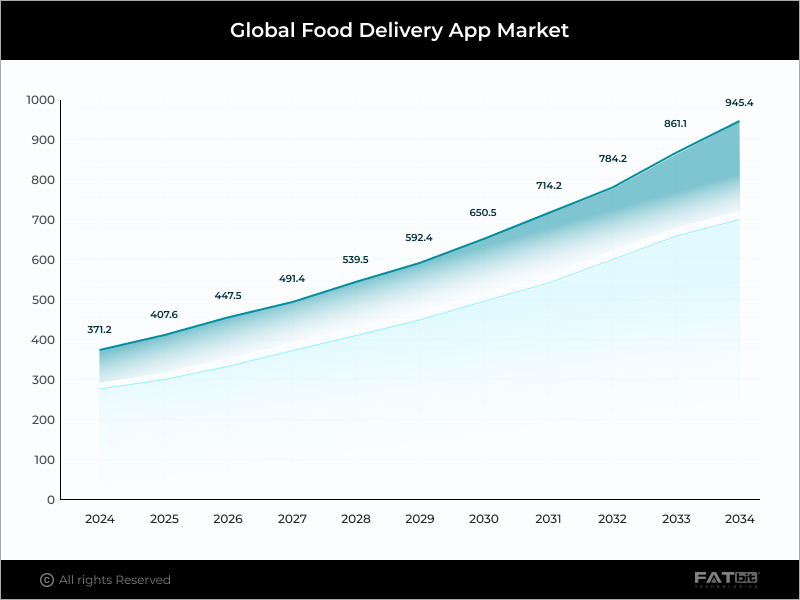
The global market size is projected to reach $945.4 billion by 2034, growing at a CAGR of 9.4% from 2025 to 2034, according to Market.Us.
Changing lifestyles, the expansion of restaurants and cloud kitchens that deliver exclusively online, diverse choices, instant doorstep delivery, technological advancements, smartphone adoption rates, internet penetration, and improved customer experience are key growth drivers for online food delivery businesses.
In short, if you are an entrepreneur or a startup planning to start a food delivery business, you need to build an ecosystem. You need a thriving food delivery platform that can meet customers’ demand, fulfill restaurants’ expectations, and help you achieve your goals.
Now the question is, where to start? How to build a food delivery app?
A no-code food delivery app is the right answer to all your questions. This informative craft is especially crafted for startups and entrepreneurs seeking detailed information on building an online food delivery app.
From understanding food delivery apps to exploring their top players, monetization strategies, key features, cost to build, and a step-by-step guide to build alongside the best no-code solution, you will get to know everything.
Key Stats and Highlights of the Food Delivery Industry that Businesses Should Look For
Don’t just create a food delivery app because someone has suggested to you about this profitable venture, but dive deep and understand if it works for you. However, before you dive deep into building a food delivery business, let’s check out some industry stats and highlights.
The online food delivery market in the US is expected to grow at a CAGR of 9.6% from 2025 to 2030.
North America was the largest food delivery market worldwide. However, today, China is dominating the market.
DoorDash, Uber Eats, and Grubhub are major food delivery platforms in the US.
DoorDash leads the US food delivery industry. It capitalized on nearly 67% of the market share.
The Asia Pacific region is expected to register the fastest growth, with a CAGR of 10.4% from 2025 to 2030.
Due to increased smartphone penetration and internet connectivity, the platform-to-consumer segment accounts for 71% of revenue.
Mobile-first strategies deliver the best results for food delivery businesses.
Online payment methods account for nearly 67% payment in the industry.
Why Build a Food Delivery App Using a No-Code Platform?
You are not alone who wants to know why build a food delivery app using a no-code platform. There are many. Let’s make the concept clear for you.
Actually, no-code food delivery apps are not something beyond development that is designed without code. They are also developed from scratch.
However, the difference a no-code solution makes is that it helps build a similar platform without the need for coding expertise. They are flexible and available under white-labeling, which means you can rebrand a no-code food delivery app as your own.
Apps developed from scratch are especially designed according to your specific needs. On the other hand, no-code food delivery apps are pre-built solutions that can be tailored and aligned with your unique business requirements.
Several more reasons exist why entrepreneurs and startups are prioritizing readymade no-code eCommerce solutions instead of building a food delivery app from scratch.
You should also consider the factors highlighted below when deciding between developing a food delivery app from scratch and choosing a no-code food delivery app.
1. Accelerated Development: Unlike custom food delivery app development, no-code apps accelerate the development timeline. Instead of months and years, they enable tapping into the online food delivery business within days.
2. Cost-Efficiency: As we have discussed in the cost section above, where custom development required thousands and lakhs of dollars, a no-code food delivery app can help you build a platform in a few hundred dollars, making it a cost-efficient selection.
3. Time-Tested: A no-code food delivery app is built by industry experts to ensure optimum performance and outcomes. Most importantly, if you are choosing a reliable solution, you can be assured of the features, functionality and performance that it has delivered to its clients. In short, a no-code white-label food delivery app is time-tested.
4. Flexible and Adaptable: You can easily customize a no-code food delivery app to align it with your unique requirements. At the same time, their flexible architecture is designed to adapt to growth, expansion and changing requirements of the business.
5. No Technical Expertise is Needed: A white-label food delivery software eliminates the need for technical expertise. They are to use. You can simply implement CMS-level customization and start operating your food delivery app business.
However, it doesn’t mean a no-code food delivery app solution is not flexible with customization. By getting started with the right solution, you can even implement code-level changes. Of course, in-depth code-level customization necessitates technical expertise. No need to worry, you can ask the solution provider for technical support.
What is a Food Delivery App?
A food delivery app is a digital platform that connects customers with local restaurants or any food businesses that want to serve customers online. It enables customers to order their favourite food instantly and get it delivered.
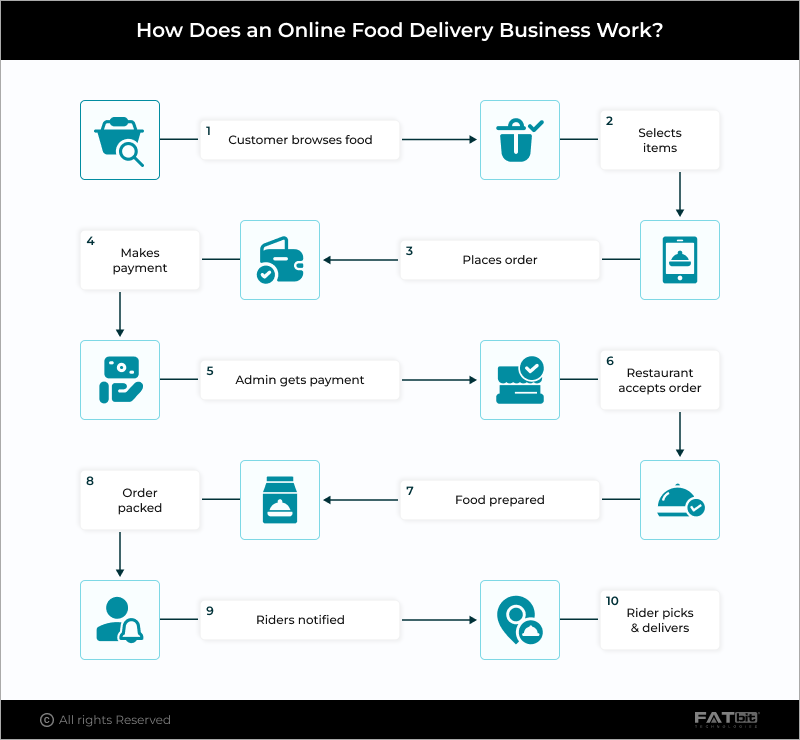
Customers search, browse menus and place orders, selecting their preferred payment method. Restaurants accept orders, get them prepared and hand them over to the delivery partner who ensures doorstep delivery.
In short, the food delivery app works as an intermediary between customers, restaurants and delivery partners. All app users are to seamlessly complete transactions, accessing cutting-edge features and functionality of the platform.
Uber Eats, Grubhub, and DoorDash are prominent examples of food delivery apps operating in the industry.
How does a Food Delivery App Work?
A food delivery app primarily connects four different participants, including customers, restaurants (food businesses), delivery personnel and the admin who is responsible for ensuring operations. In the image below, we will explore a complete cycle of an order, understanding the roles and responsibilities of all the different users using a food delivery app.
Assumptions:
Restaurants are registered and have listed their food items on the food delivery app.
The customer who is placing an order has also signed in and completed their profile.
Meanwhile, the customer can track the order and check its status.
Once the order is received, they can add ratings and reviews.
Top Food Delivery Apps Leading the Online Food Delivery Industry
The food delivery industry is thriving not only because of the customers’ shift, but the role of top food delivery apps should also be recognized. They have revolutionized the journey and transformed imagination into an enhanced buying experience. Let’s explore the top food delivery app leading the industry.
Food Delivery App
Founded Year
Headquartered in
Annual Revenue
App Downloads
DoorDash
2013
San Francisco, CA, USA
$10.72 Billion
26.5 Million
Uber Eats
2014
San Francisco, CA, USA
$13.75 Billion
42.7 Million
Deliveroo
2013
London, UK
$2.60 Billion
10 Million+
(Google Play)
Grubhub
2004
New York, USA
$2.1 Billion
10 Million+(Google Play)
Just Eat Takeaway.com
2001/2000
(Merged in 2020)
Kolding, Denmark/
Amsterdam, Netherlands.
$3.4 Billion
10 Million+/500K+(Google Play)
Want to Make a Food Delivery App Similar to DoorDash, Uber Eats, & Deliveroo?
Monetization Strategies: How Does an Online Food Delivery Business Generate Revenue?
Of course, the revenue model ensures long-term sustainability. At the same time, one can’t ignore the importance of proper planning and execution.
Businesses operating in this highly competitive online food delivery industry need to plan monetization strategies smartly. They need to be careful about their competitors’ business models while prioritizing ROI and profits.
Revenue streams discussed below are sustainable enough that most of the food delivery businesses opt for. Let’s explore each one of them and understand how they help in revenue generation.
1. Commission-based Model
A significant percentage of the revenue of almost all the food delivery apps is generated from the commission-based revenue model. It’s one of the most common revenue models that many online platforms opt for. In this revenue model, the food delivery app charges a fixed percentage from the partner restaurant on each successful order that takes place via the app.
Uber Eats charges restaurants 15–30% commission per order, depending on the city and type of restaurant. However, the commission structure can vary significantly depending on the specific business model.
2. Subscription-based Model
The subscription model brings exclusive benefits to the subscribers, which means to the customers. Food delivery apps like DoorDash and Uber Eats offer subscription plans for customers to access premium services. Customers can avail a free delivery option on eligible orders, get discounts on orders from several restaurants, receive cashback and more.
On the other hand, this revenue model enables food delivery businesses to generate a predictable and consistent income via monthly and yearly subscription plans.
DoorDash’s DashPass subscription plan, available at $$9.99/month, offers free delivery and reduced service fees on eligible orders above a certain amount. In addition, the subscription brings several more benefits.
3. Featured Listing for Restaurants
Food delivery apps generate revenue by allowing restaurants and food businesses to promote their listings. Businesses pay fees to boost the visibility of their products or restaurants in search results and on the platform. It further helps them generate more sales and revenue.
4. Third-Party Advertising
Food delivery apps also generate revenue from third-party advertising. They partner with brands, businesses and service providers and allow them to promote their businesses via banners, videos and images on the platform. Brands and businesses target potential customers and gain visibility to their offerings. On the other hand, the food delivery apps charge fees for the promotional activities.
5. Delivery Charges
In addition to the above-mentioned revenue streams, a food delivery marketplace can generate revenue by charging delivery fees from customers.
However, charges may vary depending on factors like delivery distance, order value, demand and more. Businesses can implement fixed delivery charges or can enable dynamic pricing to maximize ROI during peak hours.
Always be careful with delivery charges. Implement this revenue model with proper research and planning.
Other than these highlighted revenue streams, there can be several more, such as surge pricing, loyalty programs, affiliate partnerships, and others. Revenue streams can vary. Again, it’s crucial to decide on the best that delivers maximum for your food delivery business idea.
How Much Does it Cost to Build a Food Delivery App?
The cost of food delivery app development typically ranges from $30000 to $200000 or more for an MVP to a full-fledged, feature-rich platform.
However, the final cost to build a food delivery app can also vary significantly depending on the approach you choose. Primarily, you can choose either to develop a platform from scratch or get started with a no-code food delivery app.
Instead of investing thousands or lacs or dollars in custom development, you can create a food delivery app in a few hundred dollars, with an investment of nearly $2000 using a no-code food delivery app solution. No-code solutions are cost-effective and can give you a quick start
Also, the app’s complexity, features, API and third-party tool integrations, customization requirements and other relevant factors also affect the development cost.
In addition, operating an online food delivery business necessitates the development of three different apps alongside the admin panel: Customer App, Delivery Staff App and Merchant/Restaurant App. An entrepreneur or business owner planning to step into the industry should be mindful of when allocating budget.
Looking for a Fully Customizable White-Label Food Delivery App?
Steps to Build a Food Delivery App Without Coding Skills
Building a food delivery app was a complex and challenging journey. However, today, it’s a matter of the past. That’s true, your app is just a decision away. You need to decide on the best no-code food delivery app software. Let’s start with a step-by-step guide on how to create a food delivery app without code.
Step 1: Conduct Research and Validate Your Food Delivery App Idea
The first step of building a food delivery app is to conduct in-depth market research, analyze insights thoroughly and validate your idea. The process helps you understand your targeted market, audience, their pain points, preferences, and more.
Further, you can also evaluate supply and demand, analyze the competition, find gaps where your competitors are lacking, and understand customers’ behaviour. In short, by conducting research, you’ll be able to validate your food delivery app idea.
Step 2: Decide on Your Food Delivery Business Model
In the next step, you need to define your business model and revenue channels. Popular business models are:
1. Order-Only Business Model: In this business model, the platform manages orders only. They simply connect customers with a restaurant.
Customers utilize the platform to place orders online. Rest, from packaging to delivery, the restaurant takes complete charge.
Meanwhile, the platform charges a commission from restaurants or food delivery businesses on each order placed.
2. Order and Delivery Business Model: It’s one of the most welcomed business models that platforms like Uber Eats and DoorDash operate on.
From ordering to ensuring doorstep delivery, the food delivery app business takes complete charge. They either hire delivery personnel and partner with third-party delivery partners.
However, revenue streams in this business model are commissions from restaurants and delivery fees from customers.
3. Fully Integrated or Inventory-based Model: In this online food delivery business model, the entire process, including food ordering, food preparing and delivery, is managed by the platform itself.
They receive orders online, prepare and pack food and get it delivered to the customers. Everything is managed by the platform operator.
In this model, businesses primarily generate revenue from subscriptions, margins on food, delivery services and third-party advertising.
Popular Revenue Streams Food Delivery Businesses Generate Revenue From:
Commissions: A fixed percentage on order paid by the restaurant.
Delivery and Service Fees: Fees paid by the customer for order delivery.
PPC & Sponsored Ads: Restaurants pay in order to promote their listings for more visibility.
Subscriptions: Monthly memberships to access premium or paid services for free.
Third-party Advertising: The Food Delivery eCommerce platform can generate revenue from third-party advertising
Step 3: Define Food Delivery App Features
Building a food delivery app means developing an infrastructure that enables users to seamlessly navigate and complete transactions on the platform according to their roles and responsibilities. You can look for the user-wise features below to ensure ease of use for platform users.
Customer Specific Features
Restaurant Specific Features
Delivery Personnel Specific Features
Admin Specific Features
User Registration
Restaurant Management
Delivery Management
Restaurant Management
Location-based Search
Order Management
Real-time Tracking
User Management
Multiple Payment Methods
Payment Tracking
Multiple Order Management
Commission Management
Offers and Discounts
Delivery Tracking
GPS Navigation
Payment Management
Order Tracking
Inventory Management
Route Optimization
Reporting and Analytics
Reviews and Ratings
Promotion and Discount Management
Availability Management
CMS Management
Favorite and Wishlist
Push Notification
In-app Communication
Review Management
Push Notification
–
Push Notification
Tax Management
In-app Support
–
–
–
Step 4: Choose The Best No-Code Food Delivery Software
The selection of the right no-code food ordering and delivery app is critical. You need to be very careful when deciding. Firstly, ensure that the solution meets all your requirements, including features and functionality you are looking for. In addition, evaluate the level of control and ownership because flexibility is paramount.
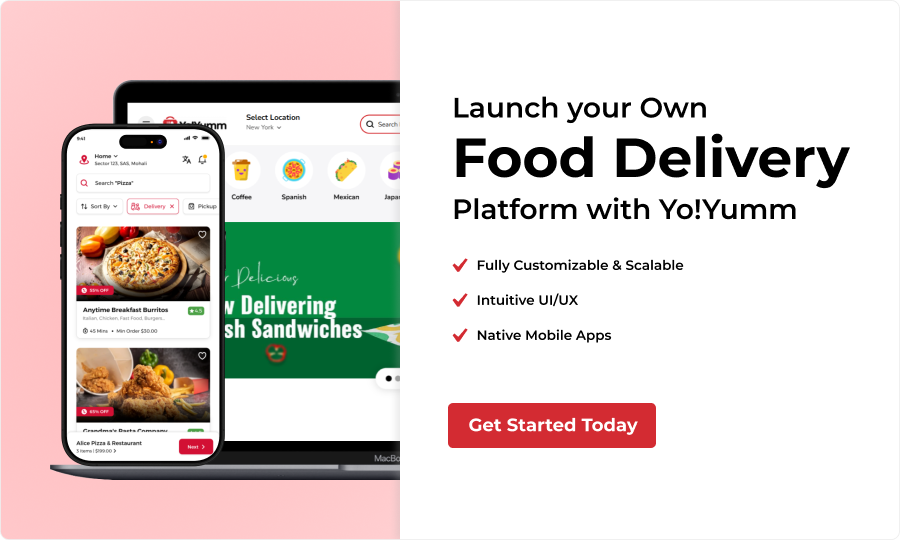
Yo!Yumm is one of the best no-code food delivery app solutions you can get started with. This readymade software is best known for offering flexibility, control and ownership.
Step 5: Build, Launch and Grow Your Food Delivery App Business
Once you have decided on the readymade white-label food delivery app, build and launch your food ordering and delivery apps. However, the job isn’t done yet. You need to plan marketing, run promotion campaigns, and promote your business through several channels with a goal to reach potential customers and onboard restaurants in maximum numbers.
Why Choose Yo!Yumm as a No-Code Food Delivery App Platform?
Yo!Yumm is a ready-to-deploy and 100% white-label no-code solution. It can help you build an ecosystem required to operate an online food delivery business.
You can introduce all three apps, including customer apps, delivery staff apps, and restaurant apps for Android and iOS users, alongside a robust admin panel using Yo!Yumm.
In addition, the points highlighted below are a few more advantages of YoYumm that one should consider when deciding on a no-code food delivery software.
Top 10 Advantages of Choosing Yo!Yumm
1. One-Time Payment: No recurring costs or any hidden charges are incurred. Yo!Yumm is available at a one-time payment model.
2. 100% White-Label: You can rebrand this readymade food delivery app as your own. It offers complete control over branding.
3. CustomizableSource Code Ownership: Yo!Yumm offers you the opportunity to buy the customizable source code of the applications, providing complete control, access and ownership.
4. Self-Hosted: The self-hosted nature of Yo!Yumm enables you to gain complete control over the platform’s performance, security and data storage.
5. Fully Customizable: Yo!Yumm allows you to customize and tailor the solution according to your unique business requirements.
6. Scalable Architecture: This no-code food Delivery app solution supports growth and expansion at no additional cost and without leading to any performance-related issues or limitations.
7. Pre-Integrated APIs: Yo!Yumm comes with all the necessary tools and APIs pre-integrated. At the same time, it’s also compatible with additional integrations.
8. Multi-Lingual and Multi-Currency Support: You can build and grow your food delivery app business globally. Yumm’s Multilingual and multicurrency support breaks down geographical barriers.
9. In-Build SEO and Marketing Features: You can promote your business across multiple channels to drive organic and paid traffic.
10. Free Technical Support: The team behind Yo!Yumm is always available at your service. They provide prompt support for all your queries and unexpected system-related issues.
This comprehensive guide is all about building a food delivery app. You have explored everything about a food delivery app, from introduction to how it works, top platforms, revenue model, cost to build and why build a food delivery app using a no-code solution like Yo!Yumm.
At the same time, you have also explored top insights and statistics of the online food delivery industry, which also provides you with an overview of how building a food delivery app can be a profitable business.
Moreover, if you are planning to launch a food delivery app business, you should start your journey with Yo!Yumm, the best no-code food delivery app solution. It’s designed to handle online food delivery transactions, ensuring a seamless experience. This readymade solution supports out-of-the-box features and further supports extensive customization by enabling code-level access.
FAQs
Q 1. How long does it take to create a food delivery app?
Ans. The time to create a food delivery app varies primarily by the approach you choose to build. If you choose custom development, it requires 6 to 12 months. Sometimes even more, depending on your requirements.
On the other hand, if you get started with a no-code solution, you can launch a food delivery app within a few days. Again, the chosen solution, customizations, and other such factors also affect the timeline.
Q 2. Can I customize and rebrand my food delivery app if built using a no-code solution?
Ans. Of course you can. No-code food delivery app solutions are white-label. They offer flexibility on branding and customization. However, the control, authority and flexibility you gain vary by the solution you start your journey with.
Q 3. Which is the best no-code food delivery app software?
Ans. Yo!Yumm can be considered as one of the best no-code food delivery app software. The solution has empowered a large number of businesses worldwide by helping them transform their online food delivery business ideas into reality. Moreover, its cutting-edge features, self-hosted nature, customization flexibility and customizable source code ownership make the solution a preferred choice among a large number of available options.
Q 4. Is Yo!Yumm a scalable food delivery software?
Ans. Yes, Yo!Yumm is designed to be scalable. It supports growth and expansion. You don’t need to spend a penny to handle an increased number of users, listings and transactions on the platform built on Yumm’s infrastructure.
Q 5. Do I need coding expertise to build a food delivery app using no-code software?
Ans. No, coding expertise is not necessary when building a food delivery app using no-code software. However, in case you seek in-depth customization or code-level accessibility, one must be an expert to do so.
Q 6. Does Yo!Yumm support third-party integrations?
Ans. Yes, Yo!Yumm’s flexible architecture supports integration with third-party APIs and tools.
Q 7. Can I migrate from an existing Food Delivery app to Yo!Yumm?
Ans. Yo!Yumm is designed to easily import existing data from other platforms. You can easily migrate to Yo!Yumm from your existing app and website.
Q 8. What are the benefits of creating a food delivery app?
Ans. A food delivery app can benefit you in many ways. It streamlines operations, enhances customers’ experience, allows businesses to reach a wider customer base, saves time for customers and restaurants, and more. In addition, if you build a multi-restaurant food delivery app, the operator can generate revenue from multiple revenue sources. At the same time, they don’t need to manage their inventory.
All innovation starts with an idea to solve real-world problems. At FATbit Technologies we are passionate about driving digital transformation to prepare businesses for a digital-first tomorrow. Let’s discuss your BIG idea NOW.
Disclaimer: The Blog has been created with consideration and care. We strive to ensure that all information is as complete, correct, comprehensible, accurate and up-to-date as possible. Despite our continuing efforts, we cannot guarantee that the information made available is complete, correct, accurate or up-to-date. We advise - the readers should not take decisions completely based on the information and views shared by FATbit on its blog, readers should do their own research to further assure themselves before taking any commercial decision. The 3rd party trademarks, logos and screenshots of the websites and mobile applications are property of their respective owners, we are not directly associated with most of them.
Vishal Tiwari is a writer with a passion for crafting engaging and informative content on diverse topics. With a keen eye for detail and a knack for storytelling, he brings a unique perspective and expertise to adapt his writing style to suit various audiences and industries.