Uber-Like Taxi App Development: Features, Cost, and Smarter Way to Launch
Views - 815
The online ride-hailing industry is growing at an unprecedented rate. This growth is driven by factors like widespread adoption of the internet, increasing preference for convenience, and the rising trend of digitization. According to industry reports presented by Statista, the ride-hailing industry is expected to generate revenue worth $229.98 billion by 2030, growing at a CAGR of 5.08% from 2026 to 2030. Additionally, the projections state that the number of users will reach 2.34 billion by 2030.
These stats present a lucrative opportunity for entrepreneurs inclined to enter the ride-hailing industry. However, before diving into the development, it is essential to have a clear understanding of industry leaders, and Uber stands out as one of them, holding nearly 50% of the market share globally.
If you are a startup founder, an entrepreneur, or an established business, looking for Uber-like app development, you landed on the right page. This blog will provide you with insight into Uber’s business and revenue model, must-have features, and steps to launch an app-like Uber. Additionally, you will also get to know how you can launch your own Uber-like taxi app in a smart and cost-effective way.
Understanding Uber: Market Growth, Business Models, and Revenue Streams
In 2010, Uber was launched with the aim of reshaping the transport services. Since its launch, it has transformed the global ride-hailing market through rapid expansion, platform-led operations, and diversified revenue streams. To understand Uber better, let’s have a look at its market growth, business models, and diversified revenue streams.
Uber’s Key Statistics
Total revenue for Q3 2025 rose 20% YoY to $13.5 billion compared with the same quarter in 2024.
Trips in Q3 2025 grew 22% year-over-year (YoY) to 3.5 billion trips, driven by 17% growth in Monthly Active Platform Consumers (MAPCs).
Uber had approximately 180 million monthly active users around 2025, indicating the number of active, regular riders on the platform.
Around 9.4 million drivers and couriers were engaged with Uber globally as of late 2025, reflecting the current scale of Uber’s driver/courier base.
Uber operates across 70+ countries, serving riders and drivers in over 10,000 cities worldwide.
Business Model of Uber
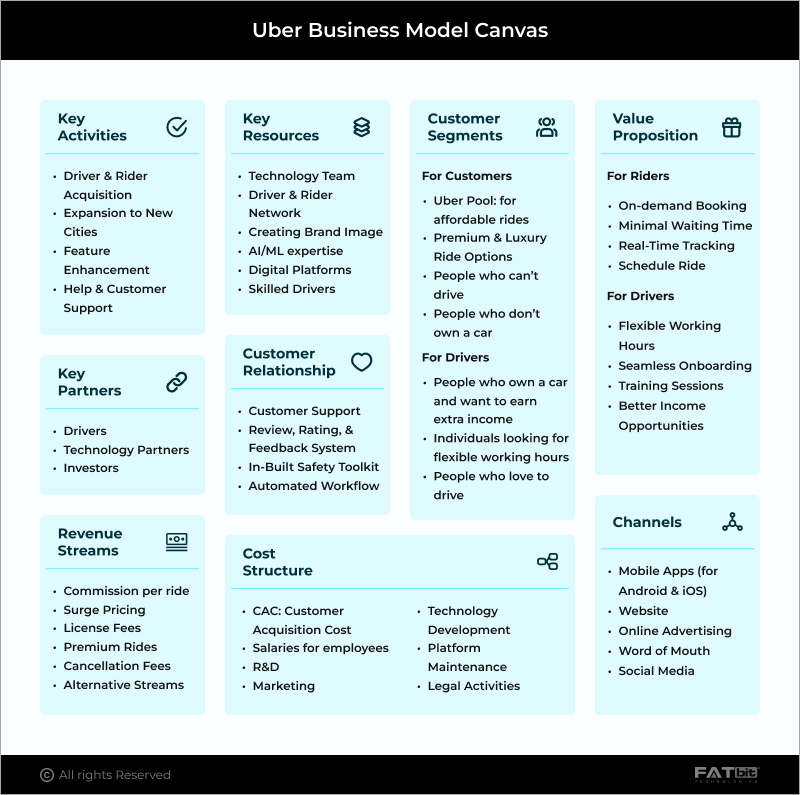
The business model of Uber is based on a scalable and platform-based ecosystem that connects riders and drivers in an efficient and asset-light manner. Through technology, partnerships, and multiple revenue streams, Uber is able to create value for various stakeholders and achieve growth on a global scale. To understand it better, have a look at the business model canvas of Uber:
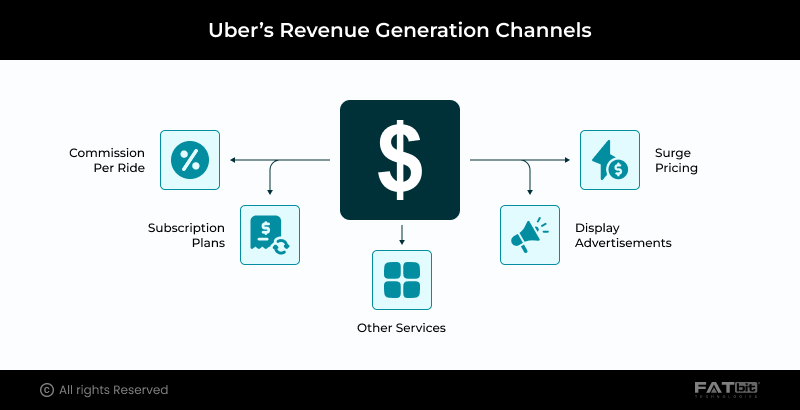
Uber’s Revenue Generation Channels
For Uber-like app development, it is essential to understand the various ways in which Uber generates revenue. From economy or budget cabs to luxury services, Uber caters to the needs of almost every user who comes across the platform. This ensures customer satisfaction and contributes significantly to the overall financial success of the platform. The primary source of revenue includes:
1. Commission Per Ride
Uber takes a commission on every ride booked on the app, typically ranging between 15 to 30%. Beyond revenue generation, this model allows Uber to scale globally without owning the fleet.
2. Surge Pricing
To ensure maximum profit generation, during conditions like bad weather, rush hour, or holiday season, Uber increases its fare temporarily. This price spike encourages drivers to go online and earn more. Thus, surge pricing not only generates higher revenue but also ensures rider availability.
3. Subscription Plans
UberOne is the name of the subscription plan offered by Uber. It allows users to pay a monthly fee to leverage the benefits like discounted rates, delivery perks, priority support, and more. This model generates recurring income and also encourages repeat usage of the platform.
4. Advertisement
As part of its diversified revenue strategy, Uber allows other brands to promote their products and services on the app. This enables Uber to generate additional income without increasing the cost.
5. Other services
Apart from the revenue channels mentioned above, Uber offers other services, including premium cabs, cancellation fees, courier services, and vehicle leasing/rentals to some drivers who do not own a car. Moreover, Uber often exclusively partners with offices, hotels, and airports to generate additional revenue.
Scale Up Your Ride-Hailing Business With Multiple Revenue Streams
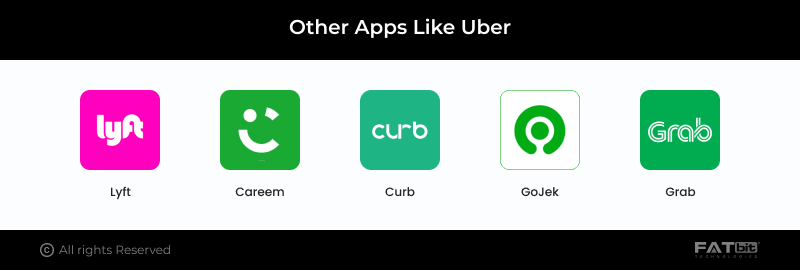
Online ride-hailing services have become the norm in today’s convenience-driven world. Similar to Uber, several other global and regional platforms have successfully replicated and localized Uber’s model to meet the diverse mobility needs. These apps demonstrate how adaptable business models, regional compliance, and service differentiation play a key role in the success of a taxi app. Some of the apps, like Uber, are listed below:
1. Lyft
Operating in the USA and Canada, Lyft is second to Uber in terms of market share in the USA. Similar to Uber, it provides multiple ride categories, real-time tracking, and a ratings and review system. Moreover, it offers a facility of a Lyft debit card, which allows you make secure online payments.
2. Careem
Acquired by Uber in 2020, Careem dominates the Middle East and parts of South Asia by tailoring ride-hailing services to regional preferences. Apart from ride-hailing services, Careem offers bike rides and food deliveries, expanding the business vertically.
3. Curb
Curb was launched due to a merger between two transportation businesses: Taxi Magic and way2Ride. It provides a premium ride, services, and wheelchair-accessible vehicle options. Somewhat similar to Uber, Curn showcases how apps like Uber can dominate the industry by utilizing existing resources.
4. GoJek
Gojek began its operation as a ride-hailing platform and evolved into a full-scale super app offering transportation, food delivery, logistics, and financial services. Its multi-service ecosystem demonstrates how Uber-like apps can drive higher user retention and revenue diversification, especially in emerging markets with mobile-first users.
5. Grab
Grab is a dominant mobility and super-app platform across Southeast Asia, providing ride-hailing, deliveries, digital payments, and financial services. By adapting to local regulations and user behavior, Grab exemplifies how apps like Uber can achieve large-scale adoption through regional customization and service expansion.
Must-Have Features to Develop an App Like Uber
A comprehensive feature set acts as a backbone for your Uber-like taxi app development. Therefore, the features offered should streamline the workflow for all user types involved. Given below are the user-specific features that your Uber-like taxi app must have:
Passenger App Features
1. User Registration
A simple sign-up option using email, mobile phone, or social media login enable user to register on the app seamlessly. Additionally, the ability to save addresses and ride history contribiutes in enhancing the user experience.
2. Fare Estimation
The fare is estimated based on the demand, pick-up, and drop-off location. An upfront fare estimation gives the user a heads-up related to the ride expenses before confirming the ride.
3. Ride Sharing
This feature allows riders, heading in the same direction, to share the same vehicle. It allows them to split the ride cost and promotes sustainability.
4. Real-time Tracking
After booking the ride, the user can track and see the driver’s location along with the estimated time of arrival. It keeps user updated about their location during the ride, and helps build trust and credibility.
5. Multiple Payment Options
To enhance user experience, your app should offer multiple payment options, including credit/debit cards, digital wallets, net banking, and more. Other than that, integrate secure payment gateways, such as Stripe and PayPal.
6. SOS Alert
Integrate your app with the SOS feature that sends an alert to emergency contacts, including ride details like location, vehicle number, and driver information. This provides peace of mind to passengers and helps build user trust.
7. Multiple Ride Options
Before booking the ride, it provides the user with a variety of ride options, such as luxury cars, shared cabs, budget rides, and more. This way, customers can select a ride that suits their requirements and budget.
8. Book Rides for Others
This featureprovidese users the ability to book a ride for others. However, make sure that your Uber-like taxi app has an option to leave the number of those for whom you have booked the ride.
Driver App Features
1. Seamless Registration and Verification
Similar to user registration, the driver onboarding process should also be seamless. Additionally, registration flow should include document upload and verification. This ensures that drivers meet the safety and security standards.
2. Advanced Navigation and Route Optimization
It helps drivers take the most efficient route and allows them to reach the destination in the fastest time possible.
3. Availability Toggle
This feature allows drivers to go online and offline based on their availability. It enables drivers to manage their working hours efficiently and lets them enjoy their idle time peacefully.
4. Earning Tracker
An earning tracker provides drivers with insights about their trips and allows them to view their hourly, weekly, or monthly income. Moreover, the tracker can include insight about incentives, bonuses, and deductions, which helps maintain transparency in payouts.
5. Subscription Plans
Offer drivers with subscription plans that include benefits like reduced commission rates, priority booking when online, incentives for staying engaged, and more. Providing benefits to the drivers will automatically benefit your business.
6. Rating and Review
Along with driver rating and review, allow drivers to rate the riders, which promotes respectful behaviour and mutual accountability on the platform. Moreover, it helps the admin/s to identify problematic users and maintain overall service quality.
It enables admin/s to manage rider and driver profiles from a centralized dashboard. Admin/s can verify users, driver details, and resolve disputes, ensuring smooth platform operations and user accountability.
2. Commission and Fare Management
This feature allows admin/s to pre-define and modify commission structure, base fare, surge pricing, and other additional charges as per the requirements.
3. Manual Ride Booking
If you want to start small, your app can include manual ride booking options, it allows admin/s to book a ride for users. Users can contact the admin directly for the ride booking in case of any technical or other issues.
4. Geofencing
Geofencing allows admins to define operational zones and control ride availability within specific geographic boundaries. It helps manage city-wise operations, apply location-based pricing, and restrict services in non-operational areas.
5. Reports and Analytics
Advanced reports and analytics provide insights into rides, revenue, user behavior, and driver performance. These insights help platform owners make data-driven decisions, optimize operations, and identify growth opportunities.
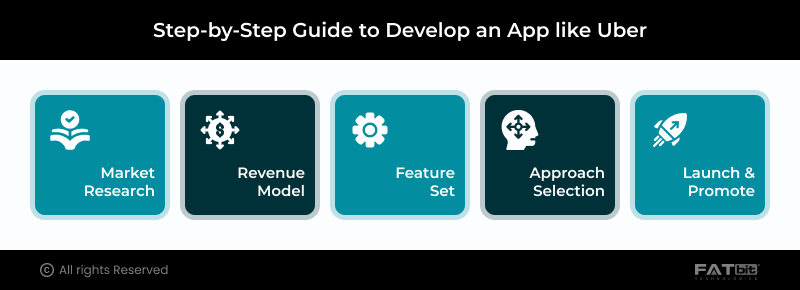
Step-by-Step Guide to Develop an App like Uber
To build a taxi app like Uber, you require strategic planning, market validation, and clear business decisions at every stage. Given below is a clear and structured development approach that helps you reduce risks, control costs, and accelerate your path to launch. Let’s begin:
Step 1: Conduct Market Research and Define Your Niche
Before starting the development, you should analyze targeted cities, customer behavior, demand patterns, and existing competitors. Other than that, identify service gaps such as underserved locations, pricing issues, safety concerns, or specialized transport needs. It will help you define a clear niche, such as corporate rides, intercity travel, bike taxis, women-only rides, or luxury transport.
Step 2: Decide Revenue Model
Once the research is done, decide how your platform will operate and generate revenue. Some of the common revenue models include:
Commission per ride
Subscription plans for drivers
Surge pricing
Cancellation fees
In-app advertising
Furthermore, decide whether your Uber-like platform will operate as an aggregator, fleet owner, or hybrid marketplace.
Step 3: Finalize the Feature Set
Features are the backbone of your Uber-like ride-hailing app. Thus, outline essential features for riders, drivers, and administrators. Some of the core capabilities typically include user registration, ride booking, real-time tracking, fare calculation, secure payments, driver management, ratings, and notifications. You can prioritize must-have features for launch and plan advanced features for future updates.
Step 4: Popular Approaches for an Uber-Like Taxi App Development
An Uber-like taxi app can grow into a enterpeise-grade multi-service ecosystem. Thus, selecting the right development approach is crucial. Typically, there are two popular approaches: custom development and leveraging a ready-made solution. To make a sound decision, it is essential to know about both approaches in detail. Let’s begin:
1. Custom Development
Using this approach, Uber-like taxi app development can be done from the ground up, providing full control over features, design, and scalability. However, it requires significant time, technical resources, and financial investment.
Pros:
Complete customization and flexibility
Full ownership and control
Tailored user experience
High scalability potential
Cons:
Very high development cost
Longer time to launch
Requires a skilled technical team
Ongoing maintenance responsibility
2. Readymade Software
Readymade software is a pre-built Uber-like taxi app solution that can be quickly customized and launched under your brand. This approach offers faster deployment and lower costs compared to developing the platform from scratch.
Pros:
Fast time to market
Lower upfront investment
Proven and tested solution
Minimal technical effort required
Cons:
In case of self-hosted solutions, businesses need to meet the minimum server requirements to host the platform
Looking for a Reliable Readymade Solution to Launch an Uber-like Taxi App?
15X less than custom development (approx: between $2,000 and $15,000, depending on the customization)
Risk Factor
Higher risk of overruns
Lower risk
Feature Availability
Added in phases
Built-in features, ready for immediate use
Market Validation
Product untested initially
Already validated and market tested
ROI Speed
Slower return on investment
Faster launch and revenue
Step 5: Launch and Promote Your Uber-Like App
Once you are done with Uber-like app development, begin with a soft launch. Initially, test the performance of your app in a limited area and gather feedback. This helps you fix issues before expanding. Additionally, prioritize driver onboarding and customer acquisition through incentives and referral programs. Promote the app using digital marketing, local partnerships, launch offers, and social media to attract early users and build momentum quickly.
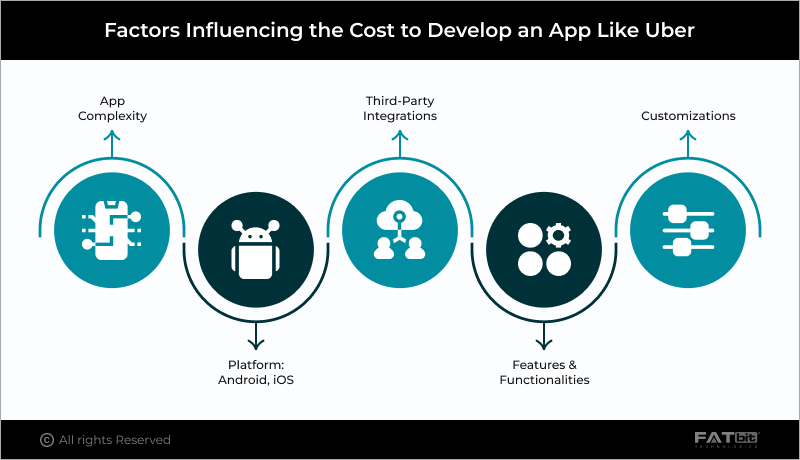
Factors Influencing the Cost to Develop an App Like Uber
The cost of Uber-like app development varies widely depending on technical scope, feature depth, and infrastructure choices. Beyond basic Uber-like taxi app development, decisions related to platforms, integrations, hosting, and customization significantly impact the overall budget and timeline.
Understanding these factors helps businesses plan realistically and avoid unexpected expenses.
1. App Complexity
UI/UX and an intuitive interface play an important role in user engagement and retention. Developing a simple app is cost-effective compared to a complex and visually rich interface.
2. Platform: Android, iOS, or Both?
Depending upon your audience, decide whether you want to build for one platform or both (Android and iOS). Building for one platform costs less and speeds up launch. Whereas choosing both platforms doubles design and testing efforts.
3. Third-Party Integrations
To provide a seamless user experience, your app should be integrated with some reliable third-party platforms, such as Google Maps, Stripe, and similar services. These integrations add licensing fees and development time.
4. Features and Functionalities
Basic features like booking and payments are standard. Whereas advanced features like ride scheduling, loyalty programs, or in-app chat add a high cost. Moreover, every added feature requires design, development, and testing. Thus, you must prioritize necessary features for your first version.
5. Customizations
Customizations such as UI/UX, branded themes, and unique workflows require more effort and add significantly to the development cost. Additionally, it also makes future updates harder to manage.
The above-mentioned factors increase the development cost, pushing your budget significantly. However, to do Uber-like app development in a cost-effective manner, the smart way is to choose a readymade solution like VivoCabs. Let’s learn what VivoCabs offers and why it is a smart choice for entrepreneurs:
VivoCabs: A Smarter Way to Develop an App Like Uber
Developed by FATbit Technologies, VivoCabs is a self-hosted white-label ride-hailing solution. Designed for scalability and operational efficiency, it offers an end-to-end digital ecosystem to quickly launch an app like Uber. It comes equipped with native mobile apps for both drivers and riders (iOS and Android) and a feature-packed admin dashboard that streamlines the operations. Being self-hosted, it provides complete control over branding and functionality.
VivoCabs is built to support multiple business models, including single-city operations, multi-city expansion, corporate transport services, and niche mobility solutions. The solution has integrated tools for driver management, fare estimation, commission settings, and analytics. Moreover, it enables operators to efficiently manage day-to-day activities while maintaining service quality and operational transparency.
Supporting deep customization, VivoCabs allows you to tailor the design, workflows, and features as per your business model and requirements. Additionally, it significantly reduces cost and enables you to launch the app faster, which makes it a turnkey solution.
Key Benefits
Faster time to market
Fully white-label solution
Self-hosted with complete ownership
Ready-made rider and driver apps
Advanced admin dashboard
Real-time ride tracking and dispatch
Supports multiple business models and revenue streams
Scalable architecture for growth
One-time cost
Full control over data, pricing, and operations
Customizable features
Third-party integrations
Schedule a Personalized Demo to See VivoCabs in Action
The ride-hailing industry offers strong opportunities for entrepreneurs who combine the right strategy with reliable technology. Uber-like taxi app development demands a clear business model, essential features, cost awareness, and a focused launch plan. Moreover, your development approach directly impacts time to market, investment, and scalability.
No doubt that custom development provides full control, but it also requires significant time and resources. Ready-made, self-hosted solutions enable faster, more cost-effective launches while covering core requirements. By prioritizing key features and user experience, businesses can minimize risks and grow steadily.
Success ultimately depends on launching quickly, adapting to market demand, and scaling efficiently. With the right foundation, entrepreneurs can build a sustainable ride-hailing platform and compete confidently in this evolving market.
FAQs
Q 1. How long does it take to launch an app like Uber?
Ans. The timeline to launch an app like Uber depends on the factors, such as feature complexity, third-party integrations, and most importantly development approach you select. Building the app using custom development typically takes 6 to 12 months or more, depending on the feature complexity. While a readymade solution like Vivocabs allows you to launch the app within a few weeks.
Q 2. What are the common challenges in developing an app like Uber?
Ans. Some of the common challenges while developing an app like Uber include:
Real-time rider and driver matching
Live location tracking and GPS accuracy
Payment gateway integration and transaction security
Regulatory and compliance management
Safety, trust, and fraud prevention
High development, infrastructure, and maintenance costs
Q 3. Is it better to use a white-label ride-hailing software or build a custom solution?
Ans. For businesses looking for complete control, ownership, and long-term cost efficiency, leveraging a white-label readymade solution is the better choice. A white-label solution like VivoCabs comes equipped with all the essential features and provides the benefits of custom development.
Q 4. How can I launch an Uber-like app in a cost-effective manner?
Ans. To launch an Uber-like app in a cost-effective manner, you can leverage a self-hosted, readymade solution like VivoCabs. It helps reduce development time and cost, enabling you to enter the market quickly. Moreover, it offers packages starting at just $1499.
All innovation starts with an idea to solve real-world problems. At FATbit Technologies we are passionate about driving digital transformation to prepare businesses for a digital-first tomorrow. Let’s discuss your BIG idea NOW.
Disclaimer: The Blog has been created with consideration and care. We strive to ensure that all information is as complete, correct, comprehensible, accurate and up-to-date as possible. Despite our continuing efforts, we cannot guarantee that the information made available is complete, correct, accurate or up-to-date. We advise - the readers should not take decisions completely based on the information and views shared by FATbit on its blog, readers should do their own research to further assure themselves before taking any commercial decision. The 3rd party trademarks, logos and screenshots of the websites and mobile applications are property of their respective owners, we are not directly associated with most of them.
Nandini Sood is a Content Writer at FATbit Technologies. Via her keen exploration of the emerging eCommerce market trends and developments, she creates insightful content for entrepreneurs, startups and business enthusiasts inclined to enter the eCommerce industry. Other than writing, she spends her free time reading and making crafts.