How to Launch an Equipment Rental Marketplace with Ready-Made Software
Views - 282
Published date 06th Aug, 2025
TL;DR
The global equipment rental market is experiencing rapid growth, creating lucrative opportunities for entrepreneurs to build online rental marketplaces.
Instead of investing large time and capital in custom development, businesses can leverage ready-made rental marketplace software like Yo!Rent.
The ready-made solutions are purpose-built to align with the latest trends and features, assisting entrepreneurs with little tech knowledge to launch faster, reduce costs, and scale efficiently.
This guide explains the business model, market opportunities, revenue streams, software selection criteria, launch strategy, and estimated costs involved in building a successful equipment rental marketplace.
The ever-evolving rental industry has been powered by offline single- and multi-vendor rental business owners who are mapping their marketplace journey to align with the industry’s digitalisation. Any existing business owner with decades of experience in the brick-and-mortar equipment rental marketplace can enhance their operations by launching an online equipment rental marketplace. Demonstrated by a projected CAGR of 7.2% in 2025-2033, the multifaceted rental marketplace is estimated to reach $130.6 billion by 2033.
The industry has recognised a massive online rental opportunity with high capital investment in the public and private construction industry, adding to the market size and profit potential of the equipment rental marketplace. Developed countries such as the United States, Canada, Japan, Russia, etc are contributing to this enhanced growth of the sector. Additionally, this digitisation enables new heavy-duty machinery-induced businesses to initiate their operations, while also powering multi-vendor exchange without the burden of ownership. This online platform provides the renting party with fair pricing for the exchange.
Overall, the equipment rental marketplace industry offers high efficiency and reliability to all its user types. This evolution involves an end-to-end digitalised infrastructure, with the latest features from inventory management to damage recovery. Therefore, this is the optimum time to launch your equipment rental marketplace. And to attain no operational compromise, partner with an experienced readymade software provider to launch your equipment rental marketplace as fast as possible.
What is an Equipment Rental Marketplace and Popular Product Categories?
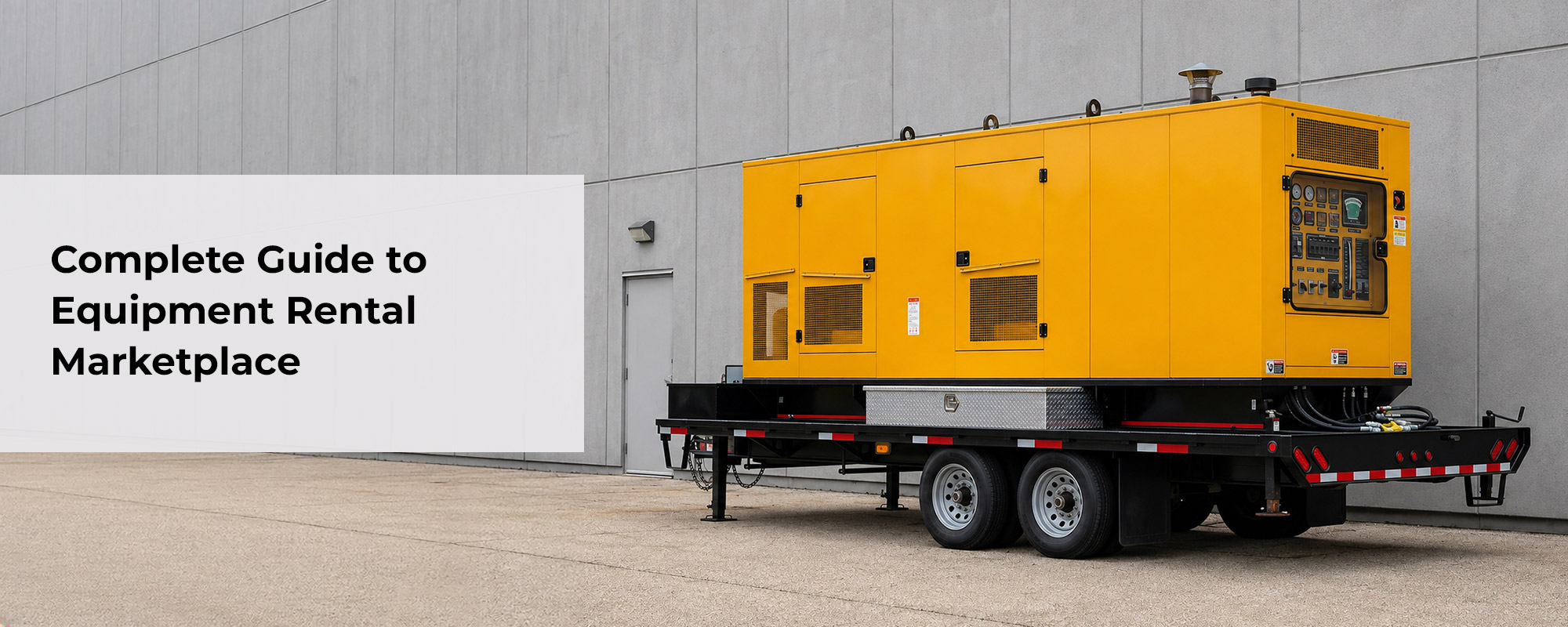
An equipment rental marketplace is an online aggregate marketplace that connects equipment owners with businesses or individuals looking to rent machinery for a specific duration. Unlike traditional rental businesses, a marketplace allows multiple equipment owners to list their inventory, giving customers access to a wider selection while enabling owners to generate revenue from underutilized assets. Businesses can effectively leverage an equipment rental marketplace to offer industry benefits, such as low tax liability, no maintenance costs, better capital utilisation, easy customer management, and more.
The user types for the marketplace may include new contractors, event planners, agricultural businesses, construction businesses, and vendors of industrial tools, construction equipment, or specialised machinery. These marketplaces include multiple popular categories such as earthmoving, aerial work platforms, forklifts, and more. Moreover, for better assistance, the table below highlights some of the most popular categories to include in your equipment rental marketplace or capitalise on.
Equipment Category
Examples
Construction Equipment
Excavators, Bulldozers, Backhoe Loaders
Earthmoving Equipment
Loaders, Motor Graders, Skid Steers
Material Handling
Forklifts, Cranes, Pallet Trucks
Aerial Work Platforms
Boom Lifts, Scissor Lifts
Agricultural Equipment
Tractors, Harvesters, Seeders
Industrial Equipment
Compressors, Generators, Pumps
Landscaping Equipment
Wood Chippers, Stump Grinders
Event Equipment
Lighting Systems, Temporary Structures
Cleaning Equipment
Industrial Vacuum Cleaners, Floor Scrubbers
Specialized Equipment
Concrete Mixers, Drilling Machines
Interested in Capitalising on the Equipment Rental Marketplace Industry?
The equipment rental marketplace can also be launched in a vertical industry niche, offering specialised machinery and high return value to the renting individual.
Trends that shape the Equipment Rental Marketplace
An equipment rental marketplace is shaped by a few major trends that have evolved in response to the evolving industry demands. These shifts improve how users book, track, and manage rented tools and heavy machinery online. A business owner can keep these in mind while deciding upon the USP of their equipment rental marketplace.
1. Digital-first Experience
The rapid digitalisation of the multifaceted equipment rental industry has led to high expansion opportunities for a business owner. Initiating with a digital-first experience and online booking, through mobile apps and websites, lets users rent gear instantly without phone calls. The digitisation has also assisted in formulating a paperless process with digital contracts, e-signatures, and instant invoices, saving time for renters and owners. Moreover, the digital-first experience enables transparent pricing and upfront, clear online cost breakdowns.
2. Internet of Things
The IoT in the equipment rental industry is a vast network of embedded smart technology integration in the marketplace to enhance overall operations. These features include real-time tracking, remote monitoring, and loss prevention tools. It assists in replacing human effort and reducing the chance of error using GPS sensors and smart sensors to track engine health, record daily working hours, send anti-theft alerts, and more.
3. Machine Learning & Artificial Intelligence
The digitisation and technological advancements have been observed to grow at an incomparable rate. The equipment rental industry has enabled predictive maintenance, optimizing fleet logistics, and automating customer support, which can be leveraged to reduce downtime, track asset usage accurately, and make data-driven decisions. Furthermore, businesses can easily integrate smart pricing, changing rental prices based on local demand and seasonal needs, and more.
4. Asset Sustainability
The digitalised equipment rental businesses have initially invested in zero-emission electric machines and energy-saving tools that use less power and fuel. Overall, the industry has undergone an electric revolution by introducing electric-powered equipment, the top manufacturers of the same being Bobcat, Case Ausa, and more. Companies are looking to contribute more to environmental causes, such as Net Zero Emissions by 2050.
5. Latest Arrival in Categories
One progressing equipment rental category creating a high-demand market is UAV (Unmanned Aerial Vehicles), also widely known as drones. The drones are efficient equipment, with multifaceted uses, such as supervision work, identifying worksite danger, cultural monitoring, environmental research, pipeline inspection, border surveillance, and more.
Get Expert Consultations with Professionals of 15+ Years of Experience!
5-step Guide to Launch an Equipment Rental Marketplace
Now that you have an insight into the rental industry and recognise the scope in the equipment industry, it is now time to indulge in strategic planning, compliance, and investing in user-focused technology. The given steps are tried and tested to deliver results and launch a success-oriented marketplace.
1. Analyse the Market and Target Consumers
Every successful equipment rental marketplace begins with comprehensive market research. Before investing in technology or onboarding vendors, entrepreneurs should evaluate industry demand, identify customer pain points, analyze competitors, and understand regional market trends. This research forms the foundation of a marketplace that addresses genuine customer needs while differentiating itself from competitors.
By gathering this market information, a business owner can identify industry gaps, their target audiences, and organise the fragmented industry to build a marketplace with a compelling value proposition that emphasizes convenience, transparency, reliability, and operational efficiency.
Find the table for an elaborated look at the target audience of different equipment rental niche marketplaces.
Target Audience
Supply Base
Demand Base
National Rental Chains
General Contractors
Regional Equipment Companies
Speciality Contractors
Independent & Small Construction Contractors
Government Agencies
New & Rental Equipment Dealers
Industrial Facilities
Speciality Equipment
Event Companies
To list a few, some of the most common challenges within the traditional equipment rental industry include,
Fragmented supplier networks
Inconsistent equipment availability
Lack of transparent pricing
Manual booking processes
Limited inventory visibility
Inefficient communication between equipment owners and renters
Each of these pain points can be addressed by launching a powerful online marketplace. A marketplace owner can easily offer high convenience to the targeted consumers who also seek flexible rental durations, faster quotations, digital documentation, and simplified logistics management.
Hence, incorporating customer feedback during the planning stage also helps prioritize essential features and ensures that the marketplace aligns with evolving industry expectations.
2. Systematically Cater to Legal Requirements
Legal compliance requirements are a non-negotiable component for launching a new business enterprise, and a heavy equipment rental marketplace especially involves systematic compliance, which requires core legal frameworks, business licensing, rental agreements, insurance, equipment type, and risk allocation to adhere to safety machinery standards.
The first step is establishing a legally registered business entity and obtaining the licenses required to operate within the target jurisdiction. Depending on the country or state, businesses may also need marketplace-specific permits, commercial rental licenses, tax registrations, and certifications for handling specialized machinery. Businesses should also comply with workplace safety regulations, such as,
OSHA Regulations
Meeting safety requirements
Tax Implication
Follow local environmental and transportation regulations
Therefore, establishing a strong legal framework not only reduces operational risks but also builds trust among customers, vendors, and business partners, contributing to sustainable marketplace growth.
3. Decide the Workflow and Business Model of your Equipment Rental Marketplace
An equipment rental marketplace is an all-encompassing marketplace that connects the equipment owners with their potential customers. Furthermore, the rental marketplace admin can enable owners to sell their equipment over the platform after covering their buying costs.
Find the workflow listed below
The sellers and buyers register or log in on the equipment rental marketplace.
The customer can now visit the website to search and browse listings made by multiple vendors, in a multi-vendor setting, or to discover equipment listed by the platform owner, as for a single-vendor marketplace.
Customers can now browse and search through efficient advanced search navigation. And to avoid overlap of booked dates, features like calendar booking can be leveraged, followed by secure payments made through the marketplace.
A robust equipment rental marketplace allows the admin to confirm the availability and pricing if the buyer has used the RFQ procurement model.
The admin collects the rental price combined with the security fees and holds it in the escrow account before sending the booking request to the equipment owner.
The owner can then accept or reject the order booking and fulfill further logistic requirements to deliver it to the booking customer.
The admin can fulfill the documentation, contracts, and insurance requirements through the online equipment rental marketplace.
Furthermore, the equipment owners can also offer on-site support with operational training with the delivery.
The final step includes the release of rental money to the equipment owner based on the return condition and inspection of the machinery.
The return on investment decides the longevity of your equipment rental marketplace, as a successful marketplace does not depend on a single revenue source. Therefore, these are some of the most popular revenue streams that can be integrated into your rental marketplace.
Commission Model
The commission model enables an equipment rental business to generate income through the platform by charging a commission on every transaction made through the platform. This commission can be fixed or percentage-based.
Customer Lifetime Value
High customer lifetime value leads to loyal customer acquisition and retention; this industry offers high customer lifetime value because contractors rent equipment regularly, and the rental marketplace is frequently used by owners to list their heavy equipment. Hence, strong customer retention justifies higher acquisition costs.
Featured Listing
The featured listing revenue model allows the equipment rental marketplace owner to charge a certain fee from the equipment owner in exchange for improving the visibility of their products on the highlighted sections, or on the home page. This is mutually beneficial as it improves the sales of their products.
Third-party Advertisement
The equipment marketplace owner can leverage the benefits of third-party advertising by renting the ad space to related businesses for a period of time in exchange for certain charges.
Subscription Model
The subscription model enables the equipment rental marketplace to earn a stable and sustained income through a monthly recurring model. The marketplace owner can offer add-on premium services such as faster delivery, personalised discounts, overall rent charges, and vetted equipment delivery.
Invest in Value and Launch a High-Returning Equipment Rental Marketplace!
4. Choose the Right Readymade Software to Launch an Equipment Rental Marketplace
While at first building your equipment rental marketplace from scratch might seem like the right approach, it has the ability to tailor the marketplace according to your unique business model and idea. But with advancing technology, new entrepreneurs can now turn towards MVP or ready-made solutions and development approaches to launch their rental marketplace efficiently.
Similarly, to choose the best ready-made equipment, given below are some of the parameters to look for in your ready solution to launch efficiently by choosing and leveraging high-performance ready-made rental marketplace software.
a. Industry-Specific Feature List
The feature list of your equipment rental marketplace can make or break your business. Hence, choosing the right ready-made software requires focusing on multi-vendor architecture, dynamic time-based pricing, and real-time conflict-free booking engines. Given below are 10 essential features; if they are available in your rental software, it needs to be shortlisted to be vetted with other listed parameters.
RFQ Management
Rental Security Management
Logistic Operations
Rental Agreement and eSigning
Advanced Search and Filtering
User Management
Rental Buffer Period
Financial Services Integration
RFQ Management
Tiered Pricing & Booking Calendar: Offering high operational convenience
Hence, it is necessary to list down all your marketplace feature requirements to gain a competitive advantage, incorporating your unique selling factors.
b. High Scalability and Flexibility
As your marketplace grows, your software should be capable of handling increased traffic, expanding inventory, and a growing vendor network without compromising performance. A scalable solution allows businesses to accommodate thousands of equipment listings, multiple vendor accounts, and increasing transaction volumes while maintaining a smooth user experience.
Ultimately, the representation of a successful business is directly proportional to the scalability of the deployed rental solution that handles growth smoothly. A business owner can easily automate workflows and support relentless and seamless business operations for attaining maximum results with high customer retention and acquisition prospects.
A foresightedly mapped equipment rental marketplace is built on flexible architecture as business requirements evolve over time. Whether you plan to expand into new geographical markets, introduce additional equipment categories, integrate third-party logistics providers, or launch mobile applications, your software should support seamless customization and future enhancements.
c. Long-term Cost Efficiency
Launching an online equipment rental marketplace is a long-term investment, making cost efficiency a key consideration when selecting software. While lower upfront costs may seem attractive, businesses should evaluate the total cost of ownership, including licensing, hosting, maintenance, software updates, customization, and technical support.
A business is a profit-oriented venture, starting with the foundational goal of generating revenue. Hence, choosing a ready-made rental marketplace software offers significant long-term savings by eliminating the need for extensive custom development and accelerating time-to-market. It also includes industry-tested workflows that reduce operational inefficiencies and support multiple revenue streams, helping businesses maximize profitability over time.
d. Rental Marketplace Software Ownership
Software ownership plays a significant role in determining your marketplace’s long-term flexibility and independence. Before selecting a ready-made solution, entrepreneurs should carefully understand the licensing model offered by the software provider.
A self-hosted solution generally provides complete ownership of the software license, greater customization capabilities, and full control over hosting infrastructure and business data. This enables businesses to modify features, integrate third-party services, and migrate servers whenever required without being dependent on the software vendor.
Whereas SaaS-based solutions typically operate on recurring subscription models where the provider manages hosting, maintenance, and updates. While these solutions simplify technical management, they often come with limitations in customization, data portability, and vendor dependency.
Therefore, evaluating software ownership helps businesses choose a deployment model that aligns with their long-term operational and expansion goals.
Get Firsthand Experience of the Industry-acclaimed Ready-made Rental Solution by Experts!
Equipment rental marketplaces process sensitive customer information, financial transactions, business contracts, and vendor data, making security a top priority. A secure platform not only protects business operations from cyber threats but also builds trust among vendors and customers.
When evaluating ready-made software, ensure that it offers enterprise-grade security features such as:
SSL Encryption
PCI-DSS Compliant Payment Processing
GDPR Compliance
Two-Factor Authentication (2FA)
Data Encryption
Fraud Detection
Secure API Integrations
Additionally, the software should support digital rental agreements, eSignatures, automated record management, and compliance with local data protection regulations.
5. Launch and Strategically Scale your Equipment Rental Marketplace
The launch of your equipment rental marketplace dictates the success of your business. Businesses can analyze user behavior through marketplace analytics, continuously improve platform features based on user feedback, and increase platform engagement by offering zero-commission introductory periods and providing featured listing incentives.
Furthermore, efficiently promoting an equipment rental platform requires targeted digital strategies, specifically localized search engine optimization, strategic social media marketing, and valuable industry partnerships.
Promotion Channels and Tactics
Search Engine Optimization
Digital Advertising
Leverage geo-targeted social media ads
Partner with local construction firms
Recruit initial equipment dealers directly
Offer referral bonuses for early users
A business owner can successfully launch a high-performing equipment marketplace with features that stand out in the generic industry.
After a business owner is clear of the comprehensive steps to launch an equipment rental marketplace, the guide covers the total cost involved in the overall launch of your powerful marketplace.
What is the Cost to Launch an Equipment Rental Marketplace with Ready made Software?
The cost to launch an equipment rental marketplace with ready-made software is highly dependent upon software hosting, feature availability, scalability capabilities, data security, and more. To break it down, these listed factors can be differentiated between the two listed ready-made solutions: self-hosted and SaaS-based solutions.
Key Metrics
Self-Hosted
SaaS-based
Developmental Cost
One-time Payment: Starts from $1500 to $5000 + Customisations
Recurring cost: Starts from $199/month ($2300+ annually + customisation cost)
Time of Development
Takes around a week to a month
Takes around 6-12 months of dedicated development
Customisability & Scalability
Very High: Depending on service provider
Limited: Depending on service provider
Data Control and Security
Totally controlled by the marketplace owner & local rules
Highly dependent on the software provider
Vendor Lock-In
Limited: Easily portable with proper documentation
Significant data migration & switching costs
Software Maintenance
Managed by business or service provider
Updates managed by software Provider
Security Control
Full control
Provider-managed
Ideal for
All business sizes, start-ups, SMBs and large enterprises.
New business owner, looking to validate their idea
For end-to-end assistance to new and existing businesses looking to expand their services and operations. Given below is one of the industry-acclaimed equipment rental marketplace software solutions, designed and developed after numerous hours of industry research to address pain points and effectively cater to industry gaps.
How can FATbit-powered Yo!Rent Assist Business Owners in Effective Industry Capitalisation?
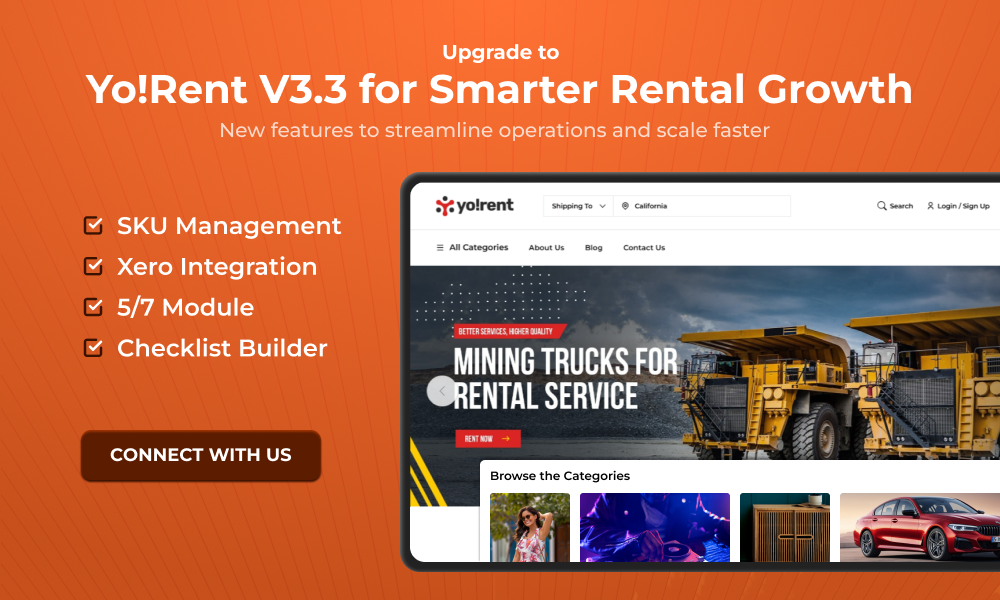
FATbit-powered Yo!Rent is the best equipment rental marketplace software, feature-rich with market-proven workflows and integrated, versatile revenue streams, ranging from hourly, daily, weekly to monthly. It is turnkey rental software designed for versatility and has successfully launched industry-diverse businesses across the globe.
Yo!Rent ensures a modern and mobile-responsive interface to all its user types, assisting business owners to offer an engaging experience with features such as RFQ, document verification, tiered pricing, multilingual and multi-currency support.
Additionally, FATbit products are renowned for offering a lifetime licence, a 100% customisable self-hosted solution, at a one-time cost and an additional 1 year of free technical support for business owners with little to no coding experience.
Listed are the Key Capabilities,
Multi-vendor marketplace architecture
RFQ and quotation management
Calendar-based rental bookings
Rental security deposit management
Digital rental agreements and eSigning
Inventory and availability management
Damage reporting and inspection workflows
Escrow-supported payment processing
Multi-language and multi-currency support
Mobile-responsive interface
Comprehensive admin dashboard
API-ready architecture for third-party integrations
One-time licensing with self-hosted deployment options
Get Hands-on Experience of Advanced & Powerful Equipment Rental Marketplace!
The equipment rental industry continues to experience strong global demand, driven by increasing infrastructure projects, industrial expansion, and businesses seeking cost-effective alternatives to equipment ownership. Entrepreneurs entering this market can significantly reduce launch risks by adopting ready-made marketplace software instead of building from scratch.
By selecting robust equipment rental software like Yo!Rent, and its robust rental-specific features, ensuring regulatory compliance, developing a balanced supply-demand ecosystem, and implementing a sustainable revenue strategy, businesses can establish a scalable and profitable equipment rental marketplace. It provides the experience and technology foundation needed to accelerate time-to-market, streamline operations, and support long-term growth.
Frequently Asked Questions
What security and compliance requirements does ready-made software have?
A reliable rental marketplace solution like Yo!Rent includes SSL encryption, PCI-DSS compliant payment processing, GDPR compliance, role-based access control, secure cloud backups, audit logs, two-factor authentication, data encryption, and digital rental agreements. These features help safeguard customer information, financial transactions, and business operations.
Is self-hosted software better than SaaS for an equipment rental marketplace?
Yes, self-hosted software is better than SaaS for an equipment rental marketplace for businesses planning long-term growth, as it generally offers greater customization, ownership, scalability, and control over data.
Yo!Rent is one such self-hosted equipment rental software that offers a cost-justifying feature list, highly operational workflows, and third-party integrations, built on a flexible architecture.
How long does it take to launch an equipment rental marketplace with ready-made software?
Depending on the level of customization and business requirements, most ready-made rental marketplace solutions can be launched within a few weeks, which is significantly faster than custom development that may take several months.
Can an equipment rental marketplace support multiple vendors?
Yes, modern rental marketplace software supports multi-vendor functionality, allowing numerous equipment owners and rental businesses to list and manage their inventory through a single platform.
Which industries benefit the most from equipment rental marketplaces?
Construction, agriculture, manufacturing, mining, warehousing, logistics, oil & gas, landscaping, and event management are among the industries that frequently rely on equipment rental marketplaces.
All innovation starts with an idea to solve real-world problems. At FATbit Technologies we are passionate about driving digital transformation to prepare businesses for a digital-first tomorrow. Let’s discuss your BIG idea NOW.
Disclaimer: The Blog has been created with consideration and care. We strive to ensure that all information is as complete, correct, comprehensible, accurate and up-to-date as possible. Despite our continuing efforts, we cannot guarantee that the information made available is complete, correct, accurate or up-to-date. We advise - the readers should not take decisions completely based on the information and views shared by FATbit on its blog, readers should do their own research to further assure themselves before taking any commercial decision. The 3rd party trademarks, logos and screenshots of the websites and mobile applications are property of their respective owners, we are not directly associated with most of them.
Tanvi Sharma is a Business Consultant at FATbit Technologies. She is passionate about exploring and analyzing the diversified aspects of the e-commerce industry. She is a proficient writer, eager to write and ignite aspiring entrepreneurs with informative blogs, whitepapers, case studies, and other content on varied topics. Her articles assist readers by providing an insightful and pragmatic overview of the market trends and developments.