The rise of multi-vendor marketplaces and the growth potential of the eCommerce industry are inspiring entrepreneurs and startups to step into this lucrative and financially rewarding landscape. As a result, they are focusing on building their eCommerce platforms, including multi-vendor marketplaces in significant numbers.
However, to build multi-vendor marketplaces quickly and cost-effectively, they are choosing readymade multi-vendor eCommerce solutions. If you are also one of those aspiring entrepreneurs or business owners who want to build a multi-vendor marketplace, readymade eCommerce solutions can be the right decision for you.
Likewise, to prove your decision right, you need to find the right solution that works best for your marketplace idea. However, selecting the best multi-vendor eCommerce solution/software from a large number of available options can be overwhelming.
We have curated a list of top multi-vendor eCommerce solutions considering all the key aspects. Each of these solutions is compared carefully. Let’s explore the list and compare details to find the best solution for you.
A multi-vendor marketplace is a platform that enables buying and selling products or services online. It connects multiple independent sellers with buyers on a single digital platform. A marketplace allows multiple sellers to list and sell their products or services by creating their separate storefronts. On the one hand, sellers get the opportunity to reach a wider customer base. On the other hand, customers on a multi-vendor marketplace gain access to a wide range of products or services at competitive prices. Amazon, eBay, Walmart, and Etsy are popular examples of multi-vendor marketplaces operating with different business models.
What is a Multi-Vendor eCommerce Software?
A multi-vendor eCommerce software is a readymade option that provides the infrastructure required to build a multi-vendor marketplace. It enables entrepreneurs or businesses to introduce a fully functional marketplace without building from scratch.
A readymade solution offers a comprehensive set of features, enabling functionalities and services that are critical to make online transactions seamless. In short, a multi-vendor eCommerce solution helps establish a complete multi-vendor marketplace ecosystem quickly and cost-effectively without the need for custom development.
What are the Different Types of eCommerce Solutions?
Multi-vendor eCommerce solutions are categorized primarily into three categories based on their availability in the market: SaaS-based solutions, open-source solutions, and self-hosted multi-vendor marketplace solutions. Each one of these platforms has its own advantages and disadvantages. You explore them and decide on any one that best suits your marketplace requirements, offers better control and is cost-effective in the long run.
As the name suggests, SaaS (Software-as–a–Service), you can use the services of the solution via the internet. To get access to use, you need to pay subscription fees on a recurring basis, either monthly, quarterly or yearly, based on package availability and your preferences.
SaaS-based solutions are hosted and are located on the service provider’s server, meaning a third-party server. Meaning you don’t need to maintain a server or hosting. However, your marketplace data is stored on a third-party server means you can access it, but don’t get complete control or ownership.
SaaS-based solutions also pose several restrictions due to their SaaS nature and access is limited based on the pricing tiers. Additionally, based on the increased number of transactions, GMV and others, they also incur extra costs.
Open-source solutions are another ready-made solution to build a multi-vendor marketplace. This type of software is available with customizable source code to the public. Anyone can view, use, modify and even distribute, depending on the licensing terms. Magento and WooCommerce are popular examples of open-source software.
Open-source solutions let businesses start their marketplace at a lower investment initially. Additionally, they are often free to use, which significantly reduces the costs.
While the software itself may be free. Besides, businesses can incur significant hidden costs when operating a fully functional multi-vendor marketplace with an open-source eCommerce solution. They require continuous support, several paid tools and more that ultimately costs you more. Moreover, you may encounter several challenges related to data security, compatibility, and other operations.
3. Self-Hosted Multi-Vendor Marketplace Solution
A self-hosted marketplace software also lets businesses build their multi-vendor marketplaces, offering more control and complete ownership. They allow you to host the platform on your preferred server. By choosing a self-hosted solution, you can gain complete control over your data, hosting, and the marketplace without any restrictions.
Self-hosted solutions like Yo!Kart often come with all the necessary features and enable functionalities required for a fully operational marketplace. Due to one-time licensing fees, a self-hosted solution may seem expensive initially. However, in the long run, it can be highly cost-saving.
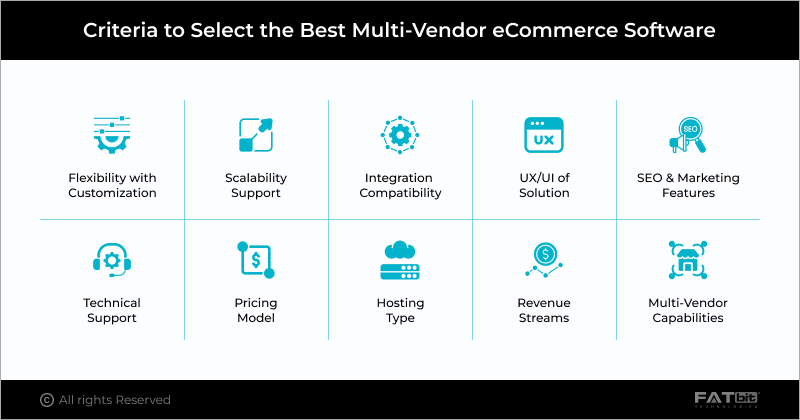
Criteria to Select the Best Multi-Vendor eCommerce Software
Selecting the best multi-vendor eCommerce solution requires careful consideration. You can’t overlook any facets that may cause challenges, restrictions, additional expenses or any unexpected surprises in the future. Below are a few critical considerations you should be mindful of when selecting a multi-vendor eCommerce solution.
1. Flexibility with Customization: Choosing a customizable eCommerce solution is a crucial requirement to keep your marketplace relevant, engaging and personalized. It gives you the flexibility to customize and tailor the platform to your specific requirements, reflecting your brand. A customizable marketplace software lets you craft personalized user experiences quickly and affordably.
2. Scalability Support: A scalable solution enables the marketplace to seize the growth opportunities. A scalable multi-vendor eCommerce solution can handle the growing demand of users and the increased number of transactions without compromising performance. In short, a scalable solution makes your platform future-proof and helps avoid unnecessary expenses required for expansion.
3. Integration Compatibility: Third-party integration compatibility in a readymade marketplace software is crucial. It helps you connect external applications and tools to improve marketplace functionality, enable external services and enhance overall user experience. Hence, prefer an eCommerce solution that is fully compatible with third-party integrations.
4. UX/UI of Solution: Your marketplace should be user-friendly and easy to navigate. Such a platform enhances user experience and helps businesses establish a loyal customer base by serving their purposes. In short, when selecting the best multi-vendor eCommerce solution, considering the software’s UX/UI is paramount.
5. SEO and Marketing Features: In today’s digital world, where competition is so high, you can’t grow your business without the right marketing tools and features. Several tools are required to promote your business, drive traffic, reach potential customers, and generate more leads and sales. Consequently, select a multi-vendor eCommerce software that offers advanced SEO and other marketing tools and features.
6. Technical Support: Building a multi-vendor marketplace using a readymade solution doesn’t require technical expertise. However, you may encounter unexpected issues such as bugs associated with the solution, performance-related challenges or any other issues that essentially require technical expertise to overcome. That’s where the need for technical support becomes critical.
7. Pricing Model: Multi-vendor eCommerce solutions available in the market primarily operate with two different pricing models. One is recurring, which incurs regular payments, and another is a one-time payment, which requires payment once in a lifetime. However, choosing a solution operating with a one-time payment is cost-effective and flexible.
There’s always a debate between recurring and one-time pricing models while choosing between one to build a multi-vendor marketplace using a readymade eCommerce solution. Let’s help you overcome the situation. Recurring payment initially requires a lower investment to get started. On the other hand, choosing a one-time payment model seems higher. However, in the long run the one-time payment model is cost-saving and poses no restrictions than recurring pricing models.
8. Hosting Type: Choose a multi-vendor eCommerce solution that offers complete control and ownership over your marketplace. Two different types of readymade solutions are available in the marketplace based on their hosting: Hosted (SaaS) and self-hosted.
A SaaS-based solution provides access to use the solution, based on the package or subscription. A self-hosted solution is more flexible. It provides complete control and ownership, whether it’s related to hosting, customization, scalability, customizable source code and even more. However, by choosing a self-hosted multi-vendor marketplace software, one can gain complete control and access.
9. Revenue Streams: Marketplaces generate revenue via multiple sources. Diversifying revenue channels establishes a marketplace making it more resilient to economic downturns and market fluctuations. Consequently, choosing a solution that enables multiple revenue streams can help the marketplace extend its revenue sources and ensure financial stability.
Marketplaces often monetize their platform and generate revenue via commission, subscription fees, sponsored ads, third-party advertisements, lead generation, etc. While considering the list of the best multi-vendor eCommerce solutions, you can also analyze whether the solution supports all the above revenue streams or not.
10. Multi-Vendor Capabilities: Choosing a dedicated multi-vendor marketplace solution will always be advantageous than converting a single-vendor solution into a multi-vendor via integrating third-party apps and tools. A solution especially designed brings all the necessary features, offers a seamless user experience, and ensures optimum marketplace speed and performance without any operational challenge.
Best Multi-Vendor eCommerce Solution to Build a Marketplace
Looking for the best multi-vendor eCommerce solution to build an eCommerce marketplace. This curated list can help you find the most suited solution. You can take a quick overview, explore pros and cons and know their ratings on trusted eCommerce platforms.
1. Yo!Kart
Overview
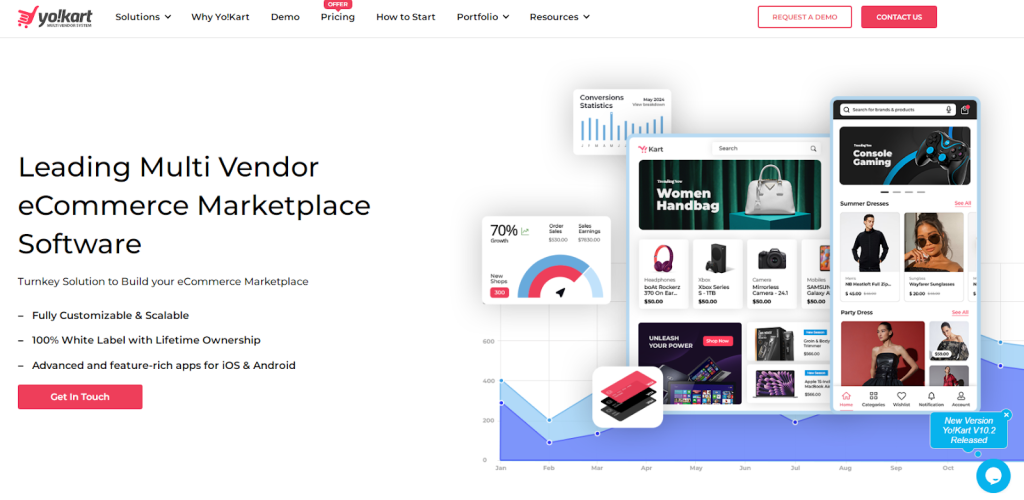
Yo!Kart is the best multi-vendor eCommerce solution designed by FATbit Technologies. The software is 100%white-label and purposely built to enable multi-seller capabilities. Entrepreneurs and startups planning to dominate the ever-growing eCommerce landscape can choose Yo!Kart to build a multi-vendor marketplace like Amazon, eBay, Walmart and Etsy. Furthermore, if looking for a B2B multi-vendor solution, Yo!Kart B2B can help build the next Alibaba and Amazon Business.
Since its launch in 2015, Yo!Kart has empowered over 5500 businesses by helping them launch their thriving eCommerce platforms. The solution covers diverse industries including electronics, fashion, sports, furniture, digital products and many more. From physical products to digital products, you can launch a marketplace of your choice with Yo!Kart.
Moreover, Yo!Kart is a user-friendly and feature-rich multi-vendor marketplace software. Its appealing UI (user interface) and intuitive UX (user experience) enhance the overall online shopping experience by making transactions enjoyable and hassle-free. Furthermore, alongside its built-in multi-vendor capabilities, it supports all the necessary features required for seamless marketplace operations.
Pros
Yo!Kart is 100% white-label. You can build a multi-vendor marketplace under your brand.
No recurring, subscription, or any transactional charges required. The solution is available at a one-time payment model.
Yo!Kart is a self-hosted software. Hence, it allows you to host the platform on your preferred server.
It’s fully customizable. Yo!Kart allows you to customize your marketplace according to your specific needs.
This ever-best multi-vendor eCommerce solution is built with scalability in mind. Hence, it supports growth and expansion without any performance degradation.
Specially designed to support multi-vendor functionality. Yo!Kart is a dedicated multi-vendor marketplace software.
The software offers customizable source code ownership. It directly means you can gain complete control over your marketplace.
With Yo!Kart, you are assigned a dedicated project manager who guides you with all your queries and concerns associated with the solution.
It has 20+ pre-integrated payment gateways and supports third-party integrations. Hence, you can easily integrate the tools and APIs you need.
Yo!Kart offers ready-to-launch buyer mobile apps natively built for Android and iOS users.
Cons
While getting started with YoKart, you need to manage the server and hosting.
Steeper learning curve due to extensive features and functionalities.
Extensive and code-level customization requires technical expertise.
Yo!Kart Pricing
Yo!Kart’s pricing starts at $499.
Ratings
G2: 4.6/5
GoodFirms: 4.8/5
Software Suggest: 4.8/5
Capterra: 4.2/5
Launch a Feature-rich Multi-Vendor Marketplace with Yo!Kart
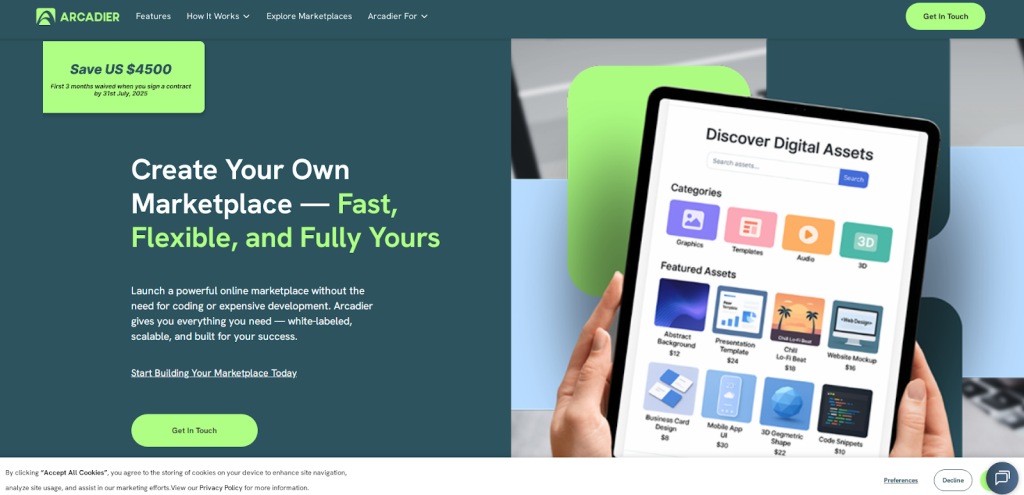
Arcadier is a SaaS-based eCommerce solution that allows you to launch a multi-vendor marketplace effortlessly. The software is inherently built to handle multi-seller transactions. Whether you are planning to launch a product-based, service-based or rental marketplace, Arcadier supports different business models, making it a multi-purpose solution.
Arcadier offers a wide range of customizable templates that allow you to tailor the platform easily. In addition, its headless approach decouples the front-end from the back-end, which offers more control when customizing. However, you can face challenges when customizing extensively. It poses limitations with customization at several stages. Some users have reported issues with its CKEditor, required for customization due to its outdated version.
Pros
Arcadier enables branding as it is a completely white-label multi-vendor marketplace software.
It offers a wide range of pre-built templates to create marketplaces for products, services and rentals.
The solution has an intuitive and user-friendly UX/UI.
Supports extensive APIs to enable extensive customization.
Offers dedicated support to help you deal with challenges.
Cons
Arcaider allows customization via APIs and plugins that can incur additional expenses.
The solution comes with higher subscription plans and can be expensive for entrepreneurs and businesses with a limited budget.
A recurring subscription fee is required.
Arcadier poses several restrictions due to its SaaS nature. However, extensive control and access required high-tier pricing plans.
Some users have also reported issues with customer support.
Arcadier Pricing
Pricing is not available on the official website.
Ratings
G2: 4.3/5
GoodFirms: No ratings were found
Software Suggest: No ratings were found
Capterra: No ratings were found
3. Marketplacer
Overview
Marketplacer is also one of those dedicated multi-vendor eCommerce solutions that help enable multi-vendor functionality. It is specifically designed for eCommerce stores that want to integrate third-party sellers into their existing platforms. Marketplacer uses API-based integrations to connect with major ecommerce platforms, such as BigCommerce, Adobe Commerce, Shopify Plus, Commerce Cloud (Salesforce) and others.
Marketplacer helps businesses transform their online stores into marketplaces, unlocking new revenue streams. The solution allows them to expand their product ranges and maximize revenue channels by connecting sellers and buyers on a single platform.
By integrating Marketplacer with eCommerce stores, businesses can enable multi-vendor features such as customizable storefronts, inventory management, vendor management, payment processing and more. However, businesses can also sell their own products as Marketplacer enables first-party and third-party sales.
Pros
Marketplacer allows you to quickly go live with your marketplace by connecting third-party sellers with your existing eCommerce platform.
Lower upfront investment is required than building a marketplace from scratch.
Enables businesses to generate revenue from multiple sources, such as commission on each sale, subscription fees, and more.
Marketplacer supports growth and expansion. You can expand product categories, number of sellers, buyers and sales generated without worrying about the marketplace performance.
Cons
Managing multiple vendors across the platform can be complex.
Required technical support and expertise to set up the marketplace.
Marketplacer incurs transactional charges alongside a monthly recurring subscription fee and a one-time implementation fee.
This marketplace solution can be expensive for small and medium-sized businesses.
Marketplacer Pricing
Marketplacer pricing is not publicly available.
Ratings
G2: 4.8/5
GoodFirms: Not available
Software Suggest: Not available
Capterra: 4.9/5
4. CS-Cart
Overview
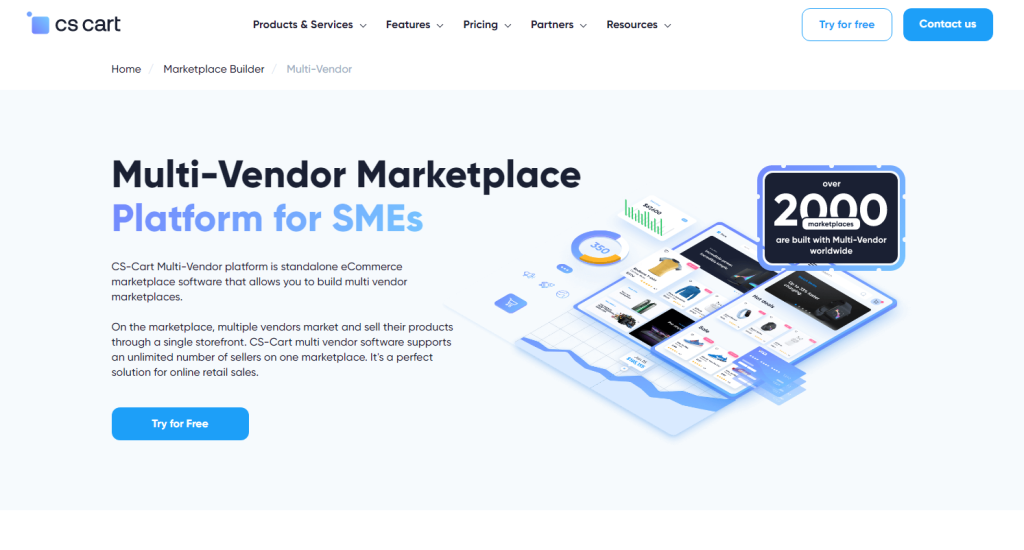
CS-Cart is also among the list of top multi-vendor eCommerce solutions that allows you to build a multi-vendor marketplace without depending on third-party integrations. It’s a purpose-built marketplace software that enables multi-vendor capabilities to handle transactions initiated between sellers and buyers seamlessly.
CS-Cart has an intuitive interface and separate dashboards for different user types, which provide a seamless and effortless experience. It offers freedom when it comes to tailoring the platform based on your specific requirements. Whether you are looking for extensive customization or want to scale your marketplace, CS-Cart can help.
Overall, CS-Cart can be one of the choices that can help you build and operate a user-friendly and feature-rich multi-vendor marketplace. However, some users have reported issues with the UX/UI that can be enhanced. A steep learning curve that requires more time and effort. In addition, you need to play smart when selecting a pricing model and package, as it offers both the options: recurring and one-time payment options.
Pros
CS-Cart has a flexible pricing model. You can choose either a recurring or a one-time payment model.
It’s a dedicated multi-vendor marketplace software.
CS-Cart can be a flexible option when it comes to choosing between SaaS and self-hosted, as the solution is available with both.
Cons
Some users reported issues with responsiveness.
Updates and upgrades can be challenging, and compatibility issues are reported.
Customer support is not satisfied. Some users reported dissatisfaction with customer support.
CS-Cart Pricing
CS-Cart pricing for a lifetime license starts at $3299.
Ratings
G2: 4.8/5
GoodFirms: 5/5
Software Suggest: 4.8/5
Capterra: 4.6/5
Transform Your Idea into a Thriving eCommerce Platform
Mirakl is a SaaS-based multi-vendor eCommerce solution that allows you to build an online marketplace effortlessly. It offers all the necessary features and tools required to manage multiple sellers, automate processes and ease operations.
The software can be an ideal choice for businesses looking for a scalable eCommerce solution. Moreover, Mirakl works best for enterprise-grade platforms such as large-scale retailers, manufacturers, B2B businesses and more.
Whether you are looking for a B2B multi-vendor marketplace software solution or want to build a B2C marketplace, Mirakl supports both business models and provides you with the right tools required to control, manage and grow your marketplace. However, the dependency of Mirakl on third-party integration is on the higher side. Hence, the solution can cost you extra due to paid tools integrations.
Pros
Mirakl supports diverse business models and caters to the needs of industries like fashion, health, beauty, DIY, grocery and more.
It’s a hosted software, which doesn’t require a server to host the platform.
Offers all the necessary features required for multi-vendor operations.
Accelerates data migration with AI support.
Cons
Getting started with Mirakl requires higher investments. Hence, not ideal for startups, SMBs or businesses with limited budgets.
You can experience limitations when customizing your marketplace built with Mirakl.
Many users have reported issues with customer support.
Growing and expanding your marketplace built with Mirakl also requires additional expense.
It can be difficult to manage for someone new to the marketplace. Hence, technical expertise is required.
Heavily relies on third-party integrations.
Mirakl Pricing
A monthly recurring fee is required, starting at $599/month. In addition, Mirakl also incurs transactional charges.
Ratings
G2: 4.1/5
GoodFirms: 5/5
Software Suggest: Not available.
Capterra: 4.5/5
6. Sharetribe
Overview
Sharetribe is another readymade multi-vendor marketplace software that allows you to launch a marketplace without coding. It’s also a SaaS-based solution. With Sharetribe, you can build a multi-vendor platform for products, rentals, services and more. The software comes with all the necessary features required for a fully operational multi-vendor marketplace. These features include user management, listing management, payment processing, and more.
Sharetribe provides complete control over design and user experience. By leveraging its headless marketplace solution. It offers multiple layout options and allows you to align them, reflecting your brand’s identity via customization. Additionally, Sharetribe’s content management tools also enable you to attract users by personalizing content, languages and text style.
Pros
You can launch a multi-vendor marketplace faster.
Sharetribe is a readymade eCommerce software that requires no coding knowledge.
It reduces the need for a large upfront investment.
Sharetribe supports scalability. You can grow and expand your businesses without worrying about infrastructure.
Cons
You can experience several limitations due to its SaaS nature.
This eCommerce solution may lack certain advanced marketing tools.
A monthly recurring fee is required and can be expensive in the long run.
Sharetribe charges 0.19% additional transactional charges after certain transactions.
Sharetribe Pricing
Sharetribe pricing starts at $39 per month. However, its Pro package required a monthly fee of $369.
Ratings
G2: 4.7/5
GoodFirms: Unavailable
Software Suggest: Unavailable
Capterra: 4.4/5
7. Nautical Commerce
Overview
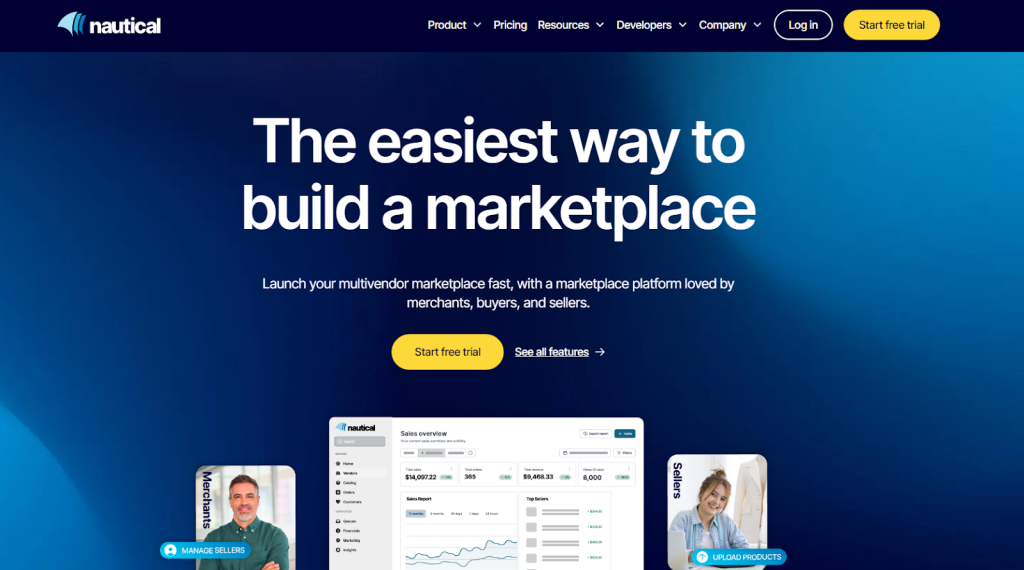
Nautical Commerce is another dedicated multi-vendor eCommerce solution that is designed to help businesses build online marketplaces. This SaaS-based solution provides flexibility when it comes to choosing between no-code and headless commerce, as it offers both.
Nautical Commerce focuses on fast deployment, offering no-code tools, headless APIs, and built-in vendor management. It also integrates several third-party tools that enable additional features and services, essentially required on a multi-vendor marketplace.
In addition, Nautical commerce is also flexible with customization. Its drag-and-drop storefront builder makes customization easier and helps businesses set up a fully customized platform. For entrepreneurs and mid-sized businesses looking to launch a marketplace quickly and easily, Nautical Commerce can be an ideal selection.
Pros
Nautical commerce enables a quick marketplace setup with minimal technical dependency.
Has a large number of pre-integrated third-party tools required to manage shipments, payments, taxes, payouts and more.
Nautical Commerce offers a headless commerce setup for a fully customized front-end.
Cons
Nautical Commerce relies on third-party integrations even for fundamental features.
The solution lacks several essential features. However, it’s expected from a newly launched platform.
Extensive customization may require a developer’s support.
Compared to other similar platforms, Nautical Commerce has high-priced plans. Besides, it lacks several fundamental features.
Nautical Pricing
Nautical Commerce pricing starts at $79 per month and goes up monthly $2000 on a 1 or 2-year term.
Ratings
G2: 4.6/5
GoodFirms: No review or rating yet.
Software Suggest: No review or rating yet.
Capterra: 4.8/5
Looking for the Best Multi-Vendor eCommerce Solution?
BigCommerce is a well-established SaaS eCommerce store solution. However, the platform provides the flexibility to build multi-vendor marketplaces using third-party extensions like Webkul’s MultiVendor app. It integrates with an application named BigCommerce MultiVendor MarketPlace to transform a store into a multi-seller marketplace.
Once integrated, the platform would allow multiple sellers to list their products and sell. The marketplace admin can access and manage products, orders, sellers, and can do much more.
However, enabling multi-vendor functionality in a store can make the operation complex and lead to several challenges, such as performance-related issues, limitations with customization, a need for technical expertise in case of modification and much more.
Pros
Easy to manage, no hosting headaches. You can simply set up a multi-vendor marketplace by integrating third-party tools like Webkul.
Enterprise-level security and you can grow your business without being worried about the architecture.
BigCommerce allows seamless integration with popular marketplace extensions.
Cons
BigCommerce is not a dedicated multi-vendor eCommerce solution. Hence, it lacks several features and functionality.
Heavily relies on third-party integrations.
The final cost can increase due to recurring fees for both the BigCommerce plan and the multi-vendor app.
You may encounter performance-related issues as it’s not natively built for multi-vendor operations.
BigCommerce Pricing
Plans start at $29/month (Standard) to $299/month (Pro) plus a recurring fee for the multi-vendor application.
Ratings (Available for Store Only)
G2: 4.2/5
GoodFirms: 3.8/5
Software Suggest: 4.8/5
Capterra: 4.4/5
9. WooCommerce
Overview
WooCommerce is a popular WordPress plugin that transforms a simple website into a full-featured online eCommerce store. However, it’s not inherently built to enable multi-vendor functionality. Therefore, building a multi-vendor marketplace with WooCommerce required adding plugins like Dokan, WCFM Marketplace, or WC Vendors. By integrating these plugins, you can create a functional multi-vendor marketplace.
Moreover, WooCommerce is an open-source solution which means you can host the solution on the server of your choice by offering complete control and access. However, due to its dependency on plugins, ensuring optimum performance and security across multiple plugins can be challenging. Suppose you have integrated a plugin coded, you might encounter challenges related to the marketplace performance, security and more.
Pros
Self-hosted or managed WordPress hosting. Users can control the hosting environment, backups, and updates.
WooCommerce is the right choice if you are seeking flexibility with customization. However, the flexibility of the plugin also matters.
WooCommerce can be cost-effective and an ideal eCommerce solution for small businesses.
Cons
Operating a multi-vendor marketplace with WooCommerce required technical expertise for setup and regular maintenance.
The marketplace performance can be a concern with an increased number of transactions and users.
Managing multiple plugins can cause compatibility issues, security vulnerabilities and more.
WooCommerce Pricing
Core WooCommerce is free, but hosting and premium plugins may cost.
Ratings (Available for Store Only)
G2: 4.4/5
GoodFirms: 4.5/5
Software Suggest: 4.7/5
Capterra: 4.5/5
10. Shipturtle (Shopify Marketplace Builder)
Overview
Shipturtle is a no-code marketplace builder. It transforms a simple Shopify store into a robust marketplace. All you need to do is install the Shipturtle plug-in into your online store from the Shopify App Store and set it up. Once done, start onboarding vendors by allowing them to list products, manage inventory, catalog, orders, deliveries and much more.
Moreover, Shipturtle also offers features like Vendor Connect to enable two-way inventory synchronization between the vendor’s platform and the marketplace (Shopify Platform). It provides a separate dashboard for vendors to manage their products. On the other hand, the marketplace admin can manage vendors, commissions, orders and more.
In addition, operating a multi-vendor marketplace with Shipturtle also enables customization. You can change the elements like design, themes, and custom layouts to match the brand identity.
Pros
Supports different business models and allows building a multi-vendor marketplace for products, services, rental, auction or hyperlocal.
Shipturtle ensures seamless multi-seller operations, offering the necessary features and functionalities required.
Easy to integrate with existing platforms like Shopify, WooCommerce, etc.
Cons
Shipturtle may lack several features compared to a solution natively built for multi-vendor.
Users often report performance-related issues, slow loading speed, errors and more.
Setting up a multi-vendor marketplace with Shipturtle requires technical expertise.
Converting a Shopify or any other online store into a multi-vendor with Shipturtle can be expensive.
Shipturtle Pricing
Sipturtle’s plan starts at $49/month and goes up monthly to $1099. It also charges a monthly recurring fee for add-ons and shipping solutions.
Ratings (Available for Store Only)
G2: 4.8/5
GoodFirms: Shipturtle does not have a profile on Software Suggest.
Software Suggest: Shipturtle does not have a profile on Software Suggest.
Capterra: 4.9/5
Top Multi-Vendor eCommerce Solutions: A Quick Comparison
The comparison table below will provide you with a quick overview of the top multi-vendor eCommerce solutions available in the market. Let’s take a look:
eCommerce Solution/Software
Hosting Type
Pricing Model
Dedicated Multi-Vendor
Native Mobile Apps
Business Model Supports
Yo!Kart
Self-hosted
One-Time
✔
✔
B2C, B2B, C2C or P2P
Arcadier
Hosted (SaaS)
Recurring
✔
X
B2C, B2B and P2P
Marketplacer
Hosted (SaaS)
Recurring
✔
X
B2C, B2B and P2P
CS-Cart
Hosted Self-Hosted
Recurring and one-time
✔
✔
B2C, B2B and P2P
Mirakl
Hosted (SaaS)
Recurring
✔
X
B2B, B2C, and Dropship
Sharetribe
Hosted (SaaS)
Recurring
✔
X
B2C, B2B, and C2C
Nautical Commerce
Hosted (SaaS)
Recurring
✔
X
B2C and B2B
BigCommerce
Hosted (SaaS)
Recurring
X
X
Depends on Plugin
WooCommerce
Self-Hosted
Recurring
X
X
Depends on Plugin
Shipturtle
Hosted (SaaS)
Recurring
✔
X
B2B, B2C and C2C
Oases Online
2003
Monthly Payment Pricing starts from $99/m (upto 25 students)
Yes
No
Only Online tutoring
Missed.com
2005
Not mentioned on Website
Yes
No
5+ niches
Class Folios.
2020
Monthly Payment Pricing starts from $6.99/m
No
No
Only Online tutoring
LearnSpeed
2005
Monthly Payment Pricing starts from 29¢ per session
No
No
6+ niches
Pencil Spaces
2020
Monthly Payment Pricing starts from $ 29.99 (Limit to 1 teacher)
Yes
Yes
5+ niches
Setmore
2011
Monthly Payment Pricing starts from $ 5 /per user
Yes
Yes
6+ niches
TutorShell
2022
Monthly Payment Pricing starts from Rs 399/per (Upto 19 students)
No
No
Only online tutoring
TutorRoom
2018
Not mentioned on Website
No
Not sure
2 niches
Tutor
2016
Monthly Payment
Yes
No
5+ niches
Platform
Pricing starts from $49
Pearl
2015
Not mentioned on Website
Yes
No
3 niches
In the above table, you have explored the 10 best multi-vendor eCommerce solutions. You can choose any one based on your specific marketplace requirements. However, if you are looking for a fully customizable and scalable solution that offers complete control and helps you save money in the long run, Yo!Kart can be the perfect fit.
Is Yo!Kart the Right Choice for You?
Selecting the best multi-vendor eCommerce solution depends on your business goals, budget, and technical resources. All the above-mentioned readymade marketplace software are reliable, have distinct strengths, from enterprise-grade features to beginner-friendly tools. You choose any form of the best multi-vendor eCommerce solutions to launch, operate and scale your marketplace effectively.
However, Yo!Kart offers more than what others provide. Therefore, choose Yo!Kart if:
You are looking for a dedicated multi-vendor eCommerce solution.
You want to gain complete control over hosting, data, and the platform.
Seeking a fully customizable, scalable and 100% white-label solution.
You want to own the customizable source code alongside a thriving, readymade eCommerce solution.
You don’t want to pay a recurring fee and any kind of transactional charges.
Wants to get a lifetime license to use the software at a one-time payment.
How to launch a multi-vendor marketplace with Yo!Kart?
With Yo!Kart, you can launch a multi-vendor marketplace in just four easy steps:
Step 1: Get Your License
Select a preferred package that suits your marketplace idea and get a lifetime license.
Step 2: Setup & Installation
A dedicated expert will connect with you to complete installation and setup.
Step 3: Customize Your Marketplace
Once installation is completed. Customize your marketplace, which includes adding your logo, name, contact information and more.
Step 4: Onboard, Launch and Grow
In the last and final step, launch your marketplace and start generating revenue by onboarding sellers and attracting customers maximum.
Building an online marketplace is more than just selling products. It requires a robust platform that can handle multiple vendors, manage orders, inventory, and much more, ensuring seamless buyer-seller interactions. The above-mentioned best multi-vendor eCommerce solutions provide all the necessary features and functionality required to operate, control and grow your marketplace.
However, if you want to know our recommendation, Yo!Kart can be an ideal choice for you. It comes with out-of-the-box features and functionality required to operate a fully operational multi-vendor marketplace. Moreover, being a dedicated multi-vendor software solution, Yo!Kart lets you operate a marketplace without any challenge.
In addition, compared to SaaS-based solutions, Yo!Kart, a self-hosted solution, offers better control, access and is more flexible when it comes to customizations and scalability.
FAQs
Q 1. How much does it cost to build a multi-vendor marketplace?
Ans. The cost of building a multi-vendor marketplace can vary widely depending on the approach you choose.
If developing from scratch, it can cost you anywhere between $30000 – $200000 or more, depending on your specific requirements.
On the other hand, choosing a readymade multi-vendor eCommerce solution can cost you between $1000 – $10000, depending on your personalized needs. However, the final cost can be lower or even higher.
Q 2. What are the benefits of building a multi-vendor marketplace?
Ans. A multi-vendor marketplace can benefit you in many ways. Some benefits include:
A multi-vendor marketplace allows you to expand your reach to a wider customer base.
It enables you to offer a wide range of products and services.
You can generate revenue from multiple sources via commission, subscription, advertisement and more compared to just selling products on an online store.
Significantly requires lower investment as operating a multi-vendor marketplace requires managing inventory.
There are several more benefits you can experience by launching a multi-vendor marketplace.
Q 3. How to build a multi-vendor marketplace?
Ans. Building a multi-vendor marketplace requires careful consideration. You can follow the steps given below to launch a multi-vendor marketplace successfully.
Step 1: Market research and idea validation
You need to conduct thorough market research to define your specific requirements, understand the gaps, know your competitors, and get an idea of whether your idea will work or not.
Step 2: Define Key Features
Define key features required in your multi-vendor marketplace. Features and functionality on the marketplace help participants, including buyers, sellers, and admins, to play their roles.
Step 3: Choose the best mutli-vendor eCommerce solution
Once you have finalized all the key features and other requirements, the next step is to choose the best multi-vendor marketplace software that matches your marketplace needs.
Step 4: Onboard Sellers and list Products
The next step is to onboard sellers by allowing them to list products on the marketplace.
Steps 5: Launch and Market
After seller onboarding, the next and final step is to launch your multi-vendor marketplace. However, keep promoting your business and attracting more customers and sellers on the platform. To do so, you need to plan marketing campaigns, promotions and much more.
All innovation starts with an idea to solve real-world problems. At FATbit Technologies we are passionate about driving digital transformation to prepare businesses for a digital-first tomorrow. Let’s discuss your BIG idea NOW.
Disclaimer: The Blog has been created with consideration and care. We strive to ensure that all information is as complete, correct, comprehensible, accurate and up-to-date as possible. Despite our continuing efforts, we cannot guarantee that the information made available is complete, correct, accurate or up-to-date. We advise - the readers should not take decisions completely based on the information and views shared by FATbit on its blog, readers should do their own research to further assure themselves before taking any commercial decision. The 3rd party trademarks, logos and screenshots of the websites and mobile applications are property of their respective owners, we are not directly associated with most of them.
Vishal Tiwari is a Senior Strategist, Consultant and Author at FATbit Technologies with 10+ years of industry experience. His expertise spans eCommerce, emerging technology, digital transformation, and business strategy. With a keen eye for detail, a strong analytical mindset and a knack for storytelling, Vishal brings unique perspectives and insights to businesses. He helps entrepreneurs, enterprises, and decision-makers make informed decisions and navigate evolving opportunities in today’s digital-first economy.